Quick takeaways
- The book’s central argument: stop trying to reach the most people and start serving the right people so well they do your marketing for you.
- The smallest viable market is not a consolation prize. It is a strategy. Choosing who you are not for is the decision most brands refuse to make and the one that matters most.
- Godin is better on principle than on practice. The book will change how you think about marketing. It will not tell you which channels to use or what to test next Tuesday.
- This is not a book about tactics. It is a book about the assumptions under the tactics. Read it for the mindset. Get the how-to somewhere else.
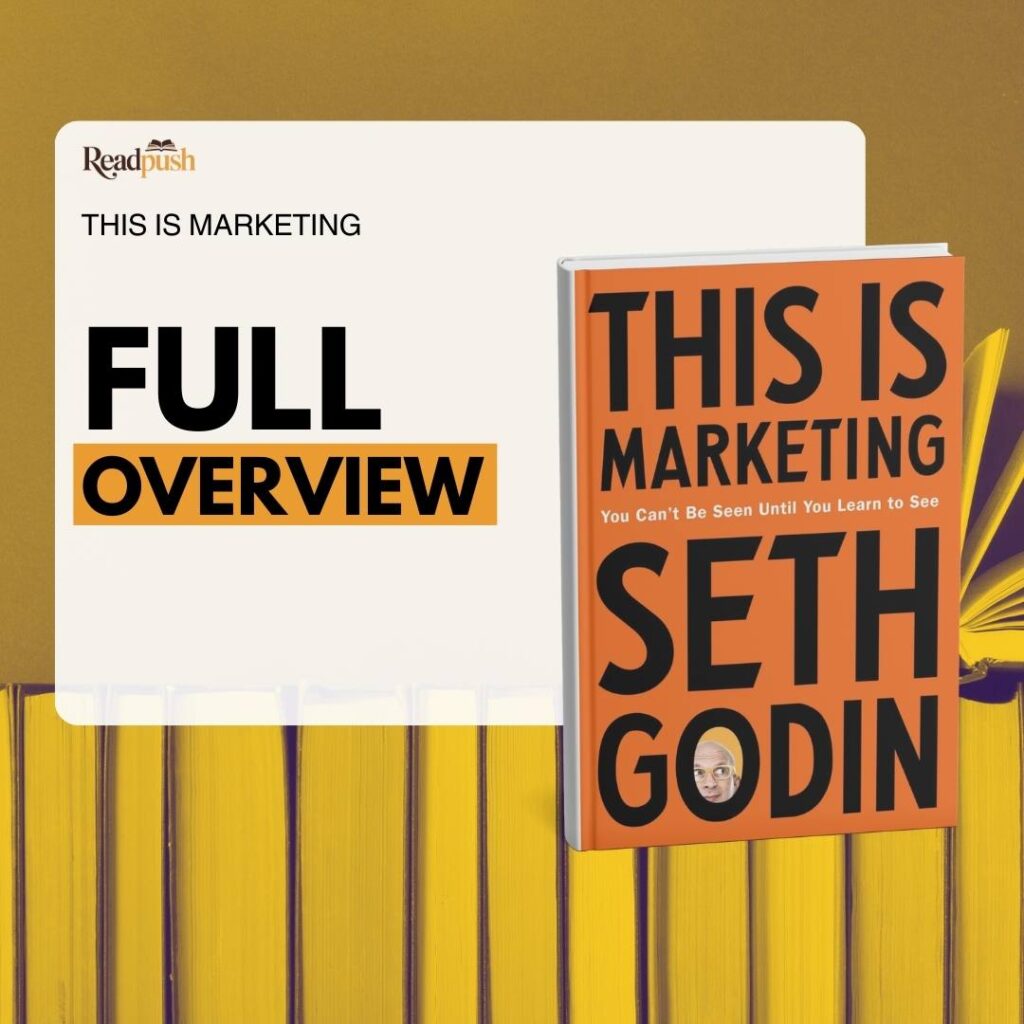
Seth Godin has been making the same argument for roughly twenty years and the marketing industry has largely ignored it, which tells you something about either the argument or the industry. Probably both.
This Is Marketing is his clearest version of the argument yet. If you have read Purple Cow or Tribes or Permission Marketing, you know the territory. If you have not, this is the right entry point. The book is short, opinionated, and deliberately light on the kind of tactical specificity that would make it date badly. That is a feature, not a flaw, though some readers will find it frustrating.
Here is what the book is actually saying, without the fable-wrapping.
The one argument the book makes
Marketing is not about reaching the most people. It is about serving the right people so well that they do your marketing for you. Everything else in the book is a variation on that. The smallest viable market, the worldview question, the trust-not-interruption framework, all of it points back to the same place: pick your people, serve them better than anyone else would, and let the word of mouth follow.
The reason this is hard to act on is not that people do not understand it. They do. The reason is that picking your people means ruling out a lot of other people, and most businesses, especially small ones where every lost customer feels significant, cannot make themselves do that. The smallest viable market sounds fine in theory. In practice it means walking away from potential customers, and most people will not do it.
Godin’s answer is that the walk-away is the thing that makes everything else work. A message precise enough to move the right people cannot also move everyone. You have to choose.
The smallest viable market
This is the idea most people take away from the book and least often apply correctly. The smallest viable market is not just a small audience. It is a specific group of people who share a worldview: a way of seeing their problem, a set of beliefs about what a solution should feel like, an identity they are trying to express or protect.
Demographics are not enough. “Women entrepreneurs aged 30 to 45” is not a worldview. It is a spreadsheet column. A worldview would be “women who left corporate jobs to start food businesses and feel embarrassed asking for help with the numbers.” That second version has beliefs in it. That is what makes a message land.
The test Godin suggests: describe what your target audience believes that most people do not. If you can answer that specifically, you have found something to build a message around. If you cannot, you are still describing demographics, not people.
Identity, stories, and how people actually decide
The second major idea in the book is that people do not make purchasing decisions rationally. They make them based on who they want to be. The question they are unconsciously asking is not “is this product good?” It is “does buying this say something I want to say about myself?”
This is why features rarely sell and stories do. A feature is a fact. A story is an invitation to see yourself differently. The best marketing does not describe the product. It describes the person who uses the product in a way that the target audience wants to recognise themselves in.
Godin’s phrase for this is “people like us do things like this.” The marketing job is to make your offer feel consistent with the identity your audience is trying to maintain or achieve. That is a different craft than listing specifications.
Trust and permission
The trust argument is the one Godin has been making since Permission Marketing in 1999 and it has aged well. The basic claim: interrupting people to tell them about something they did not ask about is an increasingly expensive way to get attention, and the attention you buy is less valuable than the attention you earn.
Earned attention comes from showing up consistently, being useful, and keeping promises. Permission is what you have when someone has decided that your messages are worth reading. That is a different relationship from someone who saw your ad and sort of remembered it.
The practical implication: build the smallest possible audience that genuinely wants to hear from you before you try to sell anything. Most businesses skip this step because it is slow. The ones that do not skip it tend to have much more durable businesses. The trust in marketing piece covers how the permission argument plays out specifically around consistency and frequency.
|
This Is Marketing Four ideas. One argument. Everything else is variation.
|
||||||||||||||||||||||||
What the book does not do
Here is where I will push back a little, because this is where the book earns most of its criticism.
Godin is a philosopher of marketing. He is genuinely good at identifying what is wrong with the conventional playbook and naming the principles that would fix it. He is much less useful on the question of what to actually do next Tuesday. Which channels? Which formats? Which metrics? The book intentionally avoids these questions on the grounds that tactics date and principles do not. That is correct. It is also frustrating if you came looking for something operational.
The examples in the book are carefully chosen for their illustrative power. They tend to be brands and companies that succeeded. The selection bias here is real: you cannot read a chapter about someone who applied the smallest viable market principle and failed because that chapter does not exist. Whether the principle works in your specific context, with your specific constraints, is something the book cannot tell you.
If you want to go deeper on specific ideas in the book, the twelve lessons from This Is Marketing develops each major concept with more applied context. And if you want something that covers the tactical layer the book deliberately skips, the 1-Page Marketing Plan is the complement Godin never wrote.
|
Honest verdict What it delivers and where to look for what it does not
|
||||||||||||
The same issue appears from another angle in Total Money Makeover Quotes That Hit Differently, where the money decision underneath the book becomes easier to see without turning the book into a slogan.
The same issue appears from another angle in Trust in Marketing Is Pattern Not Message, where the marketing problem behind the framework becomes easier to see without turning the book into a slogan.
The same issue appears from another angle in This Is Marketing by Seth Godin, where the marketing problem behind the framework becomes easier to see without turning the book into a slogan.
The bottom line
Read it if you have never thought carefully about who you are trying to serve and why. Read it if you have been chasing tactics without a coherent underlying theory of what marketing is supposed to accomplish. Read it if the last book you read on marketing felt like a series of tricks with no connecting logic.
Do not read it expecting a plan. It is not a plan. It is a philosophy with some examples. Those are different things, and the book is valuable for what it is rather than frustrating for what it is not.
The marketing industry has largely ignored Godin’s core argument for twenty years. If you are reading this, you are probably not the person he is worried about. Do the thing he keeps describing: pick a specific group of people, understand their worldview, and make something just for them. Then ship it before you feel ready. That is the whole book.