Quick takeaways
- “The rich have money work for them” is the one sentence the whole book is built on. Everything else is either explaining it or showing how to get there.
- The fear and cynicism quotes are the ones most people skip over. They are also the most honest. Kiyosaki is not just teaching finance. He is teaching you to notice what is keeping you from acting.
- These hold up better read one at a time than scanned as a list. Pick the one that stings the most. That is probably the right one to sit with.
I have read a lot of business books. Kiyosaki is a genuinely polarizing writer: people either love him or dismiss him as a charlatan. Both camps tend to underestimate how well he writes a single sentence. Whatever you think of his investment advice or the veracity of his “rich dad” character, the man can compress an idea into a line that lands and stays.
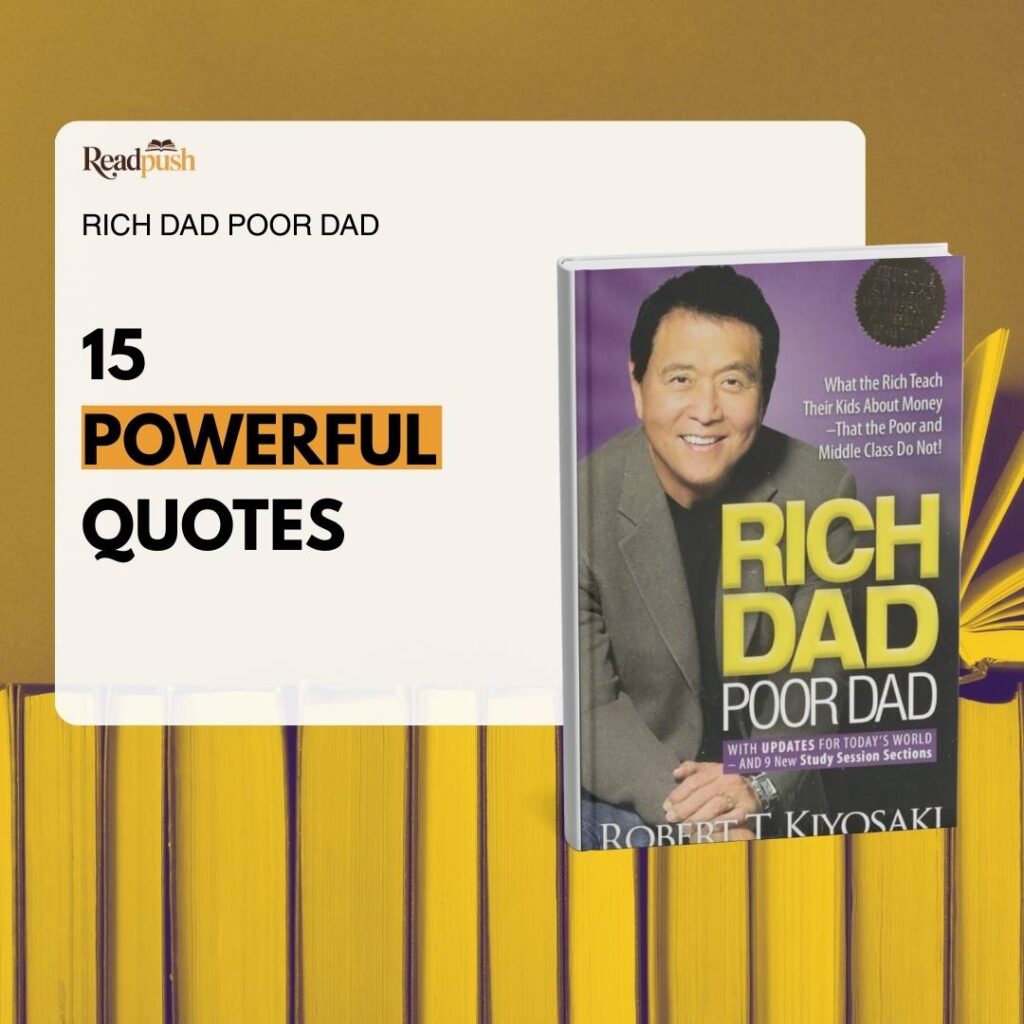
These are the fifteen from Rich Dad Poor Dad I find most worth keeping. With short notes on what each one is actually saying. The Rich Dad Poor Dad summary covers the full framework if you want the context around them.
On money, assets, and what wealth actually is
“The poor and the middle class work for money. The rich have money work for them.”
Robert Kiyosaki, Rich Dad Poor Dad, p. 58
The thesis in one sentence. Kiyosaki is describing two different relationships with income. One group trades time for wages, repeatedly, indefinitely. The other group builds or buys things that generate income without them in the room. The book is about how to move from the first group to the second, and why the education system does not teach you to want to.
“It is not how much money you make. It is how much money you keep.”
Robert Kiyosaki, Rich Dad Poor Dad, p. 61
Income and wealth are not the same thing. Plenty of high earners are broke. The variable that separates them from people with similar incomes who are not broke is almost never the salary. It is what happens to the money after it arrives. This is not a complicated idea but it is not the default operating assumption for most people.
“The single most powerful asset we all have is our mind.”
Robert Kiyosaki, Rich Dad Poor Dad, p. 80
Kiyosaki is making a prioritization argument here. Before real estate, before stocks, before any specific asset class: invest in learning how money works. People with financial education make better decisions across the board. People without it make expensive ones, often without noticing.
“Financial intelligence is simply having more options.”
Robert Kiyosaki, Rich Dad Poor Dad
The definition I find most practically useful. Financial intelligence is not about having the right answer to every investment question. It is about understanding enough to see more choices than you would otherwise see. The person who knows how real estate works has options the person who does not have that knowledge does not have. The knowledge creates the options.
On fear, courage, and why most people stay stuck
“The fear of being different prevents most people from seeking new ways to solve their problems.”
Robert Kiyosaki, Rich Dad Poor Dad
One of the more honest observations in the book. Most people know the conventional path is not working for them. They also know that doing something different will require defending that choice to people around them. The second concern often wins. Kiyosaki is pointing at this specifically because he wants you to notice the constraint rather than pretend it does not exist.
“Cynics never win. Doubt is expensive.”
Robert Kiyosaki, Rich Dad Poor Dad
Worth taking literally. Doubt has a real cost: the opportunities not pursued, the risks not taken that would have paid off, the decisions deferred so long they became irreversible. Kiyosaki is not asking you to be reckless. He is pointing out that the conservative choice, the one that feels safe, is often not actually safe once you calculate the opportunity cost.
“Winners are not afraid of losing. But losers are. Failure is part of the process of success.”
Robert Kiyosaki, Rich Dad Poor Dad
Reframing failure as a feature rather than a defect. People who do not try things almost never fail visibly. They also never build anything. Kiyosaki’s argument is that the willingness to fail is the prerequisite for success, not an alternative path that sometimes leads there.
“Emotions are what make us human. Make sure that emotions are the servants and not the masters.”
Robert Kiyosaki, Rich Dad Poor Dad
Most bad financial decisions have an emotional origin. The panic sell. The lifestyle inflation that follows a raise. The investment avoided because it felt unfamiliar. Kiyosaki is not saying stop feeling things. He is saying notice when feelings are running the decision rather than informing it. That is a practical distinction worth applying.
On education, work, and the conventional path
“Most people fail to realize that in life, it is not how much money you make, it is how much money you keep and how many generations you keep it.”
Robert Kiyosaki, Rich Dad Poor Dad
The longer version of the “how much you keep” line, with one addition: how many generations. Kiyosaki is pushing the time horizon out to something most people do not think about at all. The decisions you make now about what you own and how you structure it have consequences that extend past your own lifetime. That is a different frame than month-to-month financial management.
“The main reason people struggle financially is because they spend years in school but learn nothing about money.”
Robert Kiyosaki, Rich Dad Poor Dad
His most repeated argument, and the one that has the most institutional support from outside the book. The research on financial literacy consistently shows that most adults lack basic competency with compound interest, investment basics, and debt management. The schools taught grammar and quadratic equations. Financial independence was apparently not the priority.
“An intelligent person hires people who are more intelligent than he is.”
Robert Kiyosaki, Rich Dad Poor Dad
Practical advice for anyone building a business or managing their own finances. The people who do best financially are rarely the ones who know the most about every relevant discipline. They are the ones who know enough to identify the right people and ask the right questions. A good accountant, a good financial advisor, a good attorney: these are assets, not luxuries.
“The rich focus on their asset columns while everyone else focuses on their income statements.”
Robert Kiyosaki, Rich Dad Poor Dad
What you focus on is what you build toward. Most personal finance advice focuses on income: earn more, save a percentage of what you earn, avoid debt. Kiyosaki is suggesting the focus be different: what do you own? What grows? The question shifts from “how do I earn more” to “what am I building that earns without me.” The guide to building your first passive income stream covers what that looks like in practice.
The same issue appears from another angle in Your Money or Your Life Lessons, where the money decision underneath the book becomes easier to see without turning the book into a slogan.
The same issue appears from another angle in Your Money or Your Life Quotes, where the money decision underneath the book becomes easier to see without turning the book into a slogan.
The same issue appears from another angle in Atomic Habits Quotes, where the question of attention, habits, and what actually changes behaviour becomes easier to see without turning the book into a slogan.
On responsibility, risk, and taking action
“Often in the real world, it is not the smart who get ahead but the bold.”
Robert Kiyosaki, Rich Dad Poor Dad
Uncomfortable for people who believe analytical quality should determine outcomes. It often does not. People with good ideas who take action beat people with better ideas who wait until everything is perfect. Kiyosaki is not saying do not think. He is saying at some point, action is the differentiator.
“There is a difference between being poor and being broke. Broke is temporary. Poor is eternal.”
Robert Kiyosaki, Rich Dad Poor Dad
Distinction with teeth. Being broke is a financial state. Being poor, in Kiyosaki’s use of the word, is a mindset about what is possible. You can recover from broke with the right moves. Poor, in his framing, is the belief that nothing you do will change the trajectory. That belief is what is actually limiting, more than the account balance.
“Blame, resentment, and self-pity are signs of a mindset that keeps you trapped.”
Robert Kiyosaki, Rich Dad Poor Dad
Kiyosaki is direct about this in a way that some readers find harsh and others find clarifying. The argument: assigning blame for your financial situation feels satisfying in the short term but does nothing to change it. It is not that external factors are not real. It is that focusing on them removes you from the category of people who can do something about the situation. That shift in focus is where the work actually starts.
|
15 quotes, 4 themes Rich Dad Poor Dad: what each section of quotes is really about
|
||||||||||||||||
The one I come back to most is the asset column line. Not because it is the most poetic, but because it is the most actionable. Everything else in the book is context for that question: what are you building that earns without you? If you do not have an answer, that is where to start.