Quick takeaways
- The quotes that land hardest in Atomic Habits aren’t the ones about productivity. They’re the ones about who you’re quietly becoming.
- “You do not rise to the level of your goals. You fall to the level of your systems.” True. Also the kindest thing in the book — it redirects blame from character to design.
- “Never miss twice” is the most practically useful rule in the book. Not the most profound. The most useful.
- If only one quote travels with you, let it be the one about voting. Every small action is a vote for the person you’re becoming. Neither decisive alone. Both counting.
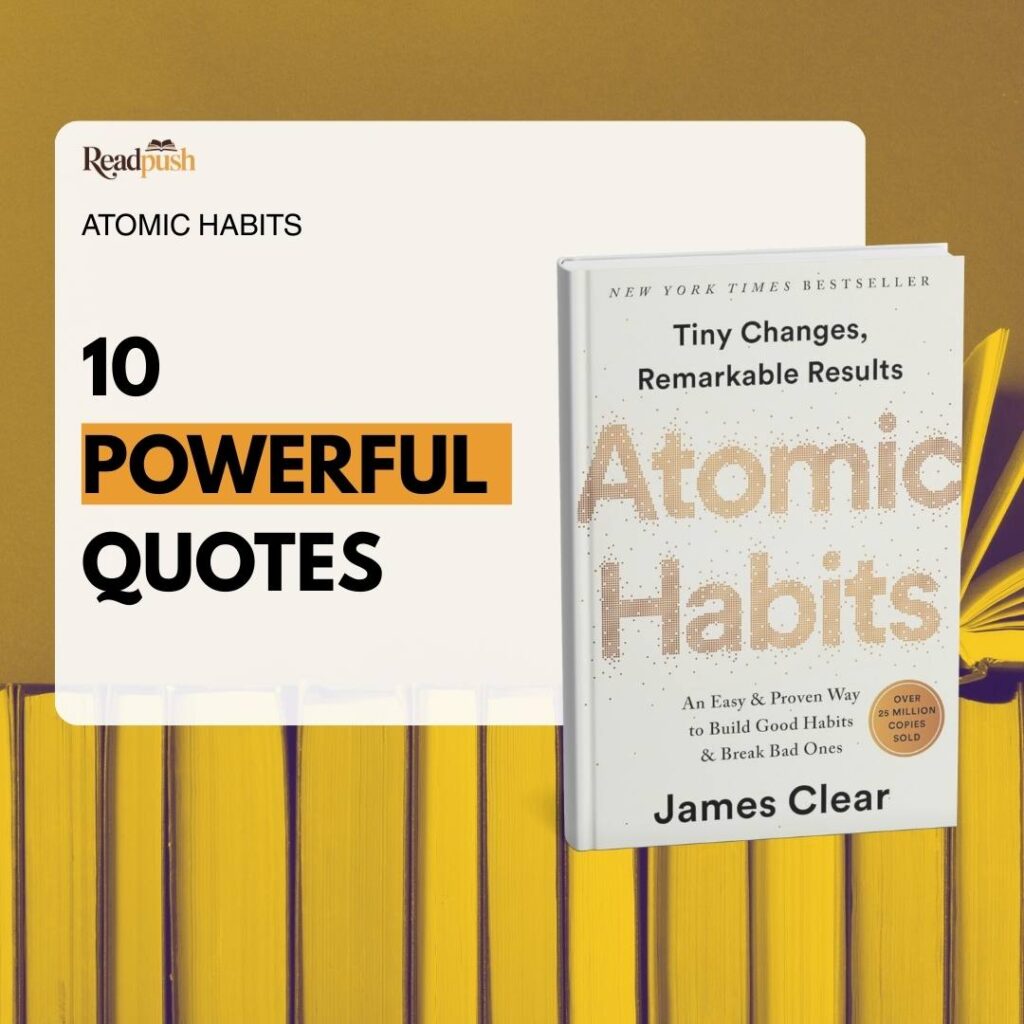
Some books give you information. Atomic Habits gives you something harder to explain — that particular feeling of being seen in a way you weren’t expecting. James Clear writes about small behaviours with the kind of precision that makes you put the book down and think about what you did yesterday. Not in a punishing way. More like a gentle tap on the shoulder.
I’ve recommended this book to more people than I can count. What strikes me about it isn’t the productivity angle, which is how it tends to get sold. It’s how quietly honest it is about why change is hard, and why that doesn’t make you broken. The quotes below are the ones that have stayed with me — not because they’re inspirational in the poster-on-the-wall sense, but because they say something true that most people are already half-aware of but haven’t quite put into words yet. That’s the best thing a book can do.
Quotes on systems and how progress actually works
“You do not rise to the level of your goals. You fall to the level of your systems.”
James Clear, Atomic Habits — p. 27
This one tends to land differently depending on where you are in life. If you’ve been setting the same goal for three years and wondering what’s wrong with you, what’s worth noticing here is that the goal itself might not be the problem. Goals give you direction. But direction without daily structure is just wishing.
Clear isn’t being harsh with this. He’s being practical in a way that’s actually kind: if it’s not working, look at the system, not yourself. The Four Laws of Behavior Change are essentially a checklist for building that system — worth reading alongside this quote if the design question is where you’re stuck.
“Habits are the compound interest of self-improvement.”
James Clear, Atomic Habits — p. 16
The financial analogy is everywhere in this book, and it works because most people understand, intellectually, how compound interest builds wealth — while being completely unable to feel it in the present moment. That’s exactly the problem with habits too. The payoff is so deferred that the daily action feels meaningless.
If this sounds familiar, it’s almost universal. The habit that feels like nothing today is the one that changes things in six months. The hard part is behaving as if you believe that before you have the evidence.
“Success is the product of daily habits, not once-in-a-lifetime transformations.”
James Clear, Atomic Habits — p. 21
Most of us are waiting for the moment when things click into place. The new year, the right job, the day we feel ready. Clear’s point is that the click doesn’t come first. The daily repetition is what creates the feeling, not the other way around. The transformation you’re waiting for is already available to you in much smaller portions than you thought.
“Goals are good for setting a direction, but systems are best for making progress.”
James Clear, Atomic Habits — p. 24
The distinction matters more than it sounds. A goal gets you oriented. A system gets you through Tuesday when you don’t feel like it. Most self-help writing focuses almost entirely on the goal, which is the easier and more exciting part. Clear keeps bringing you back to the Tuesday part, which is where everything actually happens.
Quotes on identity — the harder conversation
“Every action you take is a vote for the type of person you wish to become.”
James Clear, Atomic Habits — p. 38
This is the quote I return to most often. Not because it’s motivating, though it can be, but because it reframes what’s actually happening when you do or don’t do a small thing. Skipping the gym once isn’t a failure. It’s one vote. Going anyway when you don’t want to is also one vote. Neither is decisive. But the pattern of votes adds up to something, and that something is who you’re becoming.
You don’t have to get it right every time. You do have to notice which way you’re voting, consistently. The identity-based habits chapter is where Clear develops this idea most fully — worth reading slowly if the voting metaphor is landing for you.
“You should be far more concerned with your current trajectory than with your current results.”
James Clear, Atomic Habits — p. 19
Results are what happened. Trajectory is what’s happening. If you’re in an early stage of building something — a habit, a career, a relationship with your own health — the current results are going to look discouraging for a while. That’s not a sign it’s failing. It’s a sign you’re in the middle of it. The question isn’t where you are. It’s which direction you’re pointed.
“Environment is the invisible hand that shapes human behavior.”
James Clear, Atomic Habits — p. 92
I find this one genuinely useful with people who are being hard on themselves about willpower. You are not weak because you eat the biscuits that are on the counter. You are human, and humans respond to what’s in front of them. The environment does a lot of the work that we credit — and blame — ourselves for.
What that means practically: redesigning the environment is often more effective than resolving to try harder. Put the thing you want to do in your way. Put the thing you want to stop doing out of easy reach. It’s not cheating. It’s working with how you’re actually built.
“You don’t have to be the victim of your environment. You can also be the architect of it.”
James Clear, Atomic Habits — p. 93
This follows naturally from the one above, but adds something. It’s not just that your surroundings affect you. It’s that you can decide what those surroundings are. Most of us haven’t thought very deliberately about that. We inherited our environment and then respond to it as if it’s fixed. The invitation here is small and concrete: what’s one thing in your physical or digital environment you could change this week that would make the behaviour you want more likely?
|
Identity vs Systems The two questions these quotes are really asking
|
||||||||||||
Quotes on consistency — and what to do when you miss
“Never miss twice.”
James Clear, Atomic Habits — p. 189
Of all the quotes in the book, this might be the most practically useful. Not because it’s profound, but because it’s exactly the right rule for the moment that actually matters — the moment after you’ve already fallen off. Missing once is life. Missing twice is the beginning of a new pattern. The grace in this rule is that it doesn’t demand perfection. It just asks you not to let the slip become the story.
“When you fall in love with the process rather than the product, you don’t have to wait to give yourself permission to be happy.”
James Clear, Atomic Habits — p. 236
This is the one I’d leave someone with if they were only going to take one thing from the book. The happiness-on-arrival model — where you’ll feel good once you’ve lost the weight, finished the project, hit the number — is a way of deferring your own experience indefinitely. The goal moves. It always moves.
What doesn’t move is today. Showing up today. That’s available regardless of where the outcome is.
|
All 10 quotes at a glance Atomic Habits — the ideas behind each quote
|
||||||||||||||||||||||||||||||||||||||||||||||||||||||||||||
The same issue appears from another angle in Rich Dad Poor Dad Quotes, where the money decision underneath the book becomes easier to see without turning the book into a slogan.
The same issue appears from another angle in The Four Laws of Behavior Change, where the question of attention, habits, and what actually changes behaviour becomes easier to see without turning the book into a slogan.
The same issue appears from another angle in This Is Marketing by Seth Godin, where the marketing problem behind the framework becomes easier to see without turning the book into a slogan.
What to take away from all of this
If there’s a thread running through all ten of these, it might be this: Clear is consistently asking you to stop waiting for the large and dramatic version of change and start noticing the small and unremarkable version that’s already available. That’s not a consolation prize. For most people, it turns out to be the thing that actually works.
If the quotes are landing and you want to go further, the full Atomic Habits review covers where the system has real limits and what the research says about habit formation in more depth. Read the book slowly if you haven’t. And if you have, it holds up.