You wake up early , answer emails, post on social media, update your website , and try to squeeze in a new marketing campaign before lunch. You stay busy all day but at the end of the week , the numbers barely move. Sound familiar?
Most entrepreneurs fall into this trap believing that success means doing more. Yet the truth , revealed in Allan Dib’s The 1-page marketing plan , is that the biggest results come from the smallest set of actions. This is where the 80/20 rule marketing comes in.
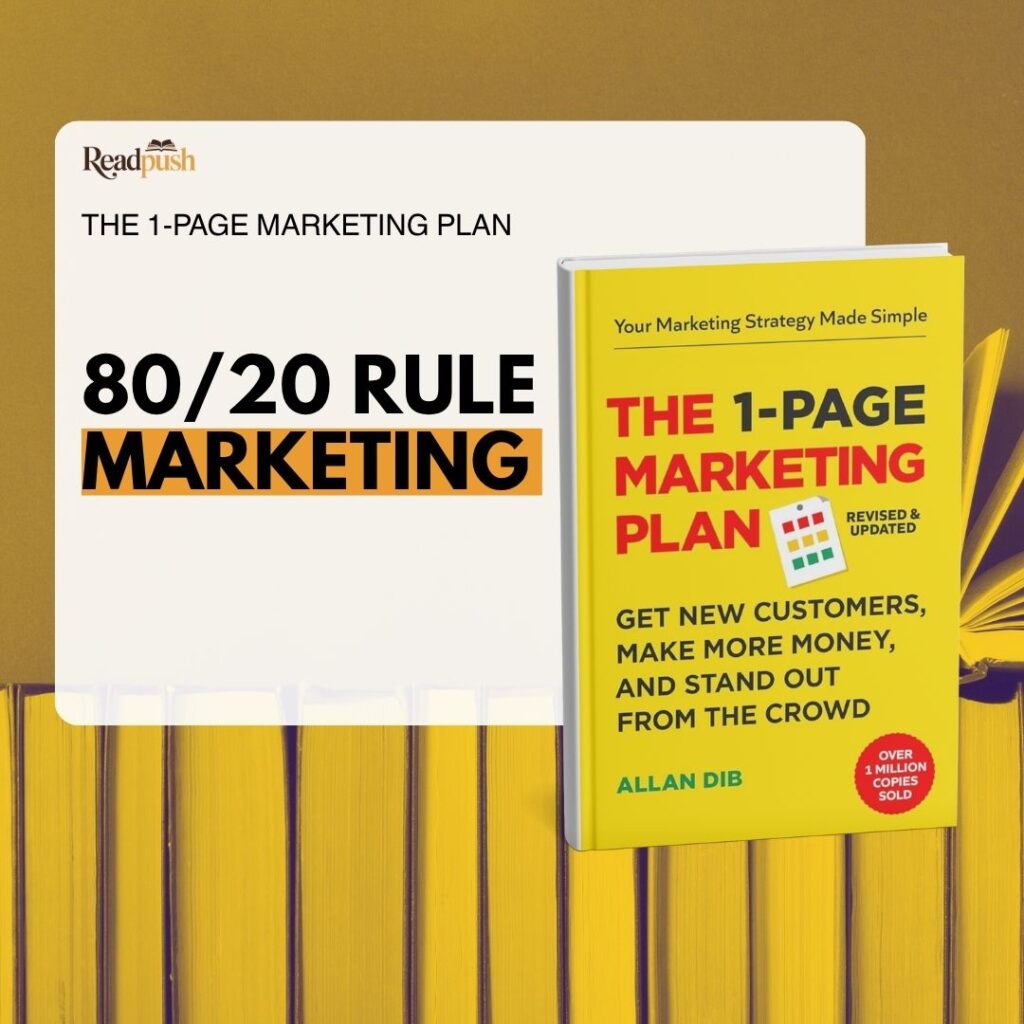
The insight comes from Dib’s bestselling book the 1-page marketing plan: Get new customers , Make more money, and Stand out from the crowd. The book’s central promise is simple: you can design a complete marketing strategy on one page and grow faster by focusing on what truly matters. (See the full breakdown in our [pillar post on The 1-page marketing plan]).
When effort doesn’t equal results
Entrepreneurs often believe more activity equals more income. So they chase every new platform, pour hours into minor details and burn energy across too many directions. The result is exhaustion without exponential growth.
This scatter-shot approach leads to what Dib calls “busy but broke”. You are working hard but not strategically. The cost of misunderstanding use is massive: wasted time, thin profit margins and constant burnout.
Without applying the Pareto principle in business, you might spend 80 percent of your day on low-value tasks replying to non-essential emails, tweaking logos, or testing ads that never convert. Meanwhile, the 20 percent of work that actually brings customers sits neglected.
The moment you understand how the 80/20 rule marketing operates, your focus shifts from endless hustle to precise impact. Instead of fighting to do everything, you’ll identify the few actions that drive the most revenue.
How the 80/20 rule marketing works
The power behind pareto
The 80/20 rule marketing comes from the Pareto principle, named after Italian economist Vilfredo Pareto. He noticed that 80 percent of Italy’s land was owned by 20 percent of its people. Dib shows this same pattern applies to business:
- 80 percent of your profits come from 20 percent of your customers.
- 80 percent of your complaints come from 20 percent of clients.
- 80 percent of results stem from 20 percent of actions.
Recognizing this pattern transforms how you think about time, effort, and investment.
Going deeper: The 64/4 rule
Dib pushes the concept further with the 64/4 rule. If you apply 80/20 to itself, 64 percent of results come from only 4 percent of causes. That means the majority of your business growth depends on a tiny fraction of your activities. When you find and amplify those few actions, you open up exponential use.
use: The secret weapon of the wealthy
According to Dib, struggling entrepreneurs “spend time to save money”, while successful entrepreneurs “spend money to save time”. That shift is pure use, you can always make more money, but never more time.
This principle flips the common belief that success is about working harder. It’s actually about choosing the few highest-impact moves and amplifying them through smart marketing use.
Why marketing is the ultimate use point
Improving your marketing even slightly creates a ripple effect across your entire business. A 10 percent boost in marketing effectiveness might double profits because it increases every sale and every customer interaction.
That’s why Dib insists the greatest use sits inside your marketing system, not in product tweaks or admin optimizations. Focus your creativity where it multiplies outcomes, not where it merely maintains them.
A Simple analogy
Think of sunlight and a magnifying glass. Spread the light wide, and it warms nothing. Focus it tight, and it burns through paper. That’s the essence of the 80/20 rule marketing directing your limited energy where it ignites growth.
Why this matters
Applying the Pareto principle in business is more than a productivity trick. It changes how you think about value creation. When you identify the few activities that matter most, you can free time, cut noise, and grow faster with less stress.
Instead of being overwhelmed by endless marketing channels, you will evaluate each by ROI. You stop chasing vanity metrics and start tracking results that convert into sales.
For entrepreneurs, this focus means better time management for entrepreneurs, stronger cash flow, and room to innovate instead of firefight.
Most importantly, you regain clarity. Business feels lighter because you stop measuring success by effort and start measuring it by impact.
With the 80/20 rule as your filter, you’ll see where to apply effort and where to let go turning complexity into simplicity and busyness into progress.
How to apply this in your business
You can start using the 80/20 rule marketing framework today with a few intentional steps.
1. Identify your top 20 percent
Review the past six months of customers or campaigns. Which ones brought most of your revenue or engagement? Focus your resources there. Remove distractions that don’t convert.
2. Track ROI on every marketing channel
Dib emphasizes measurable marketing. Assign tracking links, promo codes, or call-to-action URLs to each campaign so you know which 20 percent performs best.
3. Double down on the winners
Once you know your most profitable channels, invest more time, budget, or content into them. Optimize what’s already working before starting something new.
4. Delegate or delete the rest
Outsource tasks that drain energy but don’t create use. Automate routine operations so you can focus on creative strategy and client growth.
5. Use the 64/4 filter
Ask yourself: “Which 4 percent of activities drive most of my outcomes?” These might be one ad set, one webinar, or one client segment. Refine and scale these top performers.
6. Revisit weekly
The 80/20 ratio isn’t static. Review your numbers regularly to catch changes in trends and double down on new high-yield opportunities.
For a complete step-by-step breakdown of how to implement this focus across your entire marketing process, check our [how-to guide on building a one-page marketing plan].
Common mistakes to avoid
Even though the idea is simple, many entrepreneurs misapply it. Here are four traps to watch for:
- Trying to perfect everything. Perfectionism spreads your energy thin. Focus on delivering value in the few areas that move revenue.
- Confusing activity with productivity. Responding to messages or tweaking graphics feels productive but rarely drives income.
- Failing to measure. You can’t find the 20 percent without data. Track every campaign and learn what works.
- Ignoring customer profitability. Not all clients are equal. Some bring referrals and recurring revenue; others drain time and patience. Focus on the best ones.
Avoiding these mistakes keeps your focus sharp and your results exponential.
Connection to other key ideas
The 80/20 rule marketing connects directly to other core lessons in The 1-page marketing plan. It forms the foundation for Dib’s philosophy of use and clarity.
This concept works in tandem with the direct response marketing strategy discussed in the next satellite article. Together they show how small businesses can outsmart large competitors without spending big. (Explore that deeper in our post on direct response marketing for small business.)
If you align these two ideas, your marketing will be both focused and measurable an unbeatable combination.
The power of focused simplicity
The moment you start applying the 80/20 rule marketing approach, your business feels different. You stop chasing every new tactic and begin mastering the few that matter. The reward is not only higher profits but more time, energy, and freedom.
Remember this takeaway: do less, but do it better. By focusing your attention on the small fraction of actions that create most of your success, you multiply impact while reducing stress.
For a deeper exploration of The 1-page marketing plan including practical templates, marketing frameworks, and nine powerful lessons visit our [complete summary of The 1-page marketing plan].
What this idea changes in practice
The useful way to read this piece is not as a shortcut around the book, but as a way to decide what the book is really asking you to notice. The 1-Page Marketing Plan is easy to reduce to a phrase. The phrase is helpful, but it is also where many readers stop too early.
The practical question is: what changes after you understand the idea? If the answer is only that you can repeat the concept in a meeting, the idea has not done much work yet. A good business or self-improvement book should change a decision, a habit, a conversation, or a way of measuring progress.
For this article, the change is usually smaller and more concrete than the headline suggests. You stop treating the concept as an inspirational lesson and start using it as a filter. It helps you decide what to ignore, what to inspect more closely, and where your current approach may be wasting effort.
That is where ReadPush readers get the most value. Not from another summary, and not from pretending the book is perfect. The value is in separating the durable idea from the noise around it.
Where readers often get it wrong
The common mistake is to treat the book’s central idea as universal. Most book ideas are not universal. They are conditional. They work better for some people, teams, markets, and seasons than others.
That does not make the idea weak. It makes it usable. Advice becomes more useful when you know its boundary. A habit system helps when your life has enough stability to support repetition. A strategy framework helps when the market conditions match the assumptions behind the framework. A finance lesson helps when it is applied to the right kind of risk, not every risk.
So the better reading is not, is this book right? The better reading is, where is this book right, and what would make it wrong for me? That question protects you from two bad habits: dismissing useful books because they are imperfect, and overusing famous books because they sound confident.
If you take only one thing from this article, take that discipline. Apply the idea where the conditions fit. Leave it alone where they do not.
How to apply the lesson without overcomplicating it
Start with one decision. Do not turn the book into a whole operating system on day one. That is how good ideas become heavy.
- Name the problem. What are you actually trying to improve: focus, growth, cash flow, consistency, leadership, decision quality, or something else?
- Pick the relevant principle. Choose one idea from the book that speaks directly to that problem.
- Define the test. What would look different after two weeks if the idea is working?
- Review the result. Keep what helped. Drop what added friction.
This keeps the lesson grounded. You are not trying to become the kind of person who has mastered the whole book. You are trying to make one part of your work or life less vague.
The same issue appears from another angle in Good to great leadership principles, where the business trade-off the book is trying to clarify becomes easier to see without turning the book into a slogan.
The same issue appears from another angle in Powerful quotes from The page marketing plan, where the marketing problem behind the framework becomes easier to see without turning the book into a slogan.
The same issue appears from another angle in Fooled by Randomness, where the business trade-off the book is trying to clarify becomes easier to see without turning the book into a slogan.
A better final takeaway
The strongest books on ReadPush are rarely the ones that give the neatest answers. They are the ones that improve the quality of your next question. The 1-Page Marketing Plan is worth returning to for that reason.
Ask what the idea reveals. Ask what it hides. Ask what it would look like in a normal week, with normal constraints, limited time, and imperfect follow-through. If the idea still helps there, it is probably worth keeping.
That is the standard. Not whether the book sounds impressive. Whether it survives contact with real life.