Quick takeaways
- The book’s most practically useful sentence is also the simplest: track every cent. Ignorance is expensive. Every dollar that disappears without being noticed is life energy you cannot account for.
- “The question is not how much you earn, but how much is enough.” That one changes the goal from accumulation to sufficiency, which is a different orientation entirely.
- Robin and Dominguez write about money but they are mostly writing about time. Keep that in mind as you read the quotes. The financial advice is the vehicle. Time is the point.
- The crossover quote is the one to return to when the system feels slow. The day your investment income exceeds your expenses is the day work becomes a choice. Everything in the book is aimed at that day.
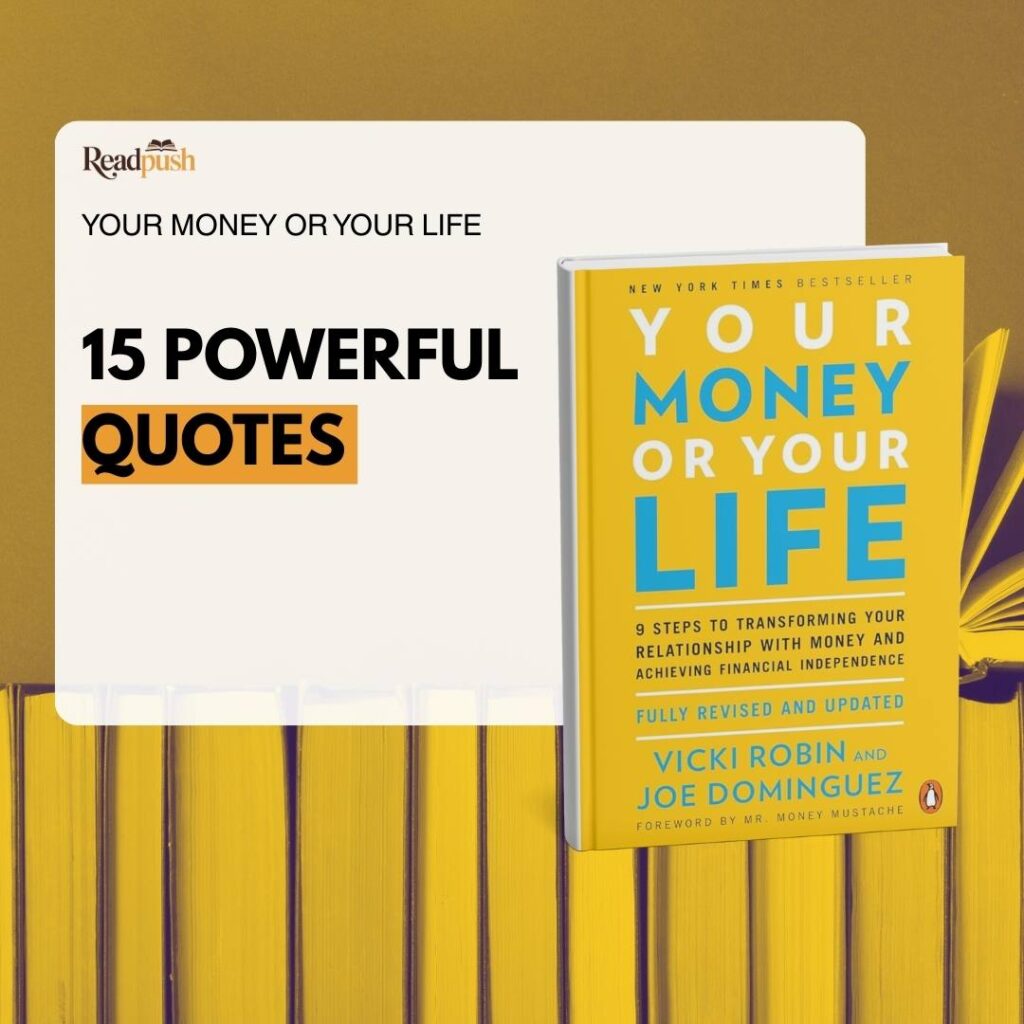
Your Money or Your Life has been in print since 1992. The reason it stays relevant is not that the financial advice is timeless (the investment section is dated) but that the framing is. Vicki Robin and Joe Dominguez are writing about time, not money. The quotes below make that clear. Here is what each one is actually saying.
If you want the full framework behind these ideas, the Your Money or Your Life summary covers the nine-step system. This piece is the quotes, with direct notes on what each means in practice.
On life energy and what money actually costs
“Your money is life energy. Every dollar you spend is a portion of your life you will never get back.”
Vicki Robin, Your Money or Your Life, p. 30
The foundational claim. Money is not a number. It is a proxy for the hours of your life you traded to earn it. When you put it that way, spending decisions look different. Not every spending decision, but the ones where the hours cost more than the purchase is worth. The system is built on surfacing those mismatches.
“If I sell the majority of my time for money, will I really be secure or fulfilled?”
Vicki Robin, Your Money or Your Life, p. 32
This is the question that makes most standard financial advice feel incomplete. Security in terms of income stability is one thing. Security in terms of actual life satisfaction is a different measurement. The book is arguing you need both, and that most people optimize hard for the first while ignoring the second.
“Track every cent. Ignorance is the most expensive luxury.”
Joe Dominguez, Your Money or Your Life, p. 40
The most operationally direct line in the book. Not philosophical. Just true. Most people underestimate their spending by 20 to 30 percent before they actually track it. The tracking step is where the system starts producing real information rather than assumptions. You cannot make decisions about what you do not see.
“The question is not how much you earn, but how much is enough to live a life you love.”
Vicki Robin, Your Money or Your Life
Reframes the goal from accumulation to sufficiency. Most personal finance assumes more is always better. Robin is arguing that there is a point at which additional income produces diminishing returns on actual life satisfaction, and that the goal is to identify that point rather than perpetually push past it. That is a genuinely different orientation.
On fulfillment, values, and how to evaluate spending
“Did I receive fulfillment, satisfaction, and value in proportion to the life energy spent?”
Vicki Robin, Your Money or Your Life
The first of the three evaluation questions the system applies to every spending category. It is simple and it is uncomfortable for a lot of categories that people have not examined. The gym membership you use twice a month. The streaming service you watch for two hours a week. The convenience purchases that accumulate because deciding feels like more work than spending. The question makes the implicit cost explicit.
“Is this expenditure of life energy in alignment with my values and life purpose?”
Vicki Robin, Your Money or Your Life
The second evaluation question. Values alignment is the part most financial frameworks skip. The question is not just whether a purchase was worth the money but whether it reflects who you are trying to be. Some spending passes the first question (it was genuinely useful) but fails the second (you would not make the same choice if you were being intentional). That gap is worth finding.
“How might this expenditure change if I didn’t have to work for a living?”
Vicki Robin, Your Money or Your Life
The sharpest of the three questions. A significant portion of most people’s spending is work-maintenance: things bought to manage the stress, inconvenience, or exhaustion of working. Convenience food because there is no time to cook. Entertainment that functions as decompression rather than genuine enjoyment. Clothing bought to meet workplace expectations. Strip that out and the actual spending picture is often quite different.
On freedom, time, and what the system is building toward
“Financial independence is not about retiring. It is about living intentionally.”
Vicki Robin, Your Money or Your Life
Worth stating explicitly because the FIRE movement, which drew heavily on this book, often conflates financial independence with retirement. Robin is not arguing for stopping work. She is arguing for work becoming a choice. The practical difference is that someone with financial independence who loves their work keeps working. Someone without it who hates their work has no option.
“When you reach the crossover point, your investment income exceeds your monthly expenses. You are financially independent.”
Vicki Robin, Your Money or Your Life
The concrete finish line the system is aimed at. Not a vague sense of security but a specific month when two lines on a chart cross. The crossover point is measurable and trackable. That concreteness is part of why the system works for people who stick with it: they can see the destination approaching rather than working toward something abstract.
“Frugality is not about deprivation. It is about enjoying the life you have while spending less on the life you thought you wanted.”
Vicki Robin, Your Money or Your Life
The most commonly misunderstood part of the YMYL framework. People assume frugality means cutting until it hurts. Robin’s version is different: it means reducing spending in categories where the cost is not producing value, and protecting spending in categories where it does. The net result is often a similar or higher quality of life with lower total expenditure, not a reduced quality of life.
The same issue appears from another angle in Rich Dad Poor Dad Quotes, where the money decision underneath the book becomes easier to see without turning the book into a slogan.
The same issue appears from another angle in How Mr Money Mustache Applied Your Money, where the money decision underneath the book becomes easier to see without turning the book into a slogan.
The same issue appears from another angle in Total Money Makeover Quotes That Hit Differently, where the money decision underneath the book becomes easier to see without turning the book into a slogan.
On purpose, enough, and the longer view
“Enough is a powerful concept. It is different from deprivation, and it is different from excess.”
Vicki Robin, Your Money or Your Life
Most financial frameworks are either about getting more or about spending less. Robin’s “enough” is a third position: the amount that actually meets your needs and aligns with your values, without excess that does not improve your life. Finding that point requires the evaluation work the system prescribes. You cannot identify enough without first tracking what you actually spend and what it produces.
“Happiness is not achieved through things but through purpose and relationships.”
Vicki Robin, Your Money or Your Life
The underlying claim the book makes about why the framework produces better outcomes than simply earning more. More income tends to produce more spending, not more satisfaction. What produces satisfaction is different: work that matters, time with people who matter, the absence of financial anxiety. The system is designed to clear the path to those things, not to maximize the income line.
“Every hour we spend working for money is an hour not spent living.”
Vicki Robin, Your Money or Your Life
Blunt and true. Not an argument against working but a reminder that every hour has an opportunity cost. The question is whether the income the hour produces is worth what you give up to earn it. For most people in most jobs, most of the time, the answer is yes. But for some categories of work, some of the time, the honest answer is no. The system helps identify which is which.
“The transformation of your relationship with money transforms your entire life.”
Vicki Robin, Your Money or Your Life
Larger claim, but one the book earns through the specificity of the preceding framework. When you change how you measure money, what you spend on, and what you are building toward, the downstream effects touch almost everything: the job you choose, the hours you work, the purchases you make, the anxiety you do or do not carry. The system is not just financial. It is a reorientation of priorities.
“When you align your money with your values, you gain clarity, purpose, and peace.”
Vicki Robin, Your Money or Your Life
The promise the book makes and mostly delivers on for the people who complete the evaluation steps. “Clarity, purpose, and peace” is not abstract. It means knowing where your money goes, having a reason for spending that aligns with what you care about, and not feeling the low-level anxiety that comes from financial decisions made on autopilot. The nine-step practical guide shows how to run the system that produces this result.
|
15 quotes, 3 themes Your Money or Your Life: what each section of quotes is pointing at
|
||||||||||||
The quote I return to most is the ignorance one. “Track every cent. Ignorance is the most expensive luxury.” It is not a philosophical statement. It is a practical instruction. Everything else in the system builds on the data that tracking produces. Start there.