Quick takeaways
- Trust is a pattern, not a message. Godin’s argument is that the bottleneck for most brands is not the quality of the message but the consistency of showing up with it.
- Marketers get tired of their own message long before the audience has even registered it. Most pivots reset the trust clock back to zero.
- A weekly newsletter that is reliably useful but not spectacular will build more trust over two years than a quarterly piece that is excellent. The ordinary stuff, maintained, does the compounding.
- Trust takes longer than most marketing plans account for. It shows up in churn, referrals, and sales cycles two years later, and by then nobody is sure what caused it.
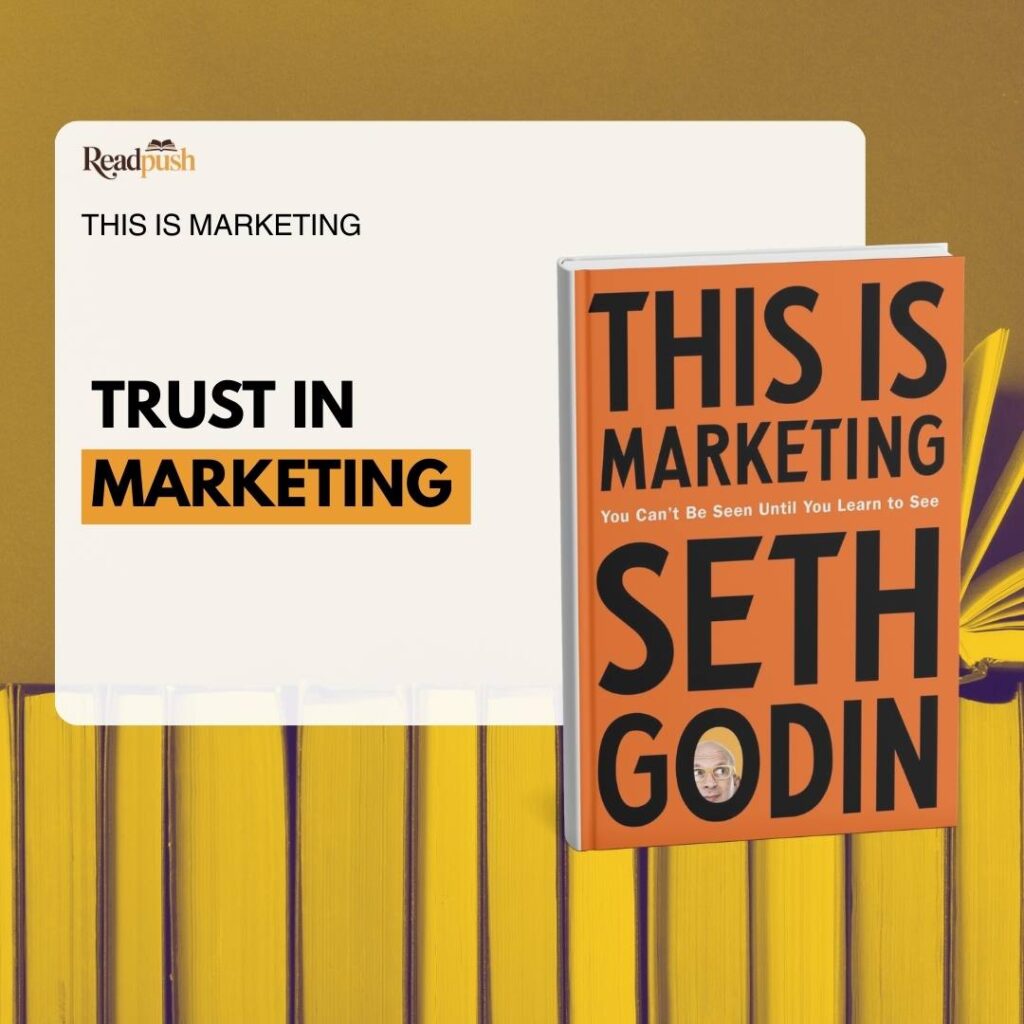
Here is a claim Seth Godin makes in This Is Marketing that sounds obvious until you realise almost nobody acts on it: trust is a pattern, not a message.
Most marketing advice focuses on the message. Get the positioning right. Find the hook. Write the better subject line. Godin’s argument is that none of that is the bottleneck for most brands. The bottleneck is consistency: showing up in the same place, saying roughly the same thing, keeping the same promise, for long enough that people start to believe you will still be there next week.
This is uncomfortable advice because it removes the excuse of needing better tactics. The problem usually is not the message. The problem is that the message changes too often, or disappears for months, or shifts every time the marketer gets bored with it.
Godin says marketers get tired of their own message long before the audience has even registered it. That is probably true of most things people are selling. The full This Is Marketing summary covers the broader argument about what marketing is actually for, with the trust idea sitting at the centre of it.
What permission actually is
The permission marketing concept from Godin’s earlier work shows up again in This Is Marketing, and it is worth being precise about what it means, because the term gets used loosely.
Permission is not consent to send emails. It is the audience’s willingness to pay attention because they have decided it is worth their time. That decision is made incrementally, through repeated exposure to something that turned out to be useful or interesting. At some point the accumulated experience tips into expectation: they start to look for you. That is permission.
The practical implication is that you cannot shortcut to it. You can buy reach, but you cannot buy the feeling of reliability. That only comes from the accumulated record of showing up and delivering what you said you would.
A large email list is not permission. A large email list where most people open the messages and find something worth reading is closer to permission. The number is not the point.
The frequency problem
Most businesses show up in bursts. Big launch, silence, another launch, silence. The problem with this rhythm is that it trains your audience to ignore you between launches, which means every launch has to work harder to re-establish attention you previously had.
Frequency, not intensity, is what creates familiarity. Familiarity is what reduces the risk someone feels before they trust you with money or attention or time.
This is where most brands underinvest. Not in the quality of their best content, but in the consistency of their ordinary content. A weekly newsletter that is reliably useful but not spectacular will build more trust over two years than a quarterly piece of content that is excellent. The ordinary stuff, maintained, does the compounding.
|
Trust vs reach What most brands optimise for vs what actually builds trust over time
|
||||||||||||||||||||||||
The honest version of how long this takes
Godin does not fully say this, but it is implied throughout the book: building genuine trust takes longer than most marketing plans account for.
The businesses I have seen get this right are usually the ones that decided consistency was a commitment rather than a strategy, where showing up was non-negotiable regardless of whether the engagement numbers in any given month looked impressive.
That is a different orientation than most marketing departments have. Most of them are optimising for what is measurable this quarter. Trust is not measurable this quarter. It shows up in the numbers two years later, when churn is lower and word-of-mouth referrals are higher and sales cycles are shorter, and by then nobody is sure what caused it.
The connection to the smallest viable market idea is worth noting here: trust is easier to build and harder to lose when you are talking to a specific group of people who share a worldview rather than a broad audience with nothing in common. The more specific you are about who you are for, the more your consistency can feel personal rather than broadcast.
The mistake worth avoiding
The most common trust-building mistake is not failing to show up. It is showing up inconsistently with inconsistent messages: changing positioning when growth is slow, rebranding when the current approach feels stale, pivoting the content direction when the engagement metrics do not look right.
Each of those pivots resets the trust clock. The audience that was just beginning to recognise you now has to start over. This is how brands stay permanently in the early stages of trust-building without ever advancing through them.
Godin’s implicit argument throughout This Is Marketing is that the brands which accumulate trust over time are doing something that looks boring from the outside: they are staying consistent. They are saying the same thing to the same people in the same way long enough for it to mean something.
That is not a complicated strategy. It is just harder than it sounds.
|
Trust reset patterns Actions that reset the trust clock back to zero
|
||||||||||||||||
What this idea changes in practice
The useful way to read this piece is not as a shortcut around the book, but as a way to decide what the book is really asking you to notice. Trust in Marketing Is a Pattern, Not a Message is easy to reduce to a phrase. The phrase is helpful, but it is also where many readers stop too early.
The practical question is: what changes after you understand the idea? If the answer is only that you can repeat the concept in a meeting, the idea has not done much work yet. A good business or self-improvement book should change a decision, a habit, a conversation, or a way of measuring progress.
For this article, the change is usually smaller and more concrete than the headline suggests. You stop treating the concept as an inspirational lesson and start using it as a filter. It helps you decide what to ignore, what to inspect more closely, and where your current approach may be wasting effort.
That is where ReadPush readers get the most value. Not from another summary, and not from pretending the book is perfect. The value is in separating the durable idea from the noise around it.
Where readers often get it wrong
The common mistake is to treat the book’s central idea as universal. Most book ideas are not universal. They are conditional. They work better for some people, teams, markets, and seasons than others.
That does not make the idea weak. It makes it usable. Advice becomes more useful when you know its boundary. A habit system helps when your life has enough stability to support repetition. A strategy framework helps when the market conditions match the assumptions behind the framework. A finance lesson helps when it is applied to the right kind of risk, not every risk.
So the better reading is not, is this book right? The better reading is, where is this book right, and what would make it wrong for me? That question protects you from two bad habits: dismissing useful books because they are imperfect, and overusing famous books because they sound confident.
If you take only one thing from this article, take that discipline. Apply the idea where the conditions fit. Leave it alone where they do not.
How to apply the lesson without overcomplicating it
Start with one decision. Do not turn the book into a whole operating system on day one. That is how good ideas become heavy.
- Name the problem. What are you actually trying to improve: focus, growth, cash flow, consistency, leadership, decision quality, or something else?
- Pick the relevant principle. Choose one idea from the book that speaks directly to that problem.
- Define the test. What would look different after two weeks if the idea is working?
- Review the result. Keep what helped. Drop what added friction.
This keeps the lesson grounded. You are not trying to become the kind of person who has mastered the whole book. You are trying to make one part of your work or life less vague.
The same issue appears from another angle in This Is Marketing by Seth Godin, where the marketing problem behind the framework becomes easier to see without turning the book into a slogan.
The same issue appears from another angle in The Startup Community Way in Its Own, where the business trade-off the book is trying to clarify becomes easier to see without turning the book into a slogan.
The same issue appears from another angle in The Smallest Viable Market, where the larger question the book raises becomes easier to see without turning the book into a slogan.
A better final takeaway
The strongest books on ReadPush are rarely the ones that give the neatest answers. They are the ones that improve the quality of your next question. Trust in Marketing Is a Pattern, Not a Message is worth returning to for that reason.
Ask what the idea reveals. Ask what it hides. Ask what it would look like in a normal week, with normal constraints, limited time, and imperfect follow-through. If the idea still helps there, it is probably worth keeping.
That is the standard. Not whether the book sounds impressive. Whether it survives contact with real life.