Quick takeaways
- The most revealing quality of this book is its intellectual honesty. Feld and Hathaway say clearly what they cannot prove and what their examples do not fully demonstrate. That is rarer than it should be.
- “Progress is uneven, slow, and surprising.” The surprising part is the most important: healthy ecosystems produce outcomes nobody planned for.
- The networks-not-hierarchies distinction is more practically significant than it appears. An institution that has adopted startup community branding is not a startup community.
- “Don’t try to be Silicon Valley” is less comfortable than it sounds. It requires sustained self-knowledge about what your particular context makes possible, which is harder than imitation.
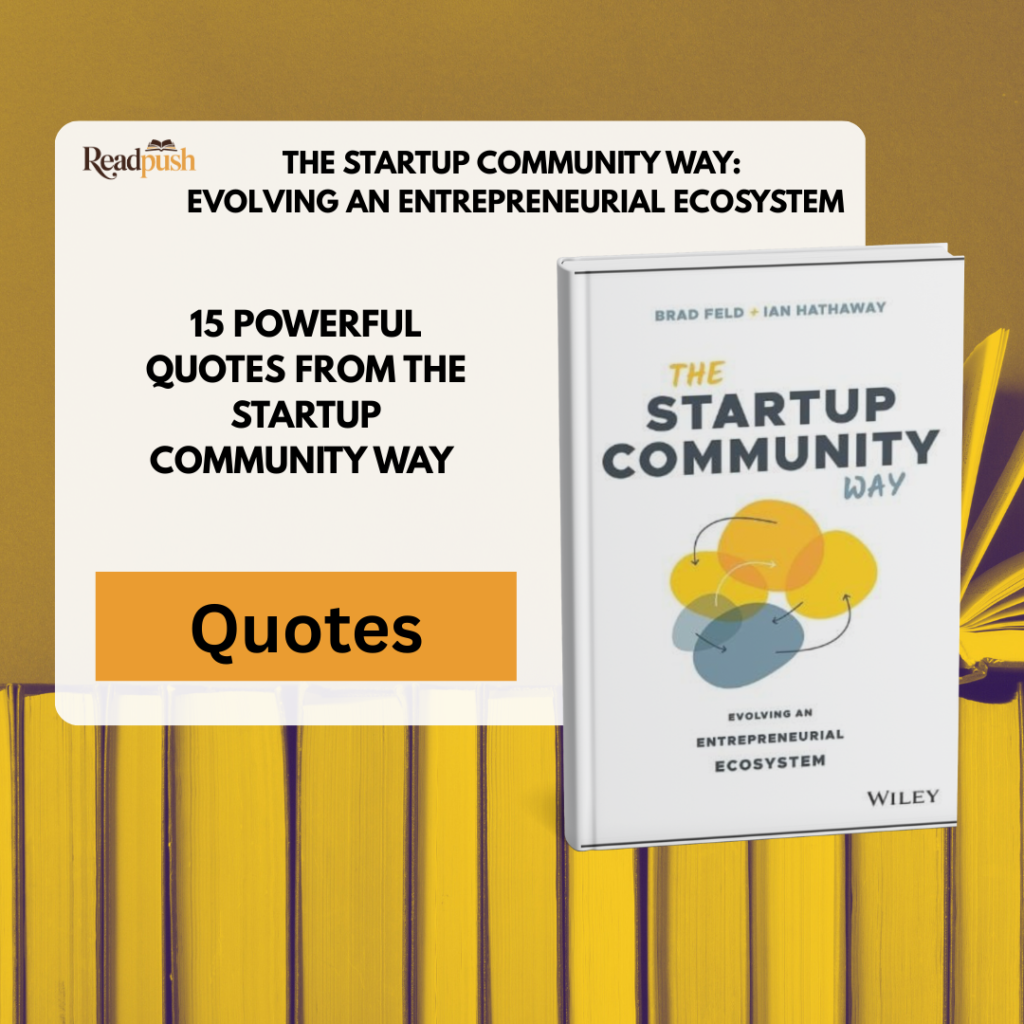
The most revealing thing about a business book is often not its central framework but the sentences that surround it: the asides, the qualifications, the moments where the author’s actual position becomes legible beneath the argument they are making. The Startup Community Way by Brad Feld and Ian Hathaway is unusual in this respect. It is unusually honest about the limits of what it is claiming, and that honesty is worth attending to.
What follows is not a summary. It is a close reading of the book’s most significant passages: what they are actually saying, and why that is different from how they are usually interpreted. The full summary of The Startup Community Way covers the main arguments systematically; this piece is interested in what happens at the edges of those arguments.
On the nature of the system
“Startup communities are complex adaptive systems.”
Brad Feld and Ian Hathaway, The Startup Community Way
This is the book’s foundational claim, stated early and returned to repeatedly. It is worth pausing on what complex adaptive systems actually means in the technical sense Feld and Hathaway intend, because the phrase is often received as atmospheric rather than substantive.
A complex adaptive system is one whose behaviour emerges from the interactions of its components, rather than from any central design. It is not merely complicated, with many moving parts that can in principle be understood and controlled. It is complex: the relationships between its parts generate patterns that cannot be predicted from the parts alone. Weather is a complex adaptive system. So are financial markets, and most living ecosystems.
The implication for anyone attempting to develop an entrepreneurial community is significant: you cannot engineer it from outside. You can participate in it, influence it, shape the conditions it operates within, but you cannot manage it into existence. Programmes that attempt to do so, the startup incubators created by municipal governments, the innovation districts planned by universities, tend to produce the appearance of an ecosystem rather than the thing itself.
“You can’t control a complex system, but you can guide it.”
Brad Feld and Ian Hathaway, The Startup Community Way
This is the corollary, and it is more practically useful than it sounds. Guiding, rather than controlling, means doing things that improve the conditions for interaction: creating spaces where founders meet, reducing frictions that prevent information from flowing, supporting the connective tissue of trust that allows communities to function. It does not mean establishing programmes with targets, metrics, and outcome reports. The latter usually optimises for the measurable at the expense of the real. The full argument for guiding rather than controlling develops what this distinction means in operational terms.
On time
“You have to have a long-term view, at least twenty years from today.”
Brad Feld and Ian Hathaway, The Startup Community Way
Feld repeats this across multiple books, and it bears repeating here because it is the requirement most consistently ignored by the organisations that most want to build startup communities. Municipal governments work on electoral cycles. Universities work on academic cycles. Corporations work on quarterly cycles. None of these timelines is compatible with the twenty-year horizon Feld is describing.
The communities he identifies as healthy, Boulder, Colorado being the one he knows best from the inside, did not become healthy in a decade. The density of relationships, the culture of information-sharing, the tolerance for failure, the willingness of successful founders to reinvest time and capital locally: these things accumulate slowly and are easily disrupted. A city that decides to build its startup community this decade and expects results by the next one has misunderstood the nature of what it is trying to build.
“Progress is uneven, slow, and surprising.”
Brad Feld and Ian Hathaway, The Startup Community Way
This is the honest sentence that most accounts of ecosystem-building omit. It is accurate in ways that are uncomfortable for anyone who needs to demonstrate impact on a regular basis. The surprising part is perhaps the most important: genuine community development tends to produce outcomes that no one planned for, and the most significant things that emerge from a healthy ecosystem are usually not the things its founders were trying to create.
On structure and culture
“Startup communities thrive in networks, not hierarchies.”
Brad Feld and Ian Hathaway, The Startup Community Way
The distinction matters more in practice than it might appear on the page. Hierarchical organisations, which is to say most organisations, concentrate decision-making authority at the top and distribute resources through formal channels. Networks distribute authority and concentrate trust through relationships. A startup community organised as a hierarchy is, in Feld’s terms, not really a startup community. It is an institution that has adopted startup community branding.
“Networks of trust are the invisible infrastructure of thriving startup communities.”
Brad Feld and Ian Hathaway, The Startup Community Way
The word invisible is doing important work here. The most valuable things in a healthy entrepreneurial ecosystem are difficult to count: the introductions made informally, the honest feedback given across a shared meal, the willingness to refer a competitor to someone who can serve them better. None of this shows up in a programme report. Much of the managed activity that does show up in programme reports has less value than these informal exchanges.
“Openness, support, and collaboration are critical behaviours in a startup community.”
Brad Feld and Ian Hathaway, The Startup Community Way
These are behaviours, not structures. They cannot be mandated. They can, at best, be modelled by the most visible participants in an ecosystem, over time, until they become the cultural default. This is why founder leadership matters to Feld’s argument: founders who demonstrate these behaviours create a norm that others will follow more readily than they would follow an institutional directive.
On identity
“Don’t try to be Silicon Valley. Be the best version of yourself.”
Brad Feld and Ian Hathaway, The Startup Community Way
This is the most quoted line from the book, and it has become something of a cliché in the regional economic development literature, which is a shame, because the underlying argument is less comfortable than the aphorism suggests. The temptation to replicate Silicon Valley, or Boston, or New York, is persistent precisely because those ecosystems are legible and documented. Their particular character, the things that make them work and the things that limit them, emerged from specific historical and cultural conditions that cannot be transplanted.
What Feld is asking communities to do instead is harder: to understand their own particular character, what the local culture values, what the local institutions make possible or difficult, what kinds of founders are already there and what they are trying to build, and to develop in ways that are consistent with that character rather than in imitation of somewhere else. The honest version of this is more demanding than “be authentic.” It requires sustained self-knowledge, which is rarer than it sounds.
“Entrepreneurship can transcend political, economic, and cultural boundaries.”
Brad Feld and Ian Hathaway, The Startup Community Way
This is the book’s most optimistic claim, and it is the one I find most open to question. Entrepreneurship in its most general sense, the impulse to create and build, does appear across contexts with remarkable consistency. The conditions that allow it to compound into a productive community are considerably more variable. The political, economic, and cultural factors that Feld suggests entrepreneurship can transcend are, in many places, the dominant forces shaping who can participate in an ecosystem and on what terms. A framework that treats these as secondary tends to describe communities that are already fortunate and underestimate what it would take to develop communities that are not.
|
Reading the quotes honestly What each passage is actually saying, vs how it tends to be received
|
||||||||||||||||||||||||
The same issue appears from another angle in Why You Cannot Control Startup Community and, where the business trade-off the book is trying to clarify becomes easier to see without turning the book into a slogan.
The same issue appears from another angle in Trust in Marketing Is Pattern Not Message, where the marketing problem behind the framework becomes easier to see without turning the book into a slogan.
The same issue appears from another angle in The Smallest Viable Market, where the larger question the book raises becomes easier to see without turning the book into a slogan.
The book’s honest limits
The Startup Community Way is most persuasive as a critique of managed approaches to ecosystem development, and least persuasive when it implies that the alternative, founder-led organic community-building, is straightforwardly available to anyone willing to try. The examples it relies on, Boulder in particular, are communities with specific advantages that Feld, to his credit, sometimes acknowledges but does not fully theorise.
This does not diminish the core argument. The claim that complex systems require a different approach than complicated ones, and that the instinct to control what can only be guided will reliably produce worse outcomes, is correct and underappreciated. The book makes that case with more intellectual rigour than most of its genre. The fuller critical assessment of The Startup Community Way examines both what the framework gets right and where the prescriptive gap is sharpest.
It is worth reading carefully, and worth arguing with. Those two things are not in tension.