Quick takeaways
- Blue Ocean Strategy is built around a specific sequence: start with buyer utility, set the price, then design the cost structure. Reversing that sequence is the most common way the method breaks down in practice.
- The value curve is the starting tool. Before you can design something new, you need to see clearly what the industry currently offers and why that landscape has everyone looking the same.
- The four actions framework (eliminate, reduce, raise, create) is where the redesign happens. Each of the four questions has a different purpose, and skipping any of them tends to produce an incomplete result.
- Noncustomers are where the largest growth opportunities usually sit. The book argues that most companies study existing buyers and ignore everyone else, which is precisely where blue ocean thinking finds room to move.
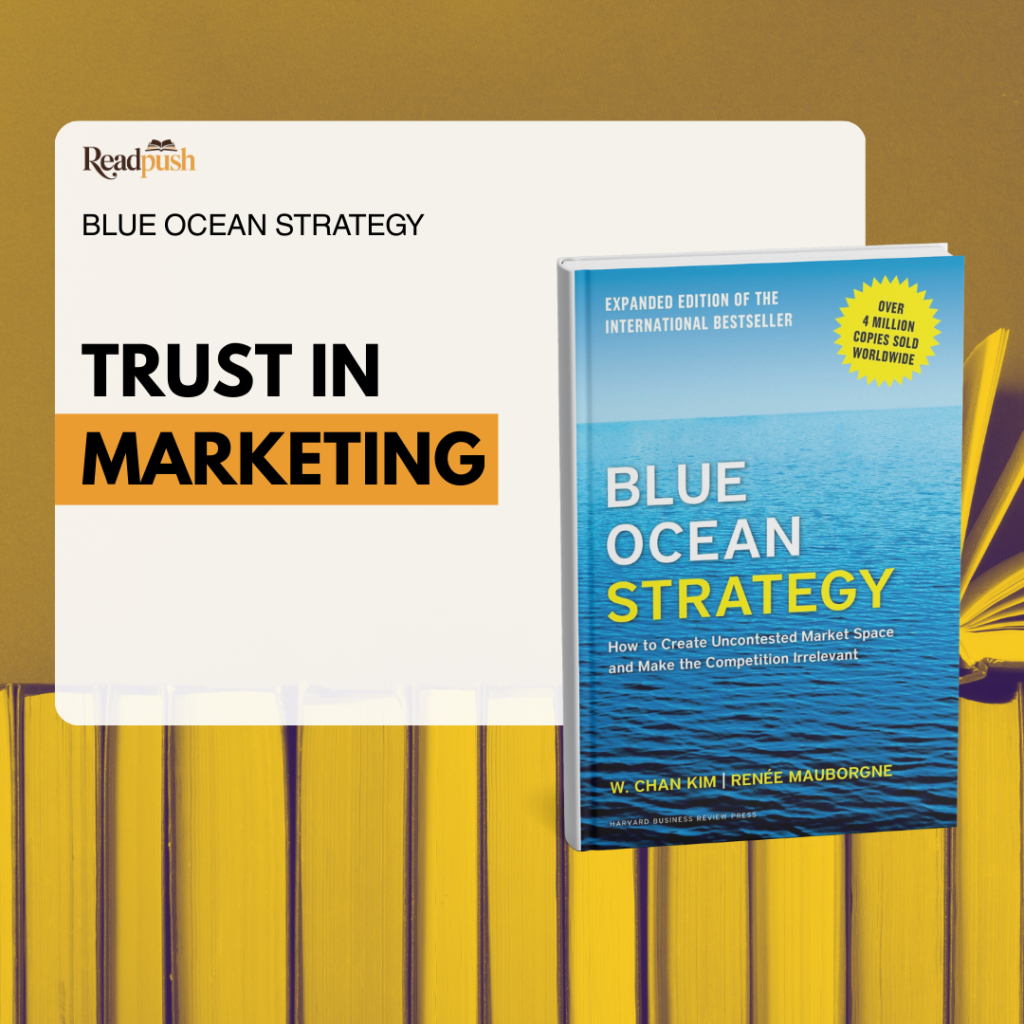
Blue Ocean Strategy by W. Chan Kim and Renée Mauborgne is, at its core, a book about how companies escape head-to-head competition by creating demand in uncontested market space. The authors call this a blue ocean move, as opposed to fighting over established territory, which they call the red ocean. The book was first published in 2005 and updated in 2015 with additional tools and case studies.
The framework is more structured than it first appears. Kim and Mauborgne are not simply arguing that companies should innovate. They are arguing for a specific method, with specific tools applied in a specific order. This guide walks through that method step by step, using the book’s own sequence. For context on the broader argument and the theoretical underpinnings, the complete guide to Blue Ocean Strategy covers the full framework.
Step one: map your current strategic landscape with the value curve
The first tool the book introduces is the strategy canvas, and the value curve is the central element of it. The idea is straightforward. List the main factors that companies in your industry compete on: price, product features, customer service, distribution, brand, and so on. Then plot, for each competitor, how much they invest in each factor. The result is a visual map of where the industry puts its energy.
In practice, most industries produce a cluster of nearly identical value curves. Companies have been watching each other long enough that they converge on the same factors, weighted in similar proportions. This is what Kim and Mauborgne mean when they say companies in red oceans all look the same. The strategy canvas makes that visible rather than leaving it as a vague intuition.
The map is also your benchmark. Once you have drawn the existing curves, you know what you are trying to move away from. Any new value curve you design will be measured against this picture.
Step two: use the six paths framework to find new angles
The six paths framework is the book’s tool for breaking out of industry logic. The problem it addresses is that most companies, when asked to innovate, stay inside the mental frame their industry has established. They think about beating competitors rather than making competitors irrelevant.
The six paths prompt you to look in different directions. Look across alternative industries: what do buyers choose instead of your category, and what makes those alternatives appealing? Look across strategic groups within your industry: why do some buyers trade up to premium and others trade down to budget? Look across the chain of buyers: the purchaser, the user, and the influencer are often different people with different priorities. Look across complementary products and services. Look across functional and emotional appeal. Look across time, specifically at trends that are already in motion but not yet fully played out.
Notice that none of these paths point you toward what competitors are doing. They point you toward buyers, non-buyers, and the broader context the product sits in. That is deliberate. The book’s argument is that competitive benchmarking, however sophisticated, keeps you inside a shrinking frame.
Step three: redesign value with the four actions framework
Once the six paths have surfaced potential opportunities, the four actions framework is the tool for translating those observations into a concrete design. The framework asks four questions about every factor the industry currently competes on.
Which factors should be eliminated? These are things the industry offers as a matter of habit that buyers do not actually value. The book’s examples include assumptions baked so deep into an industry that nobody questions them: meals on short-haul flights, live animals in circus performances. Eliminating them reduces cost without reducing value.
Which factors should be reduced well below the industry standard? Some factors are over-delivered relative to what buyers actually need. Reducing them frees up resources without meaningfully affecting the offering.
Which factors should be raised well above the industry standard? These are the areas where the industry has been under-delivering and buyers have been tolerating the gap without complaint because all the alternatives are equally limited.
Which factors should be created that the industry has never offered? These are typically the elements that come out of the six paths analysis: things buyers value in alternative industries, or needs that have been visible but unmet.
The four questions together produce what the book calls a new value curve. A good one looks clearly different from the existing industry curves on the strategy canvas: it focuses on a different set of factors, it diverges visibly, and it can be communicated simply. Kim and Mauborgne use Cirque du Soleil and Yellow Tail wine as their signature cases. Each produced a curve that was genuinely distinct from the existing competition rather than a marginal improvement on it. The Blue Ocean case studies piece covers these in more detail.
Step four: follow the strategic sequence
This is where a significant proportion of blue ocean moves fail in practice. Companies design a compelling new value curve and then immediately focus on cost or technology or internal capability. The book argues this is the wrong order. The strategic sequence specifies four checkpoints that must be passed in sequence, and passing them out of order consistently produces weak results.
The first checkpoint is buyer utility. Does the idea offer buyers something that is genuinely useful and meaningfully different from what they have now? If not, no amount of clever pricing or operational efficiency will make it work.
The second checkpoint is strategic pricing. Before designing the cost structure, the book says to set a price that will attract the mass of target buyers rather than just early adopters. This is the “strategic price,” not a cost-plus calculation. Kim and Mauborgne argue that setting price first is essential because it forces the entire design to work backwards from what buyers will actually pay, rather than forwards from what the company wants to charge.
The third checkpoint is target cost. Given the strategic price, what cost structure makes the offering profitable? This may require eliminating or reducing factors more aggressively, finding new ways to produce, or partnering rather than building in-house. The book is explicit that cost reduction comes after pricing, not before.
The fourth checkpoint is adoption. Even a well-designed, correctly priced offering can fail if buyers, employees, or partners have reasons to resist it. The book calls for identifying these points of friction early and addressing them in the design rather than after launch.
Step five: identify and reach noncustomers
One of the book’s more counterintuitive arguments is that the biggest growth opportunities often lie outside the existing customer base entirely. Kim and Mauborgne identify three tiers of noncustomers.
The first tier consists of people who use your category minimally and would stop if an alternative appeared. They are technically customers but barely. The second tier consists of people who have consciously decided not to use the category, usually because it does not meet a specific need or crosses a threshold of cost, complexity, or inconvenience. The third tier consists of people who have never been considered as potential customers at all.
The value innovation framework connects directly to this point. Creating new market space typically means serving someone who was not previously being served, rather than taking share from existing competitors. Yellow Tail grew primarily by reaching people who drank beer rather than wine. Nintendo Wii grew primarily by reaching people who had stopped gaming or never started. In both cases the relevant question was not “how do we attract more existing buyers” but “why does this category not appeal to people who might benefit from it.”
Step six: communicate the offering simply and clearly
The book spends relatively little time on this compared to the earlier steps, but the point is worth noting. A blue ocean offering is typically simpler than what the industry has been providing, and the communication should reflect that. Kim and Mauborgne’s test for a good tagline is that it should capture the key reason a buyer would choose the offering over all alternatives, in plain language that a buyer can use to explain the choice to someone else.
This step also serves as a useful diagnostic. If you cannot explain the new value curve simply, that is usually a sign the design is not yet clear enough. Complexity in the communication often traces back to unresolved complexity in the offering itself.
Step seven: launch, observe, and adjust
The book does not advocate a slow, highly-tested launch sequence in the way lean startup methodology does. What it does advocate is treating the launch as the beginning of a learning process rather than the end of a design process. The value curve will need refinement. Buyer responses will reveal things the strategy canvas did not. Friction points will appear that the adoption analysis missed.
Kim and Mauborgne note that most of the companies they studied adjusted their offering after initial market contact. The design phase is meant to maximise the quality of that contact, not to eliminate the need for it.
Common mistakes the book identifies
Several failure patterns recur across the case studies and the book’s diagnostic material.
Starting with technology rather than buyer utility is perhaps the most common. A technology that does not map to a genuine buyer problem does not create a blue ocean; it creates an expensive lesson. The buyer utility test in the strategic sequence is specifically designed to catch this early.
Benchmarking competitors rather than exploring alternatives keeps companies inside the red ocean frame. The six paths exist precisely to break that habit. If your innovation process begins by looking at what competitors offer, the book suggests you have already constrained yourself unnecessarily.
Overbuilding the product is another pattern the book returns to. The elimination and reduction questions in the four actions framework are specifically about identifying what to take away. Companies that only add features in response to competitive pressure rarely produce genuinely differentiated offerings.
Reversing the strategic sequence, particularly by designing the cost structure before the price, is the mistake that most often converts a strong concept into a weak commercial result. The book is unusually clear on this: price first, then cost.
The same issue appears from another angle in Value Innovation, where the business trade-off the book is trying to clarify becomes easier to see without turning the book into a slogan.
The same issue appears from another angle in Blue Ocean Strategy Case Studies, where the business trade-off the book is trying to clarify becomes easier to see without turning the book into a slogan.
The same issue appears from another angle in Why You Cannot Control Startup Community and, where the business trade-off the book is trying to clarify becomes easier to see without turning the book into a slogan.
If you take three things from this
First, draw the value curve before you do anything else. Without a clear picture of what the industry currently offers, you are designing in the dark.
Second, follow the strategic sequence in order. Buyer utility, then price, then cost, then adoption. The sequence exists because reversing it consistently produces weaker results.
Third, study noncustomers as carefully as you study existing customers. The people who avoid your category or have never considered it are often pointing at exactly the problem that a new value curve could solve.
For further reading: Kim and Mauborgne’s Blue Ocean Shift, published in 2017, extends the framework with a more detailed process for applying it inside existing organisations, particularly around managing the human dynamics of change. Readers who find the original framework compelling but want more on implementation will find it useful.