Quick takeaways
- The line that stays with me longest is not about money at all. “The highest form of wealth is the ability to wake up every morning and say, I can do whatever I want today.” Everything else in the book is either building toward that or explaining why people miss it.
- The compounding insight is always stated as a math point. It is really a behaviour point. You only earn compound returns if you stay invested through the parts where leaving feels obviously correct.
- “There is no reason to risk what you have for what you don’t need” is the most ignored sentence in personal finance. Most people who have enough keep optimising for more.
- Housel writes about money but he is mostly writing about psychology. The finance is the case study. The human patterns are what he is actually interested in.
Some books you read once and forget. Others you keep coming back to not because the ideas are new but because the same sentence means something slightly different each time you encounter it, depending on what you are going through when you find it again.
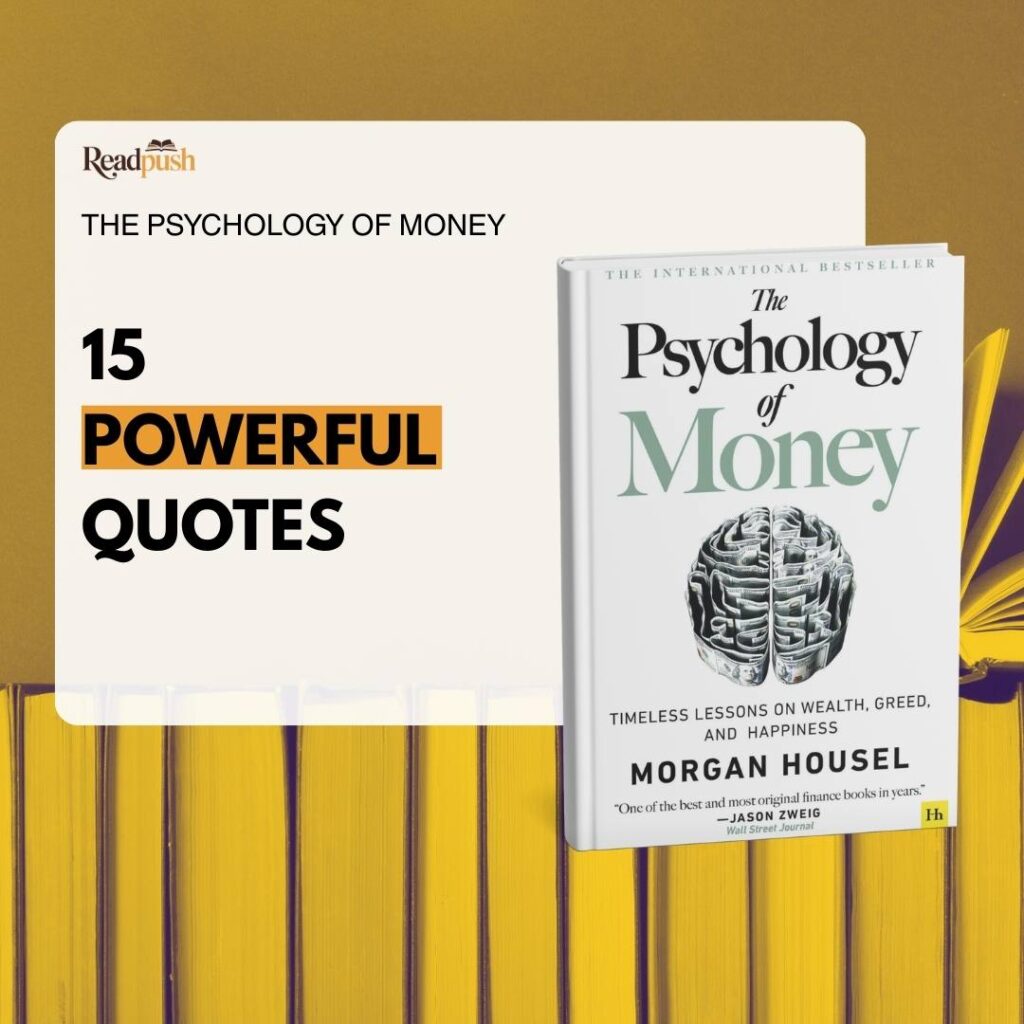
Morgan Housel’s The Psychology of Money is that kind of book for me. What makes it so quotable is not just elegant prose. It is that Housel has a gift for compressing something genuinely true about human behaviour into a single sentence that you can carry around. The fuller Psychology of Money summary covers the five most durable arguments in the book. This piece is the quotes, with honest notes on what each one is actually saying.
On behaviour and what actually determines outcomes
“Doing well with money has a little to do with how smart you are and a lot to do with how you behave.”
Morgan Housel, The Psychology of Money
This is the thesis of the entire book in one sentence, so it is worth sitting with rather than nodding past it. Housel is not saying intelligence does not matter. He is saying that in most financial contexts, the limiting factor is not knowledge or analytical ability but the capacity to stay calm, stay the course, and avoid the emotional decisions that undo careful plans. A genius who panics will underperform a patient average person almost every time.
“Your personal experiences with money make up maybe 0.00000001% of what’s happened in the world, but maybe 80% of how you think the world works.”
Morgan Housel, The Psychology of Money
I keep coming back to this one when I try to understand why reasonable people disagree so sharply about obvious financial questions. Someone who grew up during the Great Depression and someone who came of age during the 1990s bull market are not looking at the same world. They are looking at the same statistics but interpreting them through completely different emotional models trained on different historical conditions. Neither is wrong. Both have incomplete data.
“A genius who loses control of their emotions can be a financial disaster. The opposite is also true. Ordinary folks with no financial education can be wealthy if they have a handful of behavioural skills that have nothing to do with formal measures of intelligence.”
Morgan Housel, The Psychology of Money
This is the liberating corollary of the first quote. Financial success is not restricted to people with expensive educations or high-income careers. It is available to people who have learned to manage their own responses to uncertainty. That is a learnable skill, not an inherited trait.
“Some lessons have to be experienced before they can be understood.”
Morgan Housel, The Psychology of Money
There is something both comforting and frustrating about this one. Comforting because it explains a lot of financial behaviour that otherwise looks like irrationality: people are not ignoring what they know, they genuinely do not know it yet in the way that shapes decisions. Frustrating because it suggests you cannot shortcut experience with information. The lesson lands differently when you have lived through it.
On enough, and what wealth actually is
“There is no reason to risk what you have and need for what you don’t have and don’t need.”
Morgan Housel, The Psychology of Money
The most ignored sentence in personal finance. Housel is describing something specific: the moment when you have enough, and the decision about what to do with “enough.” Most financial culture is built around never having enough, always optimising for more. This sentence suggests that at some point, the rational move is to stop optimising and start protecting. Most people with enough keep taking risks as though they do not have it yet.
“The highest form of wealth is the ability to wake up every morning and say, I can do whatever I want today.”
Morgan Housel, The Psychology of Money
This is the sentence I have thought about most. It reframes the entire question of what you are working toward. Not a number. Not a house. Not a retirement date. Control over your time. That framing changes the goal from accumulating to protecting optionality. The reasonable-not-rational framework from the book is built around this same idea in practice.
“Spending money to show people how much money you have is the fastest way to have less money.”
Morgan Housel, The Psychology of Money
He is not moralising here. He is making a factual observation about the structure of visible wealth: the people you assume are wealthy because of what they drive and wear may have very little of it, because visible signals of wealth cost money that could otherwise be compounding. Actual wealth is largely invisible, which is part of why people systematically misread who has it.
“Happiness, as it’s said, is just results minus expectations.”
Morgan Housel, The Psychology of Money
An underappreciated one. The implication is that you can improve your financial wellbeing not just by improving results but by managing expectations. Someone with a moderate income and accurate expectations about what it will provide can be more financially satisfied than someone earning significantly more who expected even more still. Expectation management is a financial strategy.
On compounding, survival, and time
“Good investing isn’t necessarily about earning the highest returns, because the highest returns tend to be one-off hits that can’t be repeated. It’s about earning pretty good returns that you can stick with and which can be repeated for the longest period of time.”
Morgan Housel, The Psychology of Money
The compounding insight is always stated as a math point. It is really a behaviour point. The reason to prefer repeatable good returns over exceptional one-off returns is that you can actually stay with the former. You will behave differently during a 30% drawdown if the strategy makes sense to you than if you are trusting something you do not understand. Housel’s argument is that the best strategy is the one you can hold.
“The first rule of compounding is to never interrupt it unnecessarily.”
Morgan Housel, The Psychology of Money
“Unnecessarily” is doing the most work in this sentence. There are times when interrupting compounding is necessary: genuine emergencies, life transitions, things that could not have been planned for. The warning is against interrupting it for reasons that feel urgent but are really just emotional. Most exits from long-term investments are unnecessary by this definition.
“If I had to summarize money success in a single word it would be: survival.”
Morgan Housel, The Psychology of Money
This lands differently after you have watched someone with genuinely impressive returns make one catastrophic decision. The people who end up with the most over decades are almost always the ones who stayed in the game, not the ones who had the best returns in any given year. Survival is the prerequisite for everything else. It is also the thing most often sacrificed in the search for higher returns.
On planning, uncertainty, and the future
“Planning is important, but the most important part of every plan is to plan on the plan not going according to plan.”
Morgan Housel, The Psychology of Money
Not an argument against planning. An argument for building slack and margin into plans rather than optimising them for the expected case. The financial plans that hold up over decades are almost never the ones that assumed everything would go smoothly. They are the ones that accounted for being wrong, being surprised, needing room to manoeuvre.
“Things that have never happened before happen all the time.”
Morgan Housel, The Psychology of Money
This is partly a warning against overconfidence in historical patterns. Every economic model that says “this has never happened in 100 years of data” is implicitly assuming the next 100 years will look like the last 100. They rarely do. The honest conclusion is that uncertainty should be taken seriously as a structural feature of financial planning, not a temporary condition that will resolve once things stabilise.
“Use money to gain control over your time, because not having control of your time is such a powerful and universal drag on wellbeing.”
Morgan Housel, The Psychology of Money
The practical companion to the “highest form of wealth” quote. This one is less poetic and more operational: money’s most valuable function is not what it buys but the options it creates. The freedom to choose your hours, your projects, your pace. Housel argues this is a more direct path to life satisfaction than most of what money is typically spent on.
The same issue appears from another angle in Psychology of Money Lessons Worth Sitting With, where the money decision underneath the book becomes easier to see without turning the book into a slogan.
The same issue appears from another angle in Your Money or Your Life vs The, where the question of attention, habits, and what actually changes behaviour becomes easier to see without turning the book into a slogan.
The same issue appears from another angle in How Darrin and Kristin Schmidt Built Six, where the larger question the book raises becomes easier to see without turning the book into a slogan.
Two more worth keeping
“Wealth is what you don’t see. It’s the cars not purchased. The clothes not bought. The first-class upgrade declined. The restaurants not visited.”
Morgan Housel, The Psychology of Money
This one corrects the intuition that wealth is visible. It is not. Wealth is the gap between what you could spend and what you chose not to. Which means the most convincing signals of wealth, the visible ones, are the opposite of wealth. And the actual wealthy tend to look unremarkable by the standards of conspicuous consumption.
“Manage your money in a way that helps you sleep at night.”
Morgan Housel, The Psychology of Money
The final and perhaps most practically useful summary of the reasonable-not-rational argument. Not “maximise returns.” Not “minimise risk.” Sleep at night. The implication is that the right financial strategy is the one that allows you to hold it when things go wrong, which requires it to be calibrated to your own psychology rather than optimised by someone else’s model of your situation.
|
15 quotes, 4 themes The Psychology of Money organised by what each quote is really about
|
||||||||||||||||
The one I keep returning to most is the time-control quote. Everything else in the book is either building toward that idea or explaining why people consistently miss it. Read the book slowly if you have not. The sentences are short. They take longer to absorb than they look like they will.