Quick takeaways
- The All-Seasons Portfolio is designed for all economic conditions, not just growth ones. That is the whole point. A portfolio built only for rising markets will fail you exactly when you need it most.
- The allocation (30% stocks, 55% bonds, 7.5% gold, 7.5% commodities) will not produce the highest returns in a bull market. It is not meant to. It is meant to protect you from catastrophic losses that derail long-term progress.
- Rebalancing is the discipline the strategy depends on. Without it, risk drifts and the “all seasons” protection breaks down.
- This is a starting framework, not a final word. Your specific situation, risk tolerance, and timeline should shape how you adapt it.
If you have ever watched your portfolio drop sharply during a market downturn and felt that sick mixture of helplessness and second-guessing, you are not alone in that experience. It is one of the things I hear about most from people thinking about their finances: not the everyday decisions, but the fear of what happens when things go badly and there is nothing they feel equipped to do about it.
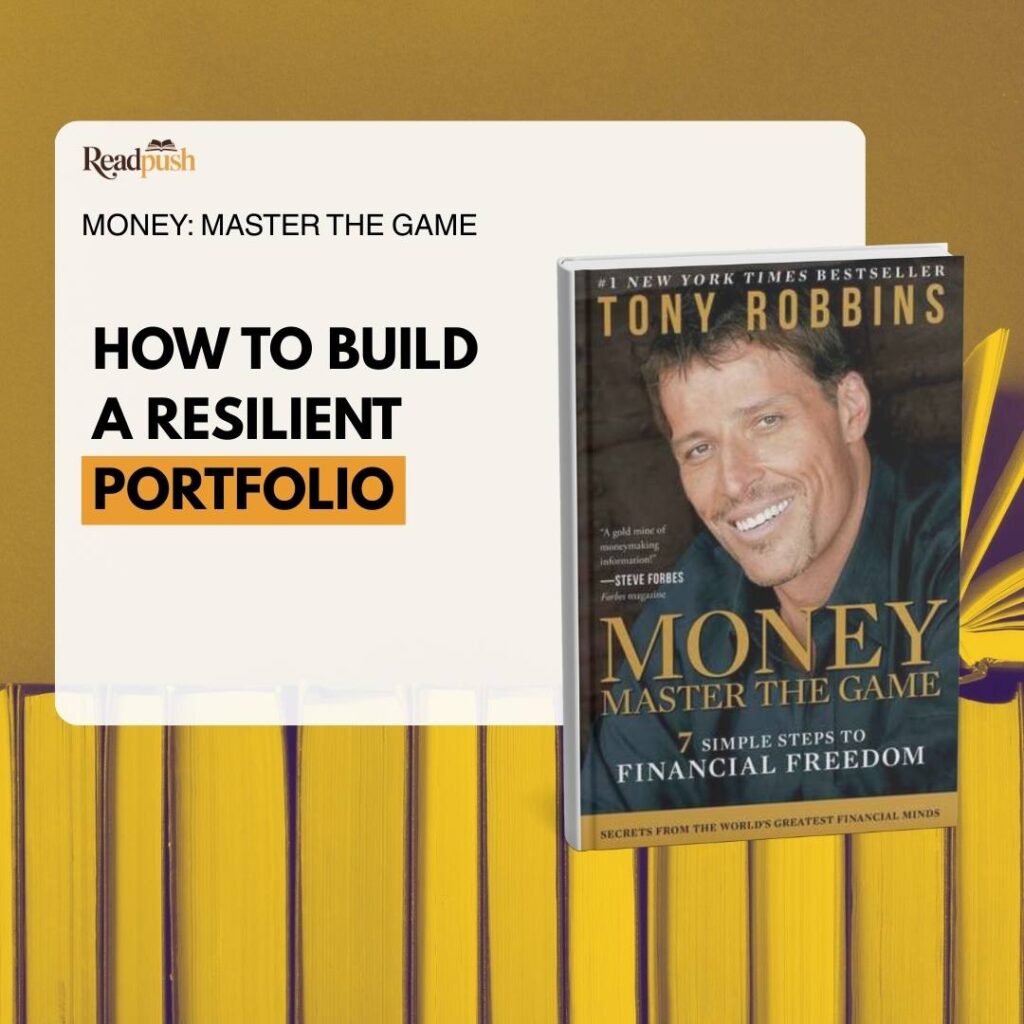
The All-Seasons Portfolio is a framework designed specifically for that moment. It comes from Ray Dalio, one of the most successful hedge fund managers of the past fifty years, and was popularized for everyday investors by Tony Robbins in Money Master the Game. The idea is straightforward: instead of building a portfolio that performs well in good conditions, build one that holds up in all of them. The Money Master the Game summary covers the book’s broader philosophy if you want that context before the practical guide.
What follows is a step-by-step implementation guide. Not investment advice, and worth running past your own advisor or doing further research before you act. But a clear picture of how this framework is actually built and maintained.
What the All-Seasons Portfolio is designed to do
Most investment portfolios are built for growth. They perform well when the economy is expanding and markets are rising. They suffer when conditions shift. The All-Seasons approach is different: it distributes risk across asset classes in a way that accounts for four economic conditions, not just one.
The four conditions are: rising growth, falling growth (recession), rising inflation, and falling inflation (deflation). Different asset classes perform differently in each of these environments. Stocks do well in growth. Long-term bonds do well in deflation and slow growth. Gold and commodities tend to hold value in inflation. By holding all of them in specific proportions, the portfolio is structured so that no single economic condition can devastate the whole.
What’s worth noticing is that this approach trades the highest possible return for stability across conditions. In a strong bull market, an All-Seasons allocation will underperform a portfolio of pure equities. That is the cost of the protection. Whether that trade-off is right for you depends on your relationship with volatility, something worth sitting with honestly before you proceed.
|
The allocation Dalio’s All-Seasons Portfolio: what each asset does and why it is there
|
||||||||||||||||||||||||||||||||||||||||
Before you start: what you actually need
A few honest prerequisites before the steps. You need access to a brokerage account that allows ETF investing, a basic understanding of what stocks and bonds are and how they behave differently, and an honest sense of your own risk tolerance. That last one matters more than most investment guides acknowledge.
Risk tolerance is not just about money. It is about what happens to you emotionally when a portfolio drops. Someone who will check their account every day during a downturn and feel genuine distress has a different practical risk tolerance than someone who will barely notice. The All-Seasons approach is designed for the first type of person, or for the person who knows they can become the first type under enough pressure. Take that seriously.
How to build and maintain the portfolio
Step 1: calculate your real numbers
Before allocating anything, know what you are working with. Total investable assets, existing holdings (and what they currently represent as percentages), and the gap between your current allocation and the All-Seasons target. If you already have a portfolio, this step is about understanding where you are starting from, not assuming you are starting from zero.
Step 2: allocate across the five asset classes
The Dalio allocation as Robbins describes it: 30% stocks, 40% long-term bonds, 15% intermediate-term bonds, 7.5% gold, 7.5% commodities. This is the starting point. It is not a mandate. Your own situation, age, income needs, and risk comfort may justify modest adjustments. The principle is that the bonds-heavy allocation is intentional: bonds provide stability that stock-heavy portfolios do not.
Use low-cost index ETFs to fill each position. The fee savings over decades compound significantly. A 1% fee difference across 30 years of investing can exceed the value of the original investment.
Step 3: invest gradually rather than all at once
If you are deploying a significant sum, dollar-cost averaging over three to six months reduces timing risk. You buy more shares when prices are lower and fewer when they are higher, automatically. You do not have to predict anything. The method sidesteps the question of whether this is a good time to invest, which is a question most people answer worse than they think they do.
Step 4: set a rebalancing schedule and follow it
This is the step that holds the strategy together. Over time, different assets grow at different rates. If stocks do very well for two years, they might drift from 30% to 40% of the portfolio. That changes the risk profile. Rebalancing, quarterly or semi-annually, brings the allocation back to target.
The emotional challenge of rebalancing is that it requires selling what has done well and buying what has not, which feels counterintuitive. It helps to have the schedule set in advance and automated where possible, so the decision does not have to be made in the moment when the market is doing something alarming.
Step 5: review annually, adjust for life changes
The All-Seasons framework is designed to be low-maintenance, not no-maintenance. An annual review should check whether your risk tolerance has changed, whether your income or spending needs have shifted, and whether the portfolio still reflects your actual situation. As you move closer to retirement, for example, the balance between growth and protection typically shifts.
|
Common mistakes What tends to go wrong and what to do instead
|
||||||||||||||||
The same issue appears from another angle in How Bridgewater Associates Built the All Seasons, where the money decision underneath the book becomes easier to see without turning the book into a slogan.
The same issue appears from another angle in Rich Dad Poor Dad Lessons for Entrepreneurs, where the money decision underneath the book becomes easier to see without turning the book into a slogan.
The same issue appears from another angle in Baby Step Explained, where the larger question the book raises becomes easier to see without turning the book into a slogan.
The emotional case for this approach
One thing that often goes unspoken in investment guides is that the best portfolio is the one you can actually hold. Not the one with the highest theoretical return. The one you will not panic-sell at the worst possible moment.
The All-Seasons approach is designed partly around the psychology of this. By holding assets that perform differently in different conditions, you reduce the experience of watching everything fall at once. When stocks drop in a recession, long-term bonds typically rise. The overall impact feels less catastrophic. And a portfolio that does not feel catastrophic during a downturn is one you are more likely to stay in.
For the underlying psychology of why financial decisions are harder than they look, The Psychology of Money is worth reading alongside this framework. Housel’s work on survivability and the behavioral drivers of financial outcomes covers the emotional terrain in a way that complements what Dalio and Robbins are offering on the structural side.
Take this framework as a starting point rather than a final answer. Run it past a fee-only financial advisor if you are deploying a significant sum. Adapt it for your own situation. And then, once it is in place, let it run. The discipline of not reacting is most of the work.