Quick takeaways
- The All-Seasons Portfolio was created by Bridgewater, not adopted from Robbins. Robbins brought it to a general audience. The direction of influence matters for understanding what the strategy actually is.
- Risk parity is the insight at the heart of it: distribute risk equally, not dollars equally. Most portfolios do the second and call it diversification. Bridgewater understood this was not the same thing.
- The strategy’s performance through 2008 is its most credible evidence. The All-Weather fund declined around 3.9% that year while the S&P 500 fell 38%. That gap is the whole argument in numbers.
- For individual investors, the practical takeaways are the allocation framework and the rebalancing discipline, not the institutional mechanics, which require scale and sophistication most people do not have.
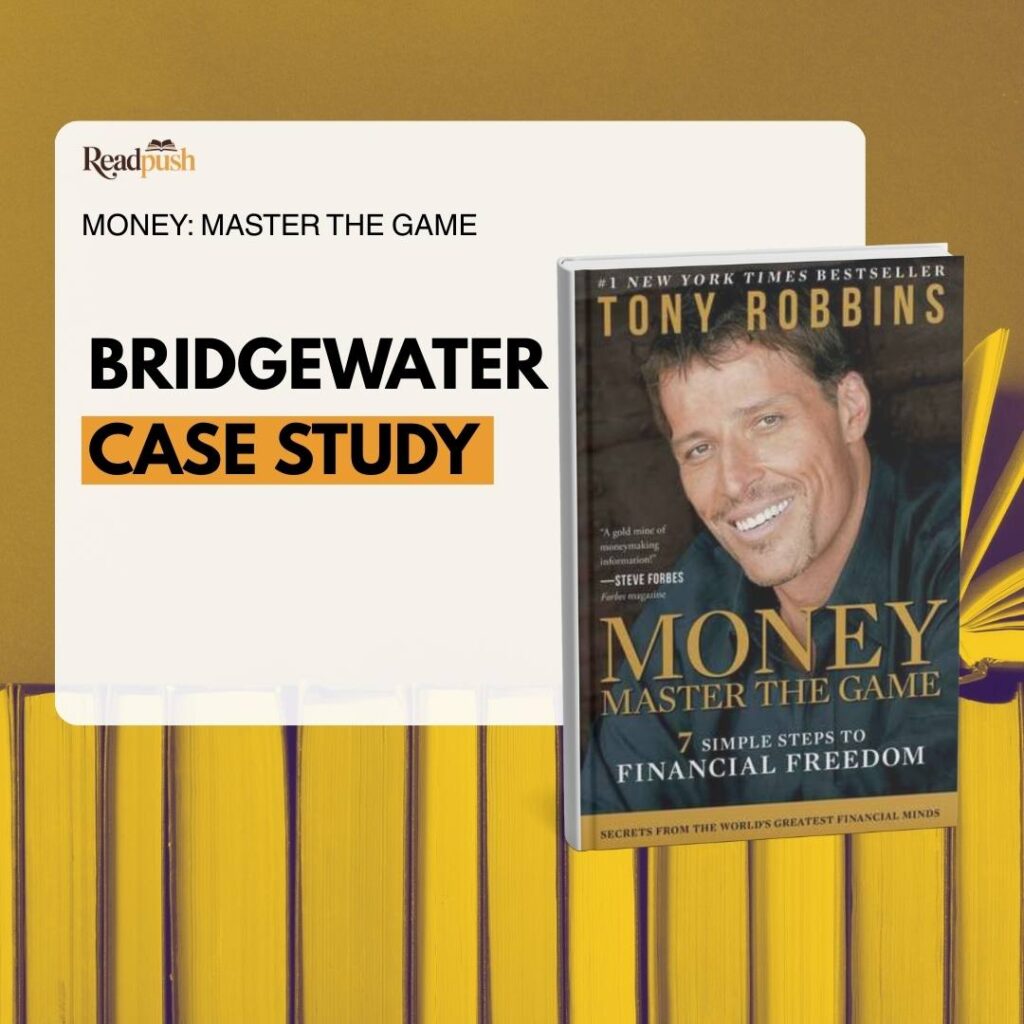
There is a version of this case study that gets the story backwards, and it matters enough to correct before we go further. Bridgewater Associates did not adopt the All-Seasons Portfolio from Tony Robbins. They created it. Robbins interviewed Ray Dalio for Money Master the Game and brought the principles to a general audience, which is a different and more accurate description of the relationship. What Robbins did was valuable: he translated an institutional investment strategy into something individual investors could understand and act on. But the origin of the strategy is Dalio’s, and the evidence for whether it works comes from Bridgewater’s institutional track record, not from the book.
With that corrected: the case study is genuinely interesting, and the lessons for individual investors are real. The step-by-step guide to building the All-Seasons Portfolio covers the practical implementation. This piece is about what Bridgewater’s experience tells us about whether the strategy actually works, and what that means for the rest of us.
What Bridgewater actually built
Ray Dalio founded Bridgewater in 1975. By the 1990s, the firm had developed what it called the All-Weather Portfolio, a strategy specifically designed to perform across different economic conditions rather than to maximize returns in favorable ones. The core insight was about risk, not return: most portfolios that appear diversified are actually deeply concentrated in equity risk. When stocks fall sharply, most other assets in a typical portfolio fall with them, because the real driver is not the asset class but the underlying exposure to growth conditions.
Dalio’s approach was to think about risk allocation differently. Rather than holding 60% stocks and 40% bonds by dollar amount, he looked at how much each asset contributed to total portfolio volatility. Bonds are much less volatile than stocks, so a 60/40 split by dollars is actually closer to 90/10 by risk. To achieve genuine balance, you need far more bonds by dollar amount to equalize their risk contribution. This is risk parity, and it is the conceptual core of All-Weather.
The strategy emerged from a genuine question Dalio was wrestling with: how would a portfolio hold up if you did not know what the future economic environment would look like? He mapped the four conditions that could exist: rising growth, falling growth, rising inflation, falling inflation. Then he identified which asset classes tend to perform well in each. Stocks do well in growth. Long-term bonds do well in deflation. Gold and commodities hold value in inflation. By holding all of them in proportions that equalize their risk contribution, the portfolio has something working for it in any environment.
|
The logic behind the strategy Four economic conditions, four asset responses
|
||||||||||||||||||||||||
The evidence that matters: 2008
The most credible evidence for the strategy’s design is its performance during the 2008 financial crisis. Bridgewater’s All-Weather fund declined approximately 3.9% that year. The S&P 500 fell around 38%. That gap, between a difficult year and a catastrophic one, is the strategy’s central claim made concrete.
What’s worth noticing is what this means and what it does not mean. The strategy did not avoid losses entirely. It reduced them to something manageable while most other approaches produced losses that took years to recover from. Investors who held All-Weather through 2008 were in a fundamentally different position at the start of 2009 than investors who held conventional stock-heavy portfolios. The position you are in at the bottom of a downturn determines how much you benefit from the recovery.
Over longer periods, backtesting of the strategy shows positive returns in most years going back to the 1970s, with particularly strong performance relative to alternatives during deflationary periods and recessions. The trade-off is underperformance during extended bull markets, where a stock-heavy portfolio would do significantly better. Whether that trade-off is right depends on your own relationship with volatility and your time horizon, not on the strategy’s objective superiority in all circumstances.
What the institutional experience teaches individual investors
Bridgewater’s implementation of All-Weather at institutional scale involved tools and structures that individual investors cannot replicate: derivatives for leveraging the bond positions, sophisticated rebalancing systems, and the kind of research capacity that comes with managing billions. Robbins was transparent about this in the book: the allocation he describes is a simplified version designed for individual investors, not a replica of what Bridgewater actually runs.
The simplified version (roughly 30% stocks, 55% bonds, 7.5% gold, 7.5% commodities) captures the structural logic without the institutional mechanics. The key principles translate: diversify across asset classes that respond differently to economic conditions, equalize risk contribution rather than dollar allocation, rebalance regularly, use low-cost instruments. These are available to anyone with a brokerage account.
What does not transfer is the expectation that your simplified individual portfolio will perform identically to Bridgewater’s institutional fund. The leverage, the scale, and the sophistication of the execution all affect outcomes. The principles are sound and the structure is meaningful. The exact replication of institutional results is not the goal and should not be the expectation.
An honest assessment of the strategy’s limits
The All-Seasons approach has genuine critics, and their concerns are worth knowing. The high allocation to long-term bonds (around 40% in the simplified version) was designed in a period when bonds reliably appreciated when stocks fell. In a rising interest rate environment, long-term bonds can fall at the same time as equities, which undermines the diversification logic. The 2022 environment, where both stocks and bonds fell sharply, exposed this as a real limitation rather than a theoretical one.
The gold and commodity allocation adds inflation protection but also adds volatility that not everyone is comfortable holding over time. And the strategy’s underperformance during strong equity bull markets can be genuinely difficult to maintain commitment to, particularly when everything you hear suggests stocks are the obvious choice.
None of this invalidates the strategy. It contextualizes it. The All-Seasons approach is not a perfect solution. It is a thoughtful framework for investors who prioritize stability and downside protection over maximum return, and who understand the trade-offs they are making. Understanding those trade-offs clearly is the same work the Psychology of Money encourages: know what you are actually optimizing for, because most financial mistakes come from optimizing for the wrong thing.
|
Honest assessment What the strategy offers and where its limits are
|
||||||||||||
The Bridgewater story is useful not because it promises a result you can replicate, but because it shows what it looks like to take the question of resilience seriously at the design stage. Most investors optimize for returns and hope for stability. Dalio built a system that explicitly traded some return for stability, and then measured whether that trade-off was worth it. It was, in 2008. It was not, in 2022. That is what honest investing looks like: knowing what you are getting, knowing what you are giving up, and making the choice with clear eyes.
A practical way to use this idea
The simplest way to make this article useful is to turn the idea into one decision. After reading How Bridgewater Associates Built the All-Seasons Strategy (and What It Means for Individual Investors), ask what you would actually do differently this week. If the answer is vague, the lesson is not ready yet.
Try this: name the situation where the idea matters, choose one signal to watch, and decide in advance what response would be wiser than your usual one. That keeps the lesson from becoming another interesting thought with nowhere to go.
The best ReadPush takeaways are practical in that ordinary sense. They do not need drama. They need a place in a normal week.
The same issue appears from another angle in Psychology of Money Lessons Worth Sitting With, where the money decision underneath the book becomes easier to see without turning the book into a slogan.
The same issue appears from another angle in How to Build Resilient Portfolio Using the, where the money decision underneath the book becomes easier to see without turning the book into a slogan.
The same issue appears from another angle in How Darrin and Kristin Schmidt Built Six, where the larger question the book raises becomes easier to see without turning the book into a slogan.
What to watch for
Be careful not to overuse the idea. A good book concept becomes less useful when it is applied to every problem. Use it where the fit is natural, and leave it alone where another framework would explain the situation better.
That kind of restraint is part of good reading. It lets the book help without asking it to become a complete philosophy of work, money, habits, or life.