Quick takeaways
- Housel’s central argument is that financial success is mostly behavioral, not technical. That framing makes this book worth reading even if you already understand how investing works.
- The “enough” concept and the “tail events” lesson are the two that keep coming back for me. Between them, they explain most of why people with good strategies still end up with bad outcomes.
- These twelve lessons are better absorbed one at a time than read in a sitting. The ones that land will be different depending on where you are right now.
- This is a book that rewards re-reading, not because the ideas are complicated but because they mean different things at different life stages.
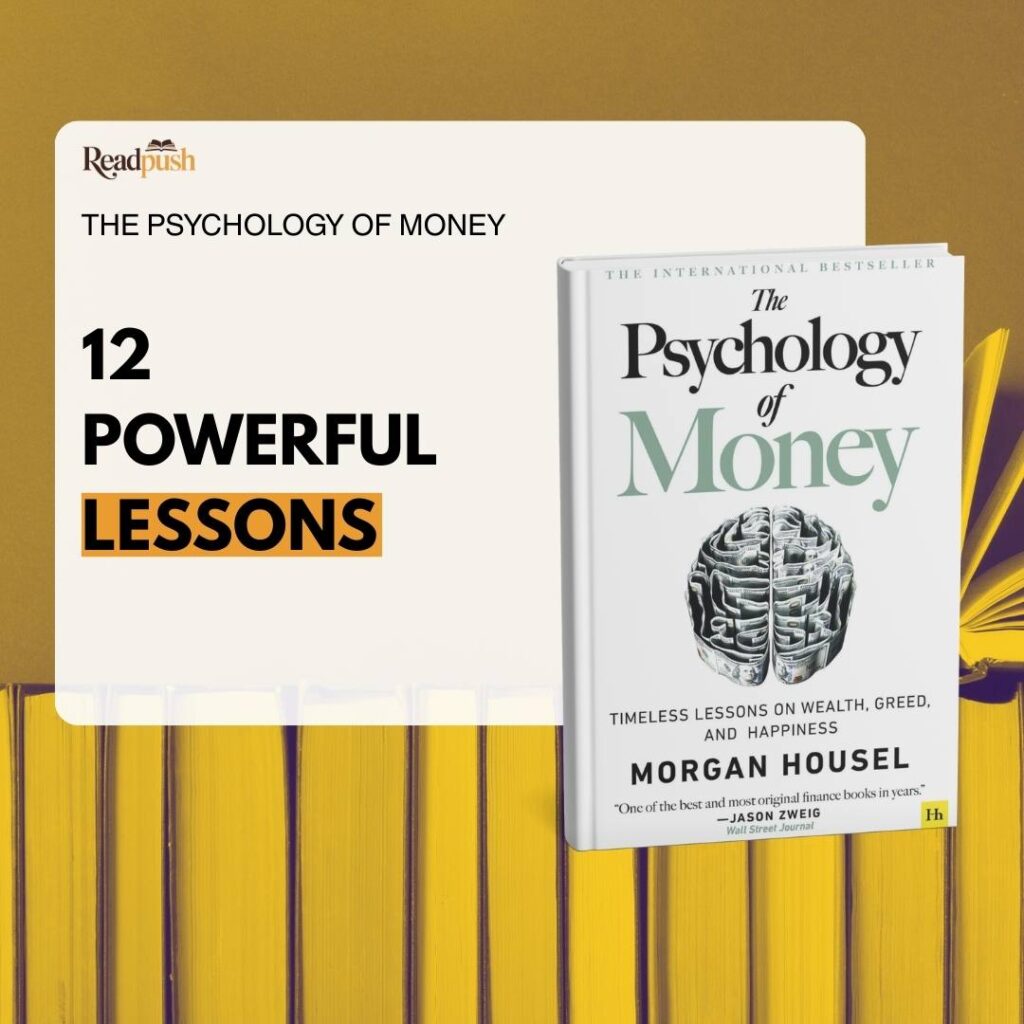
Morgan Housel’s The Psychology of Money is one of those books I keep coming back to, not because I forgot what it said but because it keeps saying something slightly different depending on where I am when I pick it up again. That is the mark of a book that is working at a deeper level than most.
What Housel is really doing is making the case that financial outcomes are shaped more by psychology than by knowledge. Most people who struggle financially know roughly what they should be doing. The gap is not information. It is the emotional and behavioral patterns that interfere with acting on the information. The full Psychology of Money summary covers the five core arguments if you want the condensed version. This piece is the twelve lessons I find most worth sitting with.
On behavior and what actually shapes outcomes
1. Your money story shapes your financial worldview more than you realize
Housel writes that your personal experience with money makes up about 0.00000001% of what has happened in the world, but around 80% of how you think the world works. The generation that grew up during the Great Depression will never relate to debt the same way as someone who came of age during the 1990s bull market. Neither view is wrong. Both are rational responses to the experiences that shaped them.
I keep coming back to this one because it explains so much financial disagreement that otherwise looks like irrationality. Before you judge a financial decision someone else made, it helps to ask what history they are reasoning from. And before you make your own decisions, it helps to ask the same question of yourself.
2. Behavior beats intelligence, consistently
Housel tells the story of Ronald Read, a gas station attendant and janitor who died with over eight million dollars saved through patient investing. And Richard Fuscone, a Harvard-educated Merrill Lynch executive who went bankrupt. The difference was not capability. It was behavior: Read lived modestly and saved consistently; Fuscone borrowed heavily and spent lavishly.
The lesson is less about any specific strategy and more about what actually compounds: consistency, patience, and the discipline not to disrupt a system that is working. Financial intelligence does not protect you from behavioral mistakes. It sometimes makes you overconfident that it will.
3. You cannot separate money from emotion
Housel is direct that personal finance is personal. The mathematically optimal strategy is useless if you cannot psychologically sustain it. Someone who sleeps well with a conservative allocation, even if it theoretically underperforms a more aggressive one, will likely outperform the person who is technically correct but emotionally unable to hold through a downturn. The right plan is the one you can actually maintain, not the one that looks best in a spreadsheet.
|
12 lessons, 4 themes The Psychology of Money: what each section of lessons is really about
|
||||||||||||||||
On wealth, enough, and what money is actually for
4. Wealth is what you do not see
Housel makes a distinction between rich and wealthy that I think about often. Rich is current income. Wealthy is accumulated assets that have not been spent. The car in the driveway and the watch on the wrist signal the first. The investment account that no one sees signals the second. Most people who look wealthy are demonstrating spending, not saving. Actual wealth is mostly invisible, which means most of our intuitions about who has it are probably wrong.
5. Knowing when “enough” is enough
This is one I keep returning to. Housel argues that “enough” is one of the most important and underappreciated concepts in personal finance. The failure to define it leads people to keep optimizing for more, taking on risks they do not need, and occasionally losing what they already have. The investor who, having built genuine financial security, continues to pursue speculative returns and loses it all has not failed at investing. They have failed at the harder question: knowing when the game was already won.
6. Freedom of time is the real dividend
The highest form of wealth, in Housel’s framing, is the ability to decide how you spend your time. Not a number in an account, not a particular asset, but the capacity to choose your hours. This reframes the purpose of money from accumulation to optionality. A financially comfortable person who is still trapped by obligations and anxiety does not have the thing money is supposed to provide. A person with less, who has genuine control over their time, may have more of it than they realize. The reasonable-not-rational framework from the book takes this idea into practice: build a financial plan around what actually lets you sleep well, not what maximizes on paper.
On compounding, survival, and long games
7. Compounding is about survival, not just growth
Warren Buffett’s returns are extraordinary. What is less discussed is that he has been investing since he was a child, giving him a time horizon that almost no other investor has had. Housel’s point is that compounding requires staying in the game across decades, which requires surviving the downturns, the crises, and the moments when leaving feels obviously correct. The highest long-term returns are not necessarily earned by the best strategy but by the person who interrupted their strategy least.
8. Tails drive outcomes more than averages
Housel notes that most of what happens in financial markets happens in a small number of extreme events. The best and worst days of the market account for an outsized share of total returns over long periods. This means that a patient investor who stays through the bad days is also, almost by definition, present for the outsized good ones. The person who exits to protect themselves from the tail losses also removes themselves from the tail gains. This is not an argument for recklessness. It is an argument for understanding what patience actually protects you from missing.
9. Being reasonable beats being rational
Housel distinguishes between rational, the mathematically optimal choice, and reasonable, the choice you can psychologically sustain. Someone who pays off a mortgage early even though the expected market return exceeds the interest rate is making a “suboptimal” rational decision. If that mortgage payoff allows them to sleep, to stay invested everywhere else, and to hold their strategy through a crisis, it may produce better actual outcomes than the technically correct choice. The plan that holds is worth more than the plan that is theoretically superior but gets abandoned.
The same issue appears from another angle in Powerful lessons from The Total Money Makeover, where the money decision underneath the book becomes easier to see without turning the book into a slogan.
The same issue appears from another angle in Money Master the Game Lessons That Are, where the money decision underneath the book becomes easier to see without turning the book into a slogan.
The same issue appears from another angle in How Bridgewater Associates Built the All Seasons, where the money decision underneath the book becomes easier to see without turning the book into a slogan.
On planning, uncertainty, and how to think about the future
10. Good plans leave room for plans to fail
Housel is direct that the best financial plan is one built with margin for error. Not because failure is inevitable, but because the future contains things you cannot predict, and a plan with no slack will crack under the pressure of events it was not designed for. The people who do best over long periods are almost always the ones who built slack into their systems: cash reserves, conservative assumptions, flexibility to adjust without disaster. Optimization is the enemy of resilience.
11. Pessimism sounds smarter, but optimism tends to win
There is a social and intellectual premium on pessimism. The person who identifies what could go wrong sounds thoughtful. The person who expects things to generally work out sounds naive. Housel notes that this asymmetry is real but misleading: over long time horizons, the world has generally gotten better, markets have generally recovered, and patient optimism about the long run has generally beaten sophisticated pessimism that prompted action. This does not mean ignore risks. It means not let the weight of short-term risk assessments overwhelm the genuine case for long-term patience.
12. Humility about what you do not know is a financial strategy
The final lesson the book teaches, quietly, is that intellectual humility is protective in financial contexts. The investor who is certain they know where markets are heading will take concentrated positions and eventually be wrong in a way that is catastrophic. The investor who accepts genuine uncertainty will maintain diversification, keep reserves, and avoid the kind of overconfidence that tends to precede the biggest financial mistakes. Housel’s book is, in a way, an argument for appropriate epistemic modesty: know what you do not know, and design your financial life around that honest assessment rather than around the confident predictions of people who have forgotten that they have been wrong before.
|
Start here Which lesson to read first, based on where you are
|
||||||||||||||||
The two I come back to most are the “enough” lesson and the survival lesson. Between them, they explain most of why people with genuinely good strategies end up with disappointing outcomes: they did not define what they were building toward, so they kept pushing past it, or they interrupted the compounding at exactly the wrong moment.
Read this book slowly if you have not. And when you have, read it again in five years. The lesson that does not land today may be the one that matters most then.