Quick takeaways
- These books are solving different versions of the freedom problem. Robin and Dominguez: what does enough look like, and how do you get there through savings and alignment? Ferriss: how do you do less work and live better right now, before you reach financial independence?
- The 4-Hour Workweek is more immediately actionable. Your Money or Your Life builds toward something more durable.
- The failure mode for Ferriss followers is assuming the lifestyle design hacks work indefinitely at scale. They work well for a specific window. After that, you need the underlying wealth the Robin book helps you build.
- Read order if you have time for both: Robin first for the foundation, Ferriss second for the efficiency layer on top of it.
Whether you should read Your Money or Your Life or The 4-Hour Workweek depends on one question: what problem are you actually trying to solve?
If the problem is that you do not know where your money goes and you want a framework for building real financial independence, read the Robin. If the problem is that you are working too many hours on the wrong things and you want practical tools for reclaiming time now, read the Ferriss. They are not competing books. They are solving adjacent problems, and which one is more useful depends entirely on where you are.
What each book is actually doing
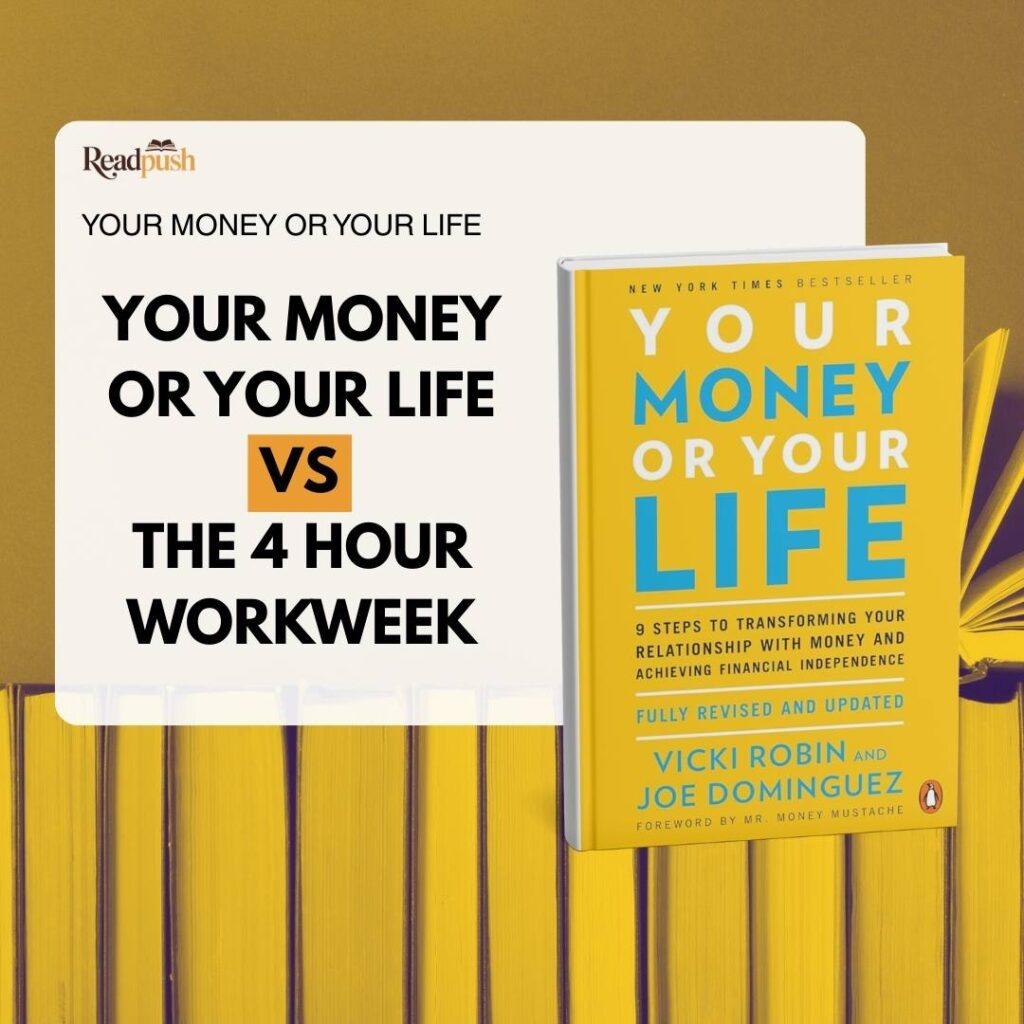
Your Money or Your Life by Vicki Robin and Joe Dominguez, originally published in 1992, is built on one reframe: money represents your time on earth, not just a number. Every dollar you spend cost you some hours of your life to earn. When you start measuring purchases in life energy rather than dollars, the spending math changes. The book walks through a nine-step system oriented toward the crossover point: the month your passive investment income exceeds your monthly expenses. That is financial independence. Everything in the book is in service of getting there. The full Your Money or Your Life summary covers the nine steps in detail if you want the complete framework.
The 4-Hour Workweek by Tim Ferriss, published in 2007, is doing something different. It is not primarily a financial independence book. It is a lifestyle design book. The core argument: most people overwork because they have not examined the assumption that more time at work produces better results. Ferriss argues that ruthless prioritization, outsourcing, automation, and working in compressed bursts can dramatically reduce working hours without reducing income. The goal is not financial independence per se. It is “time wealth” now, without waiting for a crossover point that might be fifteen years away.
|
Side by side Your Money or Your Life vs The 4-Hour Workweek
|
||||||||||||||||||||||||
Where each one is stronger
Your Money or Your Life wins on depth and durability. The life-energy reframe is genuinely original and does not exist quite this clearly anywhere else. The tracking and evaluation system is thorough. And the crossover-point goal gives the whole effort a concrete finish line. Thirty years after first publication, the core framework is still the standard reference for the FIRE (Financial Independence, Retire Early) community for good reason.
The weakness: the investing advice is outdated, and the book can feel slow if you are not in the right headspace for sustained self-examination. It asks a lot of patience. Some readers are not ready for that and put it down before the evaluation stages start producing results.
The 4-Hour Workweek wins on immediate impact. The efficiency frameworks, the 80/20 prioritization applied to your week, the outsourcing experiments, the batching: these are things you can try this month and measure. For knowledge workers and entrepreneurs who are genuinely overworked, the book produces results faster than almost anything else in the category.
The weakness: some of what Ferriss describes works best in a specific window of a career or business. The lifestyle design model, especially the parts about geographic arbitrage and outsourcing, has become more mainstream and thus less of a competitive advantage than it was in 2007. The underlying principles of ruthless prioritization and ruthless elimination of low-value tasks hold up much better than the specific tactics.
The failure mode for each
For Ferriss followers: assuming the efficiency hacks are permanent and sufficient. They are not. Outsourcing tasks and working in compressed bursts creates time, but it does not build wealth. If you spend the reclaimed hours on consumption rather than asset-building, you end up with a great lifestyle and limited financial runway. The Robin book is the one that addresses what to do with the time and income once Ferriss frees them up.
For Robin followers: the patience requirement is genuinely hard. The system asks you to track every cent, evaluate every spending category, and build toward a crossover point that might be ten or fifteen years away. The people who stall out usually do so in the middle phases, when the awareness work is done but the crossover point is still far enough away to feel abstract. For the psychology behind why people abandon long-horizon financial plans, the Psychology of Money covers the behavioral side in more depth.
Which to read, and when
If you are early in building financial literacy and want a foundational framework for understanding your relationship with money, read Your Money or Your Life first. It gives you the values-and-alignment layer that nothing else quite covers.
If you are already financially literate and your main problem is that you are working too much on the wrong things, read The 4-Hour Workweek for the efficiency toolkit. Skip the parts that have aged badly and take the prioritization framework seriously.
If you have time for both, read Robin first and Ferriss second. The financial foundation gives the efficiency work somewhere to land. Without it, the time you free up tends to fill with the same patterns of unreflective consumption that made the situation inefficient in the first place.
|
Decision guide Which book to start with, based on your actual situation
|
||||||||||||
Worth reading both. Worth being clear about which problem you are solving before you decide which to pick up first.
What this idea changes in practice
The useful way to read this piece is not as a shortcut around the book, but as a way to decide what the book is really asking you to notice. Your Money or Your Life is easy to reduce to a phrase. The phrase is helpful, but it is also where many readers stop too early.
The practical question is: what changes after you understand the idea? If the answer is only that you can repeat the concept in a meeting, the idea has not done much work yet. A good business or self-improvement book should change a decision, a habit, a conversation, or a way of measuring progress.
For this article, the change is usually smaller and more concrete than the headline suggests. You stop treating the concept as an inspirational lesson and start using it as a filter. It helps you decide what to ignore, what to inspect more closely, and where your current approach may be wasting effort.
That is where ReadPush readers get the most value. Not from another summary, and not from pretending the book is perfect. The value is in separating the durable idea from the noise around it.
Where readers often get it wrong
The common mistake is to treat the book’s central idea as universal. Most book ideas are not universal. They are conditional. They work better for some people, teams, markets, and seasons than others.
That does not make the idea weak. It makes it usable. Advice becomes more useful when you know its boundary. A habit system helps when your life has enough stability to support repetition. A strategy framework helps when the market conditions match the assumptions behind the framework. A finance lesson helps when it is applied to the right kind of risk, not every risk.
So the better reading is not, is this book right? The better reading is, where is this book right, and what would make it wrong for me? That question protects you from two bad habits: dismissing useful books because they are imperfect, and overusing famous books because they sound confident.
If you take only one thing from this article, take that discipline. Apply the idea where the conditions fit. Leave it alone where they do not.
How to apply the lesson without overcomplicating it
Start with one decision. Do not turn the book into a whole operating system on day one. That is how good ideas become heavy.
- Name the problem. What are you actually trying to improve: focus, growth, cash flow, consistency, leadership, decision quality, or something else?
- Pick the relevant principle. Choose one idea from the book that speaks directly to that problem.
- Define the test. What would look different after two weeks if the idea is working?
- Review the result. Keep what helped. Drop what added friction.
This keeps the lesson grounded. You are not trying to become the kind of person who has mastered the whole book. You are trying to make one part of your work or life less vague.
The same issue appears from another angle in The Page marketing plan vs building storybrand, where the marketing problem behind the framework becomes easier to see without turning the book into a slogan.
The same issue appears from another angle in How to Run the Nine Step Life, where the money decision underneath the book becomes easier to see without turning the book into a slogan.
The same issue appears from another angle in Psychology of Money Quotes, where the money decision underneath the book becomes easier to see without turning the book into a slogan.
A better final takeaway
The strongest books on ReadPush are rarely the ones that give the neatest answers. They are the ones that improve the quality of your next question. Your Money or Your Life is worth returning to for that reason.
Ask what the idea reveals. Ask what it hides. Ask what it would look like in a normal week, with normal constraints, limited time, and imperfect follow-through. If the idea still helps there, it is probably worth keeping.
That is the standard. Not whether the book sounds impressive. Whether it survives contact with real life.