Quick takeaways
- These two books are solving different problems. Kiyosaki is working on how you think about money. Ramsey is working on what you do with it. Knowing which problem you have tells you which book to read first.
- The asset and liability distinction in Rich Dad Poor Dad is genuinely useful. The specifics of how to acquire assets starting from a normal income are considerably less so.
- Ramsey’s Baby Steps work because they are designed around behavior, not math. The system that gets done beats the optimal system that does not.
- If you are in a stable place, read Ramsey first, Kiyosaki second. Get the behavior right. Then expand how you think about what to do with the money you freed up.
I have read both of these books twice. The first time was in my late forties, a few years after my wife died, when I was trying to get my head around money in a way I had never had to before. The second time was more recently, when someone I care about asked me which one they should start with, and I realized I did not have a clean answer.
That is worth noting upfront: neither of these books is clean. They are both useful and both limited, in ways that depend almost entirely on where you are standing when you open them.
What each book is actually doing
Rich Dad Poor Dad by Robert Kiyosaki came out in the late nineties and became one of those books that people have strong opinions about without having fully read. The central argument is simple: the difference between people who build wealth and people who do not is mostly a difference in how they think about money, assets, and work. Kiyosaki frames this through the contrast between his biological father (educated, professional, chronically broke) and his friend’s father (less formally educated, entrepreneurial, quietly wealthy). The poor dad traded time for wages. The rich dad built things that generated income without him in the room.
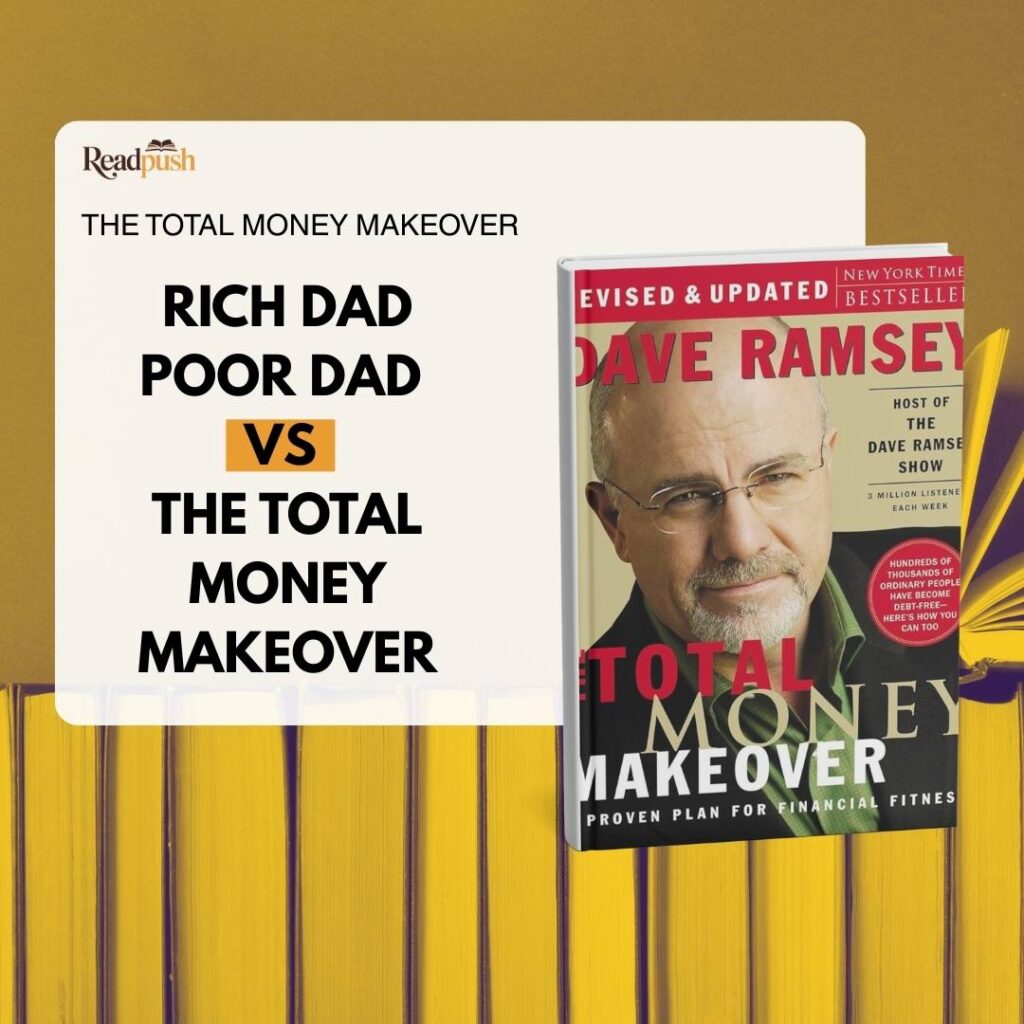
The Total Money Makeover by Dave Ramsey came a few years later and does something almost completely different. Ramsey is not particularly interested in how you think about money. He is interested in what you do with it, week to week, month to month. His system is built around what he calls Baby Steps: a specific, sequenced plan that starts with a small emergency fund, moves through aggressive debt payoff, and eventually arrives at long-term investing and generosity. It is a behavior book dressed up as a finance book.
That difference in orientation, mindset versus behavior, is the thing to hold onto when comparing them. It determines which one is actually useful to you right now.
|
Side by side Rich Dad Poor Dad vs The Total Money Makeover
|
||||||||||||||||||||||||
Where Kiyosaki is right
The asset and liability distinction at the heart of Rich Dad Poor Dad is genuinely useful, and most people have not really absorbed it even if they have heard it summarized. The short version: an asset puts money into your pocket. A liability takes money out. Your car is a liability. Your house, for most people, is a liability. A rental property that generates positive cash flow is an asset. The question Kiyosaki keeps asking, what does this do to your cash flow, is worth asking regularly about most financial decisions.
The book is also right that financial literacy is largely absent from formal education, and that most people are poorly equipped to think about money in any structural way. Reading it as an introduction to concepts like passive income, leverage, and the difference between working for money and having money work for you is genuinely valuable, particularly if nobody in your family ever talked about any of this. The Rich Dad Poor Dad summary lays out those core concepts clearly if you want to get oriented before reading the full book.
What I found, reading it in my late forties, is that the mindset shifts Kiyosaki describes are real. They did change how I looked at decisions. I started paying more attention to what things cost in ongoing terms, not just upfront. That is worth something.
Where Kiyosaki goes wrong
Here is the part people do not tell you: Rich Dad Poor Dad is much better at identifying the problem than solving it. Kiyosaki is persuasive that you should acquire assets, that you should think like an investor, that you should seek financial education. He is considerably less specific about how you do any of that starting from a normal income with normal constraints.
There is also a credibility problem that has followed the book for years. The “rich dad” is a composite figure, possibly fictional. The real estate advice is heavily context-dependent and has aged unevenly. And Kiyosaki has a consistent tendency to make the path to wealth sound more accessible than it is for most people in most circumstances.
I would put it this way: the book will change how you see money. It may not change what you do with it.
Where Ramsey is right
I have worked with a lot of people in difficult circumstances over the years, and what I have learned is that most financial problems are not primarily knowledge problems. People generally know they should not carry credit card debt. They generally know they should save. The knowledge is not the gap. The behavior is.
Ramsey understands this. His Baby Steps work because they are designed around psychology, not just math. The debt snowball, paying off the smallest debt first rather than the highest-interest one, is not the mathematically optimal approach. But it creates the kind of early wins that keep people moving when the longer road starts to feel impossible. I have seen people get out of real debt using this system who had tried and failed with smarter approaches. The system that gets done beats the optimal system that does not. The Total Money Makeover summary covers the Baby Steps in full if you want to know exactly what you would be signing up for.
The structure matters too. One of the things that paralyzes people with money is not knowing what to do next. Ramsey removes that paralysis. At any given moment, you know what step you are on and what comes after it. That clarity has real value.
Where Ramsey goes wrong
Ramsey’s absolutism around debt is where the book starts to lose me. His position, no debt ever for anything including mortgage, is defensible as a behavioral guardrail for people who have a difficult relationship with borrowing. As a universal financial principle, it does not hold up. There are circumstances in which debt is a reasonable tool. Ramsey’s framework does not have much room for that nuance.
The book also carries a certain American evangelical confidence that everything will work out if you follow the steps, which can read as dismissive of real structural constraints. Not everyone starts from the same place. Some people are dealing with medical debt, or low wages, or family obligations, or gaps in the safety net that the Baby Steps do not account for. The book is most useful for people who have a middle-class income and a spending problem. It is less useful for people whose financial difficulty stems from circumstances outside their behavior.
The same issue appears from another angle in The Psychology of Money vs The Power, where the question of attention, habits, and what actually changes behaviour becomes easier to see without turning the book into a slogan.
The same issue appears from another angle in The Lean Startup vs The Startup Community, where the business trade-off the book is trying to clarify becomes easier to see without turning the book into a slogan.
The same issue appears from another angle in Atomic Habits vs Mindset, where the question of attention, habits, and what actually changes behaviour becomes easier to see without turning the book into a slogan.
Which one to read
If your problem is that you do not know how to think about money, if nobody ever explained what an asset was, or you have never really understood why some people seem to accumulate wealth and others do not despite similar incomes, read Kiyosaki first. The mindset shift is real and the conceptual vocabulary is useful.
If your problem is that you know roughly what you should do and cannot seem to make yourself do it consistently, if you have debt you have not been able to get traction on, or you keep meaning to save and it does not happen, read Ramsey first. He will give you a system that works with how people actually behave rather than how they intend to behave.
If you are in a stable enough place to think about both, the honest reading order is Ramsey first, Kiyosaki second. Get the behavior right. Then expand how you think about what you are doing with the money you freed up.
What I would caution against is reading either one as a complete answer. They are both useful as starting points. Neither one is the whole map. If you want a third perspective that handles the behavioral and psychological side of investing more honestly than either of these, the Psychology of Money summary is worth reading alongside whichever of these you start with.
Try one for a month. Not a week. A month. See what it changes about what you actually do, not just what you think. That is the only test that matters.
|
Reading guide Which book to read first, based on your actual situation
|
||||||||||||||||