Quick takeaways
- Atomic Habits works on behavior. Mindset works on belief. They’re solving different problems, which is why most comparisons between them end up missing the point.
- If you know what you want to change but can’t get traction on it, Atomic Habits is probably the right starting point. If you keep sabotaging yourself before you even get to the action, read Mindset first.
- Dweck’s fixed-versus-growth distinction is one of the most practically useful ideas in modern psychology. It’s also one of the most commonly misread — people assume they have a growth mindset when they’ve only adopted the language of one.
- The books are complementary, not competing. What they share is more important than what separates them: both argue that who you think you are determines what you can become.
When people try to decide between Atomic Habits and Mindset, they’re usually asking a question that sounds like a book recommendation but is actually something closer to: what’s actually getting in my way? Is it that I don’t know what to do? Or that I know, and something keeps stopping me from doing it?
That distinction matters more than most comparison guides will tell you. James Clear and Carol Dweck have written books that operate at different levels of the same problem. Clear is working on behavior — the daily actions, the environments, the systems that make consistency possible or impossible. Dweck is working on the layer underneath behavior: the beliefs you hold about your own capacity to grow, to fail, to try again. One is a toolkit. The other is a mirror.
Both are genuinely good books. Neither one is universally the right first read. Here’s how to tell which one you actually need right now.
What each book is actually arguing
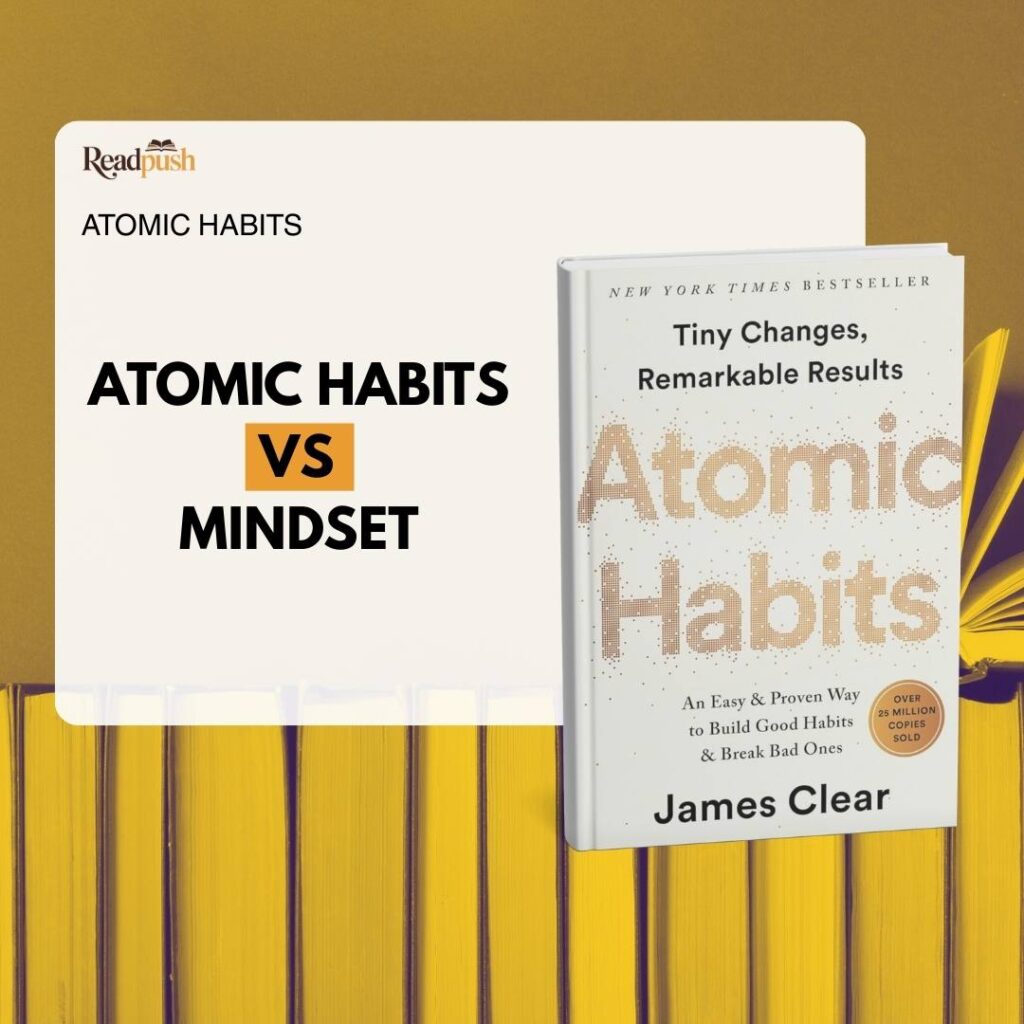
Atomic Habits, published in 2018, is organized around a single claim: that the person you become is the product of what you repeatedly do, not what you intend to do or aspire to. Clear draws on existing habit research — the cue-craving-response-reward loop that neuroscientists have been mapping for decades — and builds it into a practical system. His Four Laws of Behavior Change (make it obvious, attractive, easy, satisfying) are essentially a design checklist for your environment. The premise is that motivation is unreliable and willpower is finite, but a well-designed context can make the right behavior almost automatic.
The deepest idea in the book, the one worth sitting with, is that identity-based habits are more durable than outcome-based ones. You don’t just want to run a marathon. You want to become someone who runs. Each time you lace up your shoes, you cast a small vote for that identity. The habit is the evidence; the identity is the goal.
Mindset, published in 2006, is organized around a different claim: that the beliefs people hold about their own abilities — whether those abilities are fixed or developable — predict their behavior far more reliably than the abilities themselves. Dweck’s research spans decades and contexts: students, athletes, CEOs, couples. The fixed mindset says your qualities are carved in stone, which makes every challenge a potential verdict on your worth. The growth mindset says your qualities are starting points, which makes every challenge a source of information. The difference in behavior between people who hold these two views, Dweck shows, is substantial and measurable.
What’s worth noticing is that both books are ultimately making a psychological argument about identity. Clear says your habits shape who you become. Dweck says your beliefs about yourself determine whether you’ll let that process happen. They’re working on the same problem from different angles.
Where each one is stronger
Atomic Habits wins on practicality. The tools are concrete and immediately usable. Habit stacking, implementation intentions (“I will do X at Y time in Z place”), the two-minute rule, environment design — you can take any one of these from a chapter and apply it before you go to bed tonight. Clear also writes clearly, which sounds like a low bar but isn’t. The book is genuinely easy to move through, and the stories he uses to illustrate the system (British Cycling’s marginal gains, a writer who built her career one paragraph at a time) stay with you.
Mindset wins on depth. Dweck’s research on the consequences of praise is one of the most replicated findings in psychology: children praised for being smart become more risk-averse and less resilient than children praised for effort. That finding extends far beyond childhood. Adults in organizations where talent is treated as fixed, and not developed, show the same patterns. Dweck traces the fixed-growth distinction through relationships, sports, business, and parenting with enough specificity that it’s hard to finish the book without recognizing yourself in at least one of the examples.
One honest caveat about Mindset: the book has become so widely adopted — by schools, corporations, coaching programs — that the term “growth mindset” has been diluted into something almost meaningless. People use the phrase to mean “I believe I can improve,” when Dweck’s actual argument is more specific and more demanding. A genuine growth mindset isn’t just optimism about the future. It’s a specific relationship to failure: welcoming it as information rather than avoiding it as a threat. That’s harder than it sounds, and it takes more than reading the book once.
|
Side by side Atomic Habits vs Mindset
|
||||||||||||||||||||||||||||||||||||
The question that actually decides this
There’s a useful diagnostic question that separates who needs which book: when you try to build a new habit or take on a new challenge, where do you tend to get stuck?
If the answer is I know what I want to do, I set it up, and then I just don’t follow through — the problem is probably environmental friction or a system that’s asking too much of you too early. That’s Atomic Habits territory. The tools there are designed for exactly that gap: lowering the cost of starting, making the right behavior easier than the wrong one, building consistency before you try to scale it.
If the answer is I talk myself out of trying things I actually want to do, I feel ashamed when I fail at something, I take mistakes personally — that’s a different problem. Those are fixed-mindset patterns, and they operate at a level that habit design doesn’t reach. Rearranging your environment won’t help much if the voice in your head is telling you the effort isn’t worth it because you’re probably not good enough anyway. Mindset is the book for that layer.
In my experience with clients, people often reach for Atomic Habits when what they actually need is Mindset. It’s more comfortable to believe the problem is your system than to look at how you’re relating to failure. Systems are fixable. Beliefs feel more fundamental. But Dweck’s point, and it’s worth holding onto, is that beliefs are more changeable than they feel. They just require honest attention, not just a new morning routine.
Common misconceptions about both books
That Clear is just telling you to start small. The two-minute rule gets the most attention, but it’s not the core of the book. The core is the identity argument: that you become who you are through accumulated action, not intention. The practical tools matter because they help you accumulate the right actions consistently, but the philosophical claim is the thing worth sitting with.
That “growth mindset” means staying positive. Dweck is not writing a book about optimism. A growth mindset, properly understood, means treating failure as informative rather than defining. It doesn’t mean believing everything will work out. It means staying engaged with difficulty rather than retreating from it. That’s a harder thing to actually do than most interpretations of the book suggest.
That you have to choose one. You don’t. They’re complementary in a specific way: Mindset helps you become willing to try, and Atomic Habits gives you a better structure for what to do once you’re trying. If you only have time for one, use the diagnostic above. If you can read both, many people find that reading Mindset first and Atomic Habits second makes each book land better. Dweck opens the door; Clear helps you walk through it.
That either book is a complete solution. Neither one addresses the things that sit underneath both behavior and belief: the structural conditions of your life, the relationships that shape your sense of what’s possible, the emotional weight that some habits carry. Both books are useful tools. Neither is therapy, and neither replaces honest attention to what’s actually hard about your specific situation.
|
Which book first? A simple reading guide based on where you’re actually stuck
|
The same issue appears from another angle in The Psychology of Money vs The Power, where the question of attention, habits, and what actually changes behaviour becomes easier to see without turning the book into a slogan.
The same issue appears from another angle in Rich Dad Poor Dad vs The Total, where the money decision underneath the book becomes easier to see without turning the book into a slogan.
The same issue appears from another angle in Atomic Habits vs Mindset, where the question of attention, habits, and what actually changes behaviour becomes easier to see without turning the book into a slogan.
What they share, and why it matters
The most important thing these two books have in common is easy to overlook when you’re focused on comparing them. Both are arguing, from different starting points, that the story you tell yourself about who you are is the most powerful force in your behavior. Clear says you vote for an identity through action. Dweck says you reveal your identity through how you respond to failure. Both are saying: watch what you’re reinforcing, because it compounds.
If you’ve read the fuller analysis of Atomic Habits on this site, you’ll have seen that the identity chapter is the one Clear himself treats as foundational. Dweck would agree with why. The behaviors only hold if the identity underneath them is stable enough to support them. That’s not a small thing. It’s most of the work.
Read whichever one speaks to where you’re actually stuck. If you’re not sure, that uncertainty is itself a useful signal. Sit with it a little before you reach for a system.