Quick takeaways
- Ramsey’s seven Baby Steps work because they remove decisions, not because they’re mathematically optimal.
- The debt snowball is bad math and good psychology, and the second part matters more for most people.
- If you don’t have $1,000 saved, that’s step zero, and there is no honest reason to skip it.
- The book is best for people in financial crisis. For everyone else, half of it is preaching to the choir.
I first read Dave Ramsey’s The Total Money Makeover in my early forties, in a kitchen at five in the morning, after a year I won’t get into here. I was not the audience Ramsey writes for. I had no credit card debt. I had a paid-off truck. I had, on paper, no business reading the book. I read it anyway because a friend slid her copy across a hospital cafeteria table and said it had kept her family from coming apart.
What I’ve learned about this book, sitting with it on and off for a decade since, is that almost everything people say about it is half right. The critics are right that the math is sometimes wrong and the tone is sometimes a sermon. The fans are right that the system works, often when nothing else has. This is a summary for the reader who wants to know what the book is actually doing under the hood, what to trust, and what to take with a grain of salt.
What the book actually is
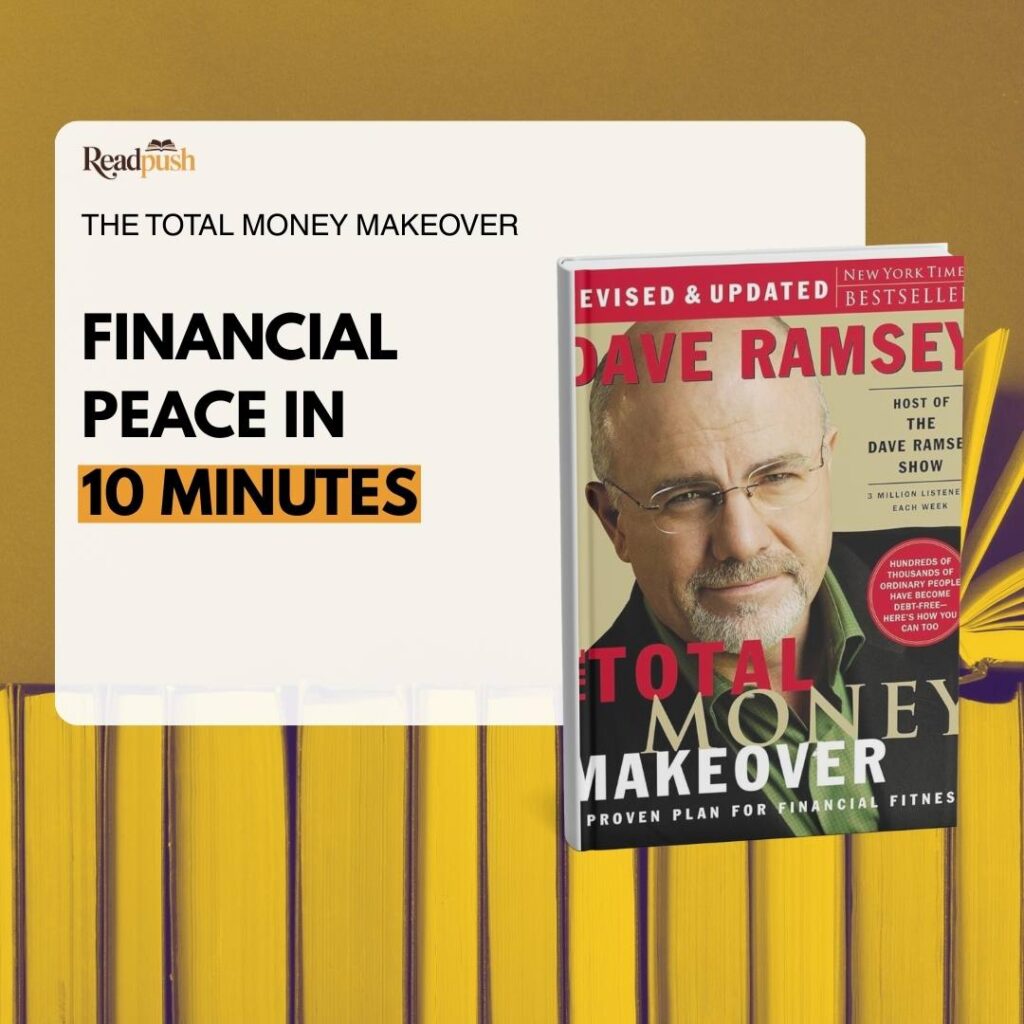
Dave Ramsey is a radio host who was bankrupt in his late twenties and built a financial-education company on the back of getting himself out. The Total Money Makeover was first published in 2003 and has sold somewhere north of seven million copies. It is not a book about investing, not really. It is a book about how to stop bleeding, and then how to build the smallest, most boring financial life that will hold.
The whole book turns on seven steps Ramsey calls the Baby Steps. Save $1,000. Pay off all non-mortgage debt smallest to largest. Build a three-to-six-month emergency fund. Invest 15 percent of household income for retirement. Save for the kids’ college. Pay off the house. Then build wealth and give. The order matters more than any single step.
|
The Total Money Makeover Ramsey’s 7 Baby Steps — in order
|
The four ideas that actually hold up
1. Behavior beats math, and that’s not a problem
The most useful thing Ramsey ever wrote is that personal finance is 80 percent behavior and 20 percent head knowledge. Critics like to point out the percentages aren’t from any study. They’re not wrong. They’re also missing the point. The reason this book has helped more families than a hundred better-written investing primers is that Ramsey understood, early, that the problem most people have with money isn’t a knowledge problem.
I watched a lot of families in financial trouble across twenty-eight years of hospice work. Almost none of them needed a better spreadsheet. They needed a way to stop the spreadsheet from being a source of fights and shame. Ramsey gives them that. The math people who object to him are mostly arguing from a position where the math has never been the hard part.
2. The debt snowball, defended honestly
The debt snowball is Ramsey’s most argued-about idea. You list every non-mortgage debt smallest to largest, and you attack the smallest first, regardless of interest rate. A finance professor will tell you this is mathematically inferior to the avalanche method, where you pay the highest interest rate first. The finance professor is correct.
There’s a 2012 study out of Northwestern’s Kellogg School, by David Gal and Blakeley McShane, that looked at actual debt-payoff behavior in a real-world dataset. People who paid off small balances first were more likely to eliminate their total debt. The mathematically inferior method beat the optimal one in practice, because the optimal one quit on people halfway through. You can read Kellogg’s summary of the study if you want the details. If you want the deeper argument for why small wins create financial breakthroughs, that piece covers it more fully.
I’ve watched both methods in real households. The snowball wins for the same reason quitting smoking by halving the daily count rarely works. Momentum is its own form of motivation, and most people don’t have enough willpower lying around to spend it on a method they hate.
3. The starter fund and the order of operations
Step one is to save $1,000 before you do anything else, including aggressively paying down debt. This is, in my view, the single most underrated idea in personal finance. A family without any savings is one transmission failure away from a new credit card. A family with even a small cushion has a chance.
In its 2024 report on household economics, the Federal Reserve found that 63 percent of American adults could cover a hypothetical $400 emergency expense with cash or its equivalent, which is the same as saying 37 percent could not. That 37 percent is the audience Ramsey is writing for. For them, step one is not a baby step. It’s the largest behavioral leap in the whole book.
4. Peace as the actual goal
The phrase “financial peace” gets thrown around like a brand line, and Ramsey has built a company on it. But underneath the marketing, the idea is correct, and it’s the part of the book that has stayed with me the longest. The goal of all this work is not to die rich. The goal is to spend less of your one short life worrying about money, fighting with your spouse about money, lying awake at three in the morning doing the mental math one more time.
I’ve sat with a lot of dying people. None of them, in my hearing, wished they’d had more in their 401(k). Several wished they’d fought less about it.
Where the book doesn’t hold up
The honest part of any summary is the part that admits what doesn’t work. There’s a fair amount of that in The Total Money Makeover.
Ramsey’s investment advice is, to put it gently, not great. He recommends “good growth stock mutual funds” and claims you can plan on a 12 percent average return. That number comes from a generous reading of long-run stock market data and ignores both fees and sequence-of-returns risk. Most serious advisers will tell you to plan on 6 to 7 percent real, after inflation. Build a retirement on Ramsey’s 12 percent assumption and you will end up short.
He’s also hostile to credit cards in a way that doesn’t make sense for everyone. If you have a debt problem, no cards. Reasonable. If you’re not the kind of person who carries a balance, a no-fee cashback card used like a debit card is fine, and the disciplined refusal of it costs you a couple of hundred dollars a year for no real benefit. The book treats this nuance as moral weakness. It isn’t.
And then there’s the tone. The book is, in places, a sermon. Ramsey leans on his evangelical Christian framing, and depending on the reader, that’s either home or a closed door. I don’t begrudge him his audience. If the church-adjacent language gets in your way, skim past it. The system underneath does not depend on it.
Common misconceptions about The Total Money Makeover
It’s an investing book. It isn’t. It’s a behavioral debt-elimination and stability book with a thin investing chapter bolted on. The investing chapter is the weakest part. Read it for the steps; get your investing education elsewhere.
The system is mathematically optimal. It isn’t, by design. The snowball is slower than the avalanche. The 15 percent retirement rule is rough. The system trades a few percentage points of efficiency for a much higher follow-through rate, and for most readers that’s the right trade.
You have to agree with Ramsey’s politics or religion for the book to work. You don’t. The seven Baby Steps work fine for atheists, agnostics, and people who disagree with him on every other subject. The system is downstream of behavioral psychology, not theology.
It’s for people with low incomes. The book reaches toward people in financial trouble most clearly, but I’ve watched high earners with high incomes and high debt benefit from the same discipline. Income is not the variable. Behavior is.
|
Honest assessment What holds up — and what to read around
|
||||||||||||||||
The same issue appears from another angle in Your Money or Your Life, where the money decision underneath the book becomes easier to see without turning the book into a slogan.
The same issue appears from another angle in What This Is Marketing by Seth Godin, where the marketing problem behind the framework becomes easier to see without turning the book into a slogan.
The same issue appears from another angle in Atomic Habits, where the question of attention, habits, and what actually changes behaviour becomes easier to see without turning the book into a slogan.
What to do with this book if you read it
If you’re in any kind of financial trouble, read the book. Don’t argue with the tone. Don’t research alternatives for three weeks before starting. Save your thousand dollars, list your debts smallest to largest, and start. The system is not perfect. It will be more perfect than what you’re doing now.
If you’re already past the survival stage, the book has less to offer, and you’d be better served by something like JL Collins’s The Simple Path to Wealth or Morgan Housel’s work. Our summary of The Psychology of Money covers the behavioral side of investing in a way that picks up where Ramsey leaves off. Pair the two, and you have most of the personal finance education a person actually needs between two short books.
One more thing. Whatever system you pick, give it a year before you decide whether it works. Not a week. A year. Most things that work in life work slowly, and quietly, and on a timeline that is longer than the one we wish we were on.