Quick takeaways
- The whole book is a variation on one idea: stop trying to reach the most people and start serving the right people well enough that they do your marketing for you.
- The smallest viable market is a strategy, not a fallback. It requires you to consciously ignore most of your potential audience. That is harder than it sounds.
- Permission marketing compounds. Paid attention rents. Know which one you are building.
- The book is a philosophy, not a playbook. Read it for the mindset. Build the actual skills somewhere else.
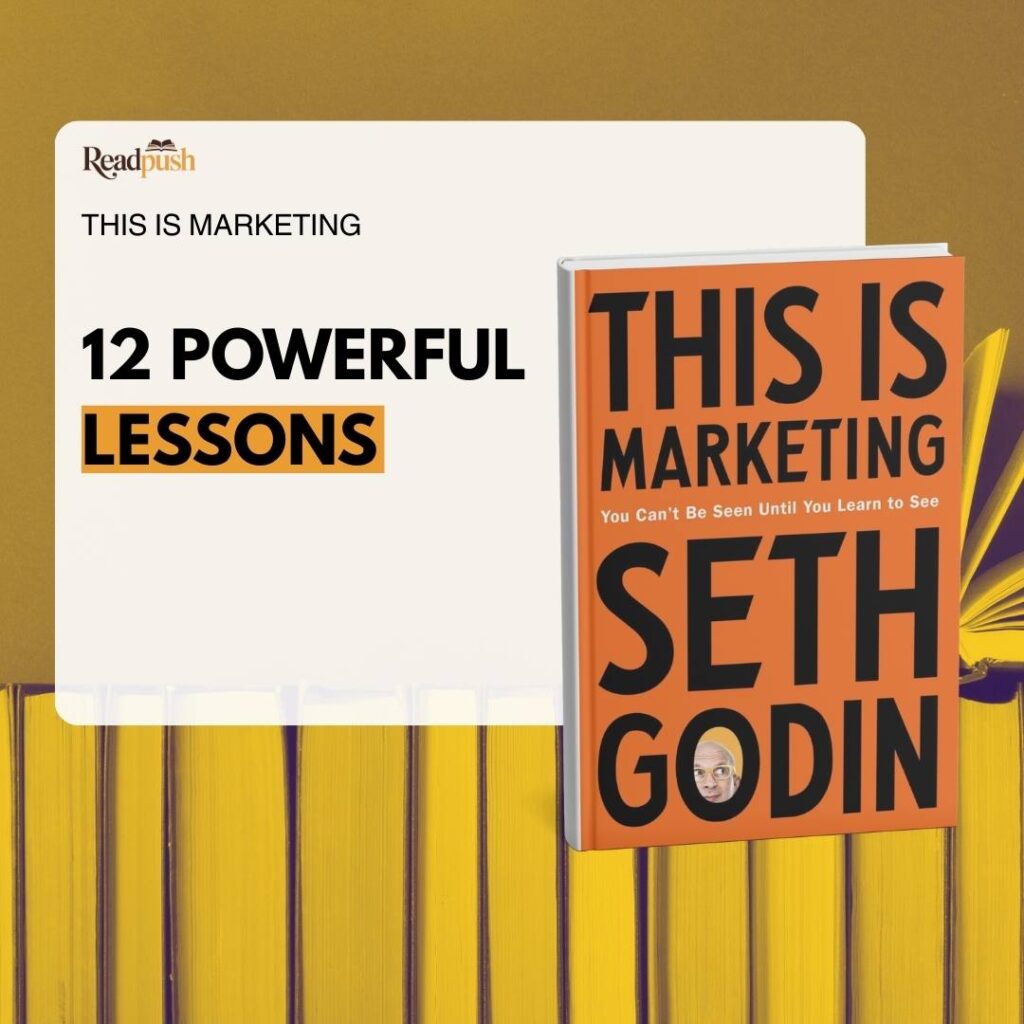
Seth Godin has written a lot of books. Some of them are essentially the same book with a different cover. This Is Marketing is the one where he finally just says the thing directly, without quite as much fable-wrapping as usual. That makes it worth reading. It also makes it easy to summarize badly, which is how you end up with twelve bullet points that sound like a motivational poster and miss the point entirely.
Here is the actual point: marketing is not about reaching the most people. It is about finding the right people and making something that genuinely changes them. Everything else in the book is a variation on that.
What follows are the lessons worth keeping, written without the “How to Apply This” bullet structure that turns real ideas into checklists nobody uses. If you want a tighter overview of the book’s core argument first, the full This Is Marketing summary covers the spine of it before you go deeper.
Marketing is the work of making change happen
Godin’s opening argument is that marketing is not about interruption, shouting, or getting attention through volume. It is about identifying a group of people who want to change something about their lives, and making that change possible.
This sounds obvious until you watch most actual marketing, which is basically “we exist and have a thing, please notice us.” That is not marketing. That is announcing. The difference matters because announcing is easy to do and nearly impossible to measure, while change-making requires you to be specific about who you are serving and what is different for them after they find you.
Godin’s version of marketing asks an uncomfortable question: what does your customer’s life look like after they interact with you? If you cannot answer that specifically, you are announcing.
The smallest viable market is a strategy, not a consolation prize
Every marketer has heard “niche down” so many times it has lost all meaning. Godin’s version of this is sharper. The smallest viable market is the smallest group of people for whom your work is remarkable, and your job is to serve them so well that they cannot stop talking about it.
The reason this works is not mystical. It is structural. If you try to speak to everyone, your message has to be so generic that it moves no one. If you speak to a hundred people who feel like you made something specifically for them, those hundred people do your marketing for you. The math of word-of-mouth favors the focused.
The hard part of this lesson is that it requires you to consciously ignore most of your potential market. Most people can say they believe in niching. Far fewer can actually watch a large potential audience and walk away from it. Godin is asking you to do that on purpose, as a strategy, not as a failure mode. That is a harder sell than it looks.
Empathy first, message second
Here is the thing about empathy in marketing: most people mistake it for friendliness, or for writing copy in a casual tone. That is not what Godin means.
Real empathy in marketing means understanding your audience’s worldview well enough to know what they already believe, what they are afraid of, and what kind of change they are actually looking for (which is often not the change they say they are looking for). You cannot talk someone into a worldview they do not already hold. You can only find where their worldview and your offer overlap and start there.
This is why market research done well beats copywriting skill almost every time. If you know exactly what your customer believes about their problem, you do not have to be clever. You just have to be accurate.
Your story has to match their story
People do not evaluate marketing rationally. They check whether it fits the story they already tell about themselves. A premium product marketed to someone who sees themselves as savvy and frugal will not land, no matter how good the copy is. The product is asking them to be someone they are not.
Godin’s argument is that effective marketing finds the narrative your audience already holds and positions your offer as the next chapter, not a challenge to the story they have been living. You are not trying to change their mind. You are trying to show them that your thing is consistent with who they already are.
This is why signals and symbols matter more than most marketers admit. The aesthetic, the language, the people you visibly serve: all of it communicates who this is for before anyone reads a word of your copy. Get the signals wrong and the right people will not self-select in. Get them right and you barely need a pitch.
Tension is a feature, not a flaw
A lot of marketers are so scared of making people uncomfortable that they sand every edge off their messaging. Godin’s point is that this removes the thing that actually drives action.
Change requires tension. People move when they feel the gap between where they are and where they could be. If your marketing eliminates that tension in the name of being friendly and non-threatening, you eliminate the motivation to act. The goal is not to make people anxious. It is to make the gap visible and then show them a way across it that feels achievable.
Comfortable marketing does not move people. It gets scrolled past.
Permission is earned, not assumed
Godin has been writing about permission marketing since 1999, and the idea has only gotten more relevant. The core of it: people you have permission to contact are infinitely more valuable than people you are interrupting. They expect to hear from you. They have opted in. They are already somewhat bought in.
The implication is that the goal of most marketing should be to convert strangers into people who want to hear from you, rather than to sell them something on the first contact. This is a long game. It is also the game that compounds, because an audience that wants to hear from you gets easier and cheaper to serve over time, while an audience you are constantly interrupting gets more expensive and less responsive.
Most paid advertising is an attempt to shortcut this process. It works, sometimes, for specific things. But it is worth being clear about what you are trading: you are renting attention rather than building it. The moment you stop paying, the attention goes away.
Trust is built slowly and destroyed quickly
This lesson is not unique to Godin. But his version of it is worth noting because he frames it around consistency rather than quality. It is not that you have to be excellent every time. It is that you have to be reliably yourself every time. People trust what they can predict. The case for consistency as the foundation of trust goes further into this idea if it is landing for you.
The practical version of this is that brand consistency matters more than most marketers give it credit for. Inconsistency in tone, in positioning, in the promises you make, is corrosive in ways that are hard to see until the trust is already gone.
Tribes form around shared language, not shared demographics
The word “tribe” has been so thoroughly mined for marketing content that it now triggers eye-rolls, which is unfortunate because the idea underneath it is genuinely useful.
Godin’s point is that communities form around shared ways of seeing the world, shared vocabulary, shared enemies, and shared aspirations. Demographics are a lazy proxy for this. Age and income do not create community. Shared belief does. The question for your brand is not “who is my target demographic?” It is “what do the people I serve believe that most people do not?” Find that, name it, and let it become the organizing principle of your community.
Ship before you are ready
The last lesson is the one Godin has been arguing for twenty years and that still gets ignored at scale. Waiting for perfect is a strategy for never shipping. The feedback you need to improve does not exist until you have put something in front of real people. The version in your head is not the version that needs feedback. The version you shipped last Tuesday is.
This is not an argument for carelessness. It is an argument that “ready” is a moving target that recedes as you approach it. Ship the thing. Find out what is wrong with it. Fix that. Ship again. Iteration beats planning at nearly every stage.
|
This Is Marketing Eight lessons. One underlying argument. Everything else is elaboration.
|
||||||||||||||||||||||||||||||||
The same issue appears from another angle in Money Master the Game, where the money decision underneath the book becomes easier to see without turning the book into a slogan.
The same issue appears from another angle in The Startup Community Way, where the business trade-off the book is trying to clarify becomes easier to see without turning the book into a slogan.
The same issue appears from another angle in The Total Money Makeover, where the money decision underneath the book becomes easier to see without turning the book into a slogan.
What the book gets right and where it runs thin
Look, This Is Marketing is a good book. Better than most things in its category, and Godin is one of the few people in this space who has actually built multiple things of real value, so when he talks about what marketing is, he is speaking from a track record, not a theory.
Where it goes thin is the “how.” Godin is excellent at reframing what you should be doing and why. He is less useful on the mechanics of actually doing it. You will finish the book convinced that you should be serving the smallest viable market and building permission and telling stories that match your audience’s worldview, and you will have a somewhat vague sense of where to start.
That is not a fatal flaw. It just means the book is better as a philosophy than a playbook. Read it for the mindset. If you want something more mechanical to pair alongside it, the 1-Page Marketing Plan is a reasonable tactical companion. Different book, much more operational, and the two together cover most of what a small business marketer actually needs.
|
Honest verdict What This Is Marketing does well, and where to look for what it does not
|
||||||||||||
Do the thing. The book is not magic. The thing is.