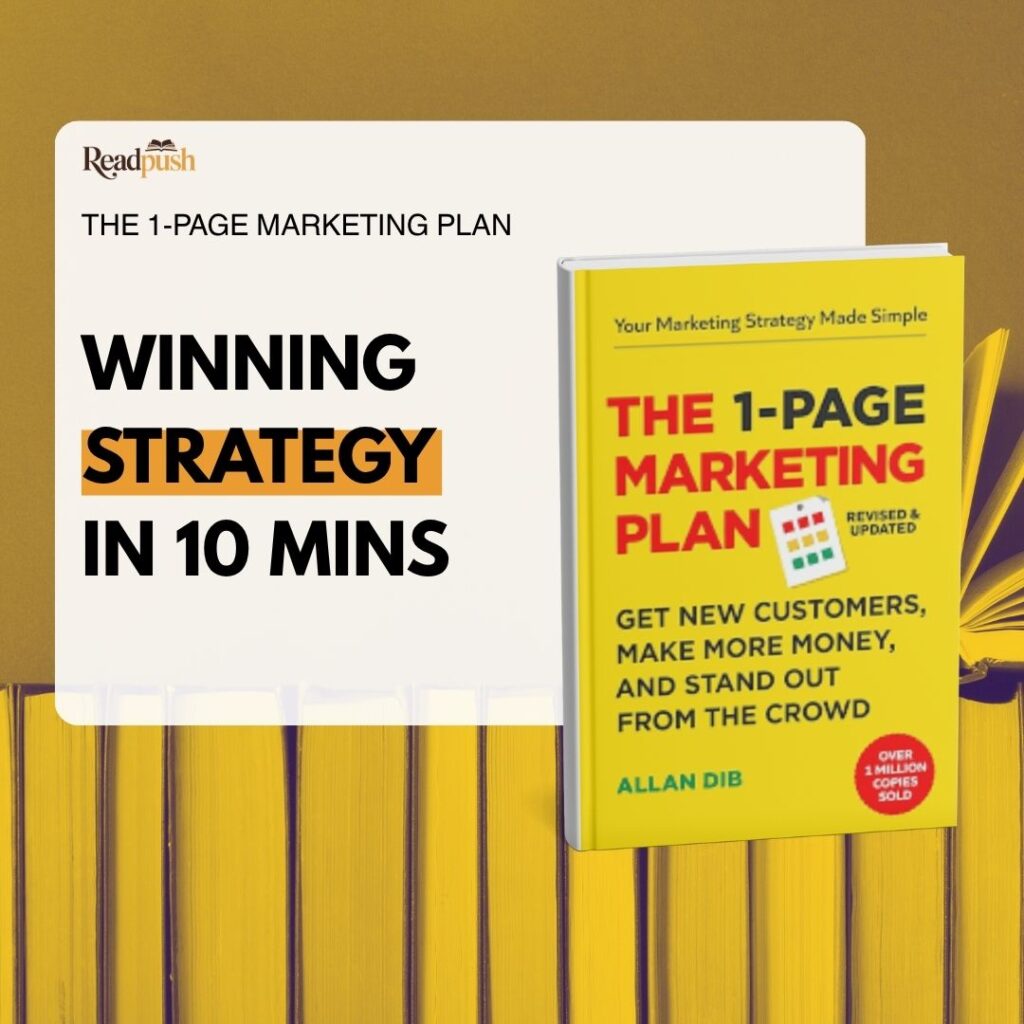
Allan Dib’s The 1-Page Marketing Plan turned complex marketing strategies into one simple page and helped thousands of entrepreneurs finally get results. This book shows how to attract leads, convert them into loyal customers, and grow a profitable business without wasting time or money. It’s ideal for small business owners, freelancers and marketers who want clarity and direction. For a complete breakdown, see our full review of The 1-Page Marketing Plan.
About the book
Allan Dib is an entrepreneur and marketing consultant known for helping small businesses scale with practical, no-fluff strategies. Published in 2016, The 1-Page Marketing Plan remains relevant because it simplifies modern marketing into an actionable framework anyone can follow. The book targets business owners who want to stop guessing and start executing an actual marketing system that drives profit.
Main concepts
Concept 1: The power of having a real plan
Most businesses rely on random marketing actions posting on social media, running ads, or emailing clients without a plan. Dib insists that real marketing success comes from following a structured process that guides every step, from lead generation to retention.
He uses the metaphor of a flight plan: you wouldn’t fly without one, so why run your business without a marketing roadmap
Takeaway: Clarity beats chaos. When you know your audience, offer, and message, every marketing decision becomes faster and more effective.
Concept 2: The 3 phases of marketing
Dib breaks down marketing into three stages: Before, During, and After.
- Before phase: Attract attention from people who don’t know you yet.
- During phase: Turn interested leads into paying customers.
- After phase: Deliver a great experience and turn customers into promoters.
Each phase has a specific goal and set of actions, helping you build momentum instead of chasing random tactics.
Takeaway: Marketing doesn’t stop at the sale, it’s a continuous system that builds trust and referrals.
We explore how to turn customers into loyal promoters in our analysis of customer lifecycle marketing.
Concept 3: Crafting your target message
In Dib’s view, most marketing fails because it talks to everyone and resonates with no one. The key is to define your target market and message-to-market match.
He recommends creating a clear customer avatar and addressing their biggest pain point directly in your messaging. For example, instead of “We offer accounting services,” say “We help small business owners stop losing money to tax mistakes.”
Takeaway: Speak the language of your ideal customer and they’ll instantly feel understood.
To dive deeper into messaging, see our analysis of storytelling and brand positioning.
Concept 4: Building a lead nurturing system
Dib emphasizes that most sales are lost because businesses stop communicating too early. A structured follow-up system through emails, value-based content, or personal outreach keeps prospects warm until they’re ready to buy.
He shares an example of a real estate agent who built trust through weekly market tips and doubled her conversion rate in six months.
Takeaway: Consistent, valuable communication converts curiosity into commitment.
Concept 5: Delivering a world-class experience
Once someone buys, the real marketing begins. Dib insists that customer satisfaction and retention drive more profit than constant new lead generation. Create systems for onboarding, feedback, and surprise value moments.
For example, sending a handwritten thank-you note or offering a loyalty bonus can turn a one-time buyer into a lifelong fan.
Takeaway: The best marketing is a delighted customer telling others about you.
Key frameworks
At the heart of The 1-Page Marketing Plan is Dib’s nine-box framework, which fits on one sheet of paper. Each box represents one step in the three phases of marketing from defining your target market to building repeat business. This structure helps you see your entire strategy at a glance and spot gaps fast.
For step-by-step implementation, follow our guide on how to apply the 1-Page Marketing Plan framework.
Key takeaways
- Clarity always beats tactics. Build a system, not random marketing actions.
- Know exactly who your target customer is before writing a single ad.
- Craft messages that focus on solving one painful problem.
- Build a follow-up process that adds value and keeps leads warm.
- Deliver more than expected to turn buyers into advocates.
- Track what works and cut what doesn’t marketing is about testing.
- Use your one-page plan daily to stay focused and accountable.
- Remember: marketing doesn’t end with a sale, it starts there.
Bottom Line
The 1-Page Marketing Plan is one of the most practical marketing books for entrepreneurs who crave clarity and results. It strips away theory and gives you a map to build a real system that attracts, converts, and delights customers. If you want to stop guessing and start growing, this book is your shortcut to smarter marketing.
To dive deeper, explore our complete breakdown of 10 lessons from The 1-Page Marketing Plan, and our analyses of customer lifecycle marketing and brand storytelling for a full picture of how to apply its ideas in your business.
What this idea changes in practice
The useful way to read this piece is not as a shortcut around the book, but as a way to decide what the book is really asking you to notice. The 1-Page Marketing Plan is easy to reduce to a phrase. The phrase is helpful, but it is also where many readers stop too early.
The practical question is: what changes after you understand the idea? If the answer is only that you can repeat the concept in a meeting, the idea has not done much work yet. A good business or self-improvement book should change a decision, a habit, a conversation, or a way of measuring progress.
For this article, the change is usually smaller and more concrete than the headline suggests. You stop treating the concept as an inspirational lesson and start using it as a filter. It helps you decide what to ignore, what to inspect more closely, and where your current approach may be wasting effort.
That is where ReadPush readers get the most value. Not from another summary, and not from pretending the book is perfect. The value is in separating the durable idea from the noise around it.
Where readers often get it wrong
The common mistake is to treat the book’s central idea as universal. Most book ideas are not universal. They are conditional. They work better for some people, teams, markets, and seasons than others.
That does not make the idea weak. It makes it usable. Advice becomes more useful when you know its boundary. A habit system helps when your life has enough stability to support repetition. A strategy framework helps when the market conditions match the assumptions behind the framework. A finance lesson helps when it is applied to the right kind of risk, not every risk.
So the better reading is not, is this book right? The better reading is, where is this book right, and what would make it wrong for me? That question protects you from two bad habits: dismissing useful books because they are imperfect, and overusing famous books because they sound confident.
If you take only one thing from this article, take that discipline. Apply the idea where the conditions fit. Leave it alone where they do not.
How to apply the lesson without overcomplicating it
Start with one decision. Do not turn the book into a whole operating system on day one. That is how good ideas become heavy.
- Name the problem. What are you actually trying to improve: focus, growth, cash flow, consistency, leadership, decision quality, or something else?
- Pick the relevant principle. Choose one idea from the book that speaks directly to that problem.
- Define the test. What would look different after two weeks if the idea is working?
- Review the result. Keep what helped. Drop what added friction.
This keeps the lesson grounded. You are not trying to become the kind of person who has mastered the whole book. You are trying to make one part of your work or life less vague.
The same issue appears from another angle in The Page marketing plan vs building storybrand, where the marketing problem behind the framework becomes easier to see without turning the book into a slogan.
The same issue appears from another angle in How to increase company value using trade, where the business trade-off the book is trying to clarify becomes easier to see without turning the book into a slogan.
The same issue appears from another angle in powerful lessons from good to great for, where the business trade-off the book is trying to clarify becomes easier to see without turning the book into a slogan.
A better final takeaway
The strongest books on ReadPush are rarely the ones that give the neatest answers. They are the ones that improve the quality of your next question. The 1-Page Marketing Plan is worth returning to for that reason.
Ask what the idea reveals. Ask what it hides. Ask what it would look like in a normal week, with normal constraints, limited time, and imperfect follow-through. If the idea still helps there, it is probably worth keeping.
That is the standard. Not whether the book sounds impressive. Whether it survives contact with real life.
What to reread in the original book
If you go back to the source, reread the chapters around the core framework rather than the promotional parts around it. Most business and personal development books repeat themselves. The useful material is usually clustered where the author explains the mechanism: why the idea works, when it fails, and what kind of behaviour it is meant to change.
When you reread, mark examples differently from principles. Examples are there to clarify. Principles are there to travel. Trouble starts when readers copy the example and miss the principle underneath it.
That distinction is especially important with The 1-Page Marketing Plan. The surface lesson is easy to remember. The deeper value comes from noticing the assumptions behind the lesson. Once you see those assumptions, you can apply the idea with more judgement and less imitation.
Who should spend more time with this idea
This idea is most useful for readers who are already dealing with the problem the book describes. If the problem is theoretical for you, the lesson may sound clever and then disappear. If the problem is active, the lesson has somewhere to land.
That is why timing matters with books. The same chapter can feel obvious at one stage of life and quietly important at another. You are not only reading the book. You are reading it from a particular set of pressures.
Use that to your advantage. If the article made something feel uncomfortably familiar, that is probably the part to inspect first.