Quick takeaways
- Habit failure is almost always a design problem, not a character problem. The four laws give you specific questions to ask instead of “try harder.”
- Law 3 (make it easy) is the most underestimated. Friction compounds quietly. Reducing it matters more than motivation.
- The laws work in reverse too. To break a habit, make it invisible, unattractive, difficult, and unsatisfying. No willpower required.
- The framework tells you how to build habits. It does not tell you which ones to build. That question still comes from you.
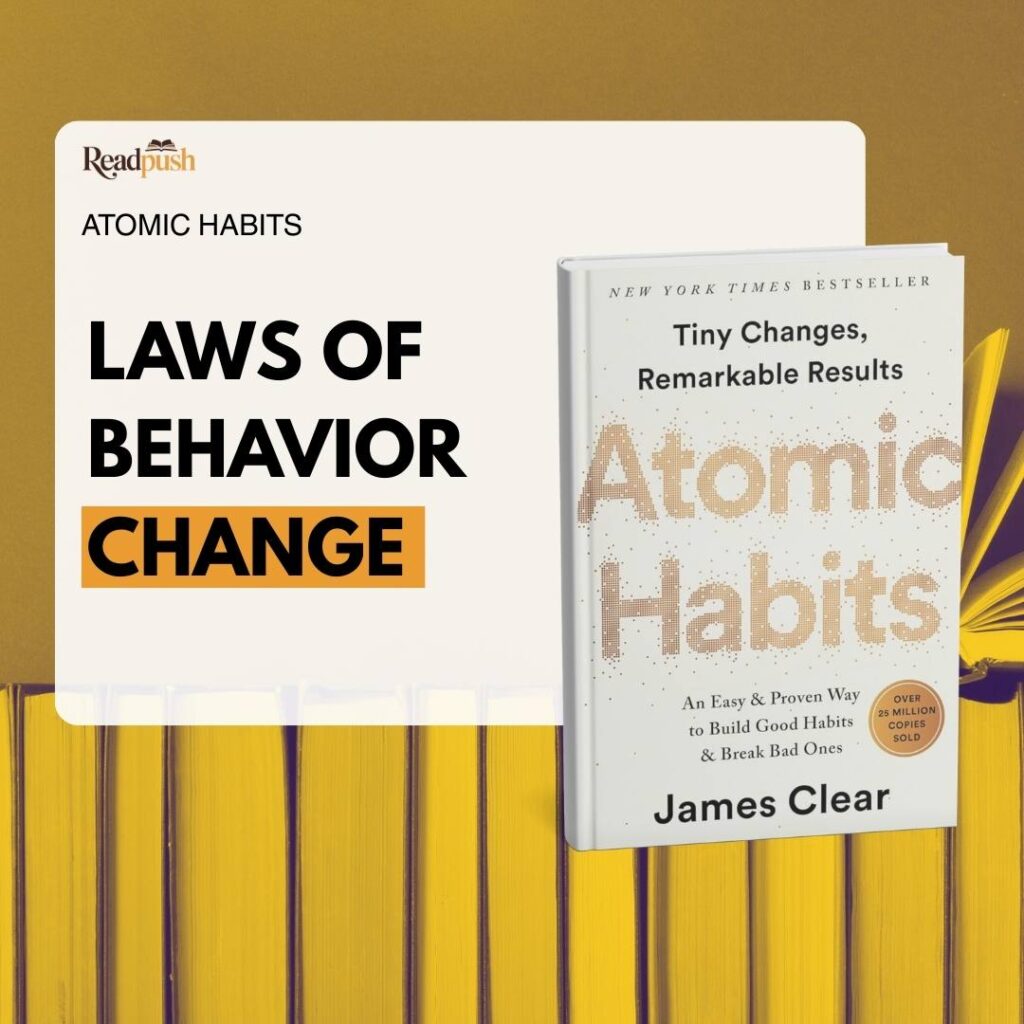
Most people who struggle with habits think the problem is them. They are not disciplined enough, not consistent enough, not the kind of person who sticks with things. What James Clear argues in Atomic Habits, and what I find genuinely useful, is that the problem is almost never the person. It is the design.
The four laws of behavior change are Clear’s attempt to make habit design legible. Not motivational, not abstract. Legible, in the sense that you can look at a habit that is not working and ask a specific question about why, and usually find a specific answer. That is rarer than it sounds.
First, the habit loop
Before the four laws make sense, it helps to understand what they are operating on. Every habit, Clear explains, runs through the same four-stage cycle: cue, craving, response, reward. The cue triggers a craving. The craving motivates a response. The response delivers a reward. The reward reinforces the cue.
This loop runs constantly, for almost everything you do automatically. The phone buzz that pulls your hand toward your pocket. The afternoon slump that sends you toward coffee. The end of a long day that makes the couch feel non-negotiable. None of these feel like habits because you are not deciding. That is the point. Habits, by definition, do not require decisions.
The four laws correspond to each stage of this loop. Get all four right, and a habit tends to stick. Get even one wrong, and it tends to fade. That is why “try harder” does not work. It addresses none of the four stages.
|
The Habit Loop Four stages. Four laws. One for each.
|
||||||||||||||||||||||||
Law 1: make it obvious
The first law is about cues, which means it is about your environment more than your intentions. We respond to what is visible, present, and associated with a context we are already in. This is not a flaw. It is just how attention works.
The practical implication is that you can make a habit more likely to happen by making its cue more obvious. Put the book on your pillow. Keep the running shoes by the front door, not in the wardrobe. Set your journal on the kitchen table where you sit with your morning coffee. The habit does not need to become more important. The cue just needs to be harder to miss.
Habit stacking is a version of this worth knowing: attaching a new behavior to an existing one so that the existing routine becomes the cue. “After I sit down with my morning coffee, I will write for ten minutes” uses something you already do reliably as the trigger for something you are trying to build. It borrows the momentum of an established habit rather than starting from nothing.
The reverse also applies. If you want to reduce a habit, make its cue less visible. Move the thing that triggers it. Change the context. You are not relying on willpower. You are reducing the number of times willpower even needs to show up.
Law 2: make it attractive
The second law is about craving, which is where desire lives. Desire, Clear points out, is not really about the action. It is about the anticipated reward. What makes a habit attractive is the feeling it promises, before the behavior even happens.
This is why willpower is such an unstable foundation. Willpower overrides desire. But if the habit feels like a chore and you are relying on willpower to do it anyway, you are fighting yourself every time. That is exhausting. And exhausted people stop.
Temptation bundling is Clear’s practical answer: pair the thing you need to do with something you genuinely want. Only listen to the podcast you love while doing the admin task you keep putting off. Only allow yourself the coffee shop you like when you are working on something difficult. The pleasant thing makes the necessary thing feel worth starting.
Social environment matters here too. We are drawn, whether we notice it or not, toward the behaviors that are normal in our group. If the people around you treat exercise as non-negotiable, the pull toward skipping it is weaker. This is not peer pressure in the anxious sense. It is just that habits feel more attractive when they are modeled by people we respect or identify with.
Law 3: make it easy
This is the law people most often underestimate, possibly because “make it easier” sounds like lowering your standards. It does not. It acknowledges something true about how behavior works: the harder a thing is to start, the less often it gets started. Friction is not neutral. It compounds.
The two-minute rule is the most practically useful version of this law. Scale the habit down until the starting version takes two minutes or less. Not “meditate for twenty minutes” but “sit down and take three conscious breaths.” Not “write the article” but “open the document and write one sentence.” The goal is not two minutes of work. The goal is to begin, because beginning is what most people cannot reliably do when they are tired or busy or not in the mood.
What is worth noticing is that this is not about being easy on yourself. It is about being honest about when resistance happens. Resistance almost always happens at the start. Once you are doing the thing, doing more of it is much less difficult. Two minutes in, the twenty-minute meditation usually continues. The one sentence often becomes a paragraph. The law is not telling you to do less. It is telling you to remove the reason not to begin.
Environment design is the other side of this. Every extra step between you and a habit is a small tax on the behavior. Reduce the steps. Have the equipment out, the app ready, the space prepared. Make the friction as close to zero as possible for the habits you want, and deliberately increase it for the ones you are trying to break.
Law 4: make it satisfying
The last law is the one most often skipped, and it is the one that most directly determines whether a habit survives.
The brain learns through immediate feedback. What gets repeated is what felt rewarding, recently. Not in six months when the goal is achieved. Now, or close enough to now that the connection between action and reward is clear. This is why so many long-term habits fail: the payoff is so deferred that the daily action feels, in the moment, pointless.
This does not mean you cannot build habits with delayed rewards. It means you need to engineer some form of satisfaction that is immediate, in addition to the eventual outcome you are working toward. Tracking is one way to do this. Crossing something off a list, marking a day on a calendar, watching a streak extend. These are small satisfactions, but they are real ones, and the brain registers them as evidence that the behavior is worth repeating.
Celebration works too, though it sounds more awkward than it is. A small internal acknowledgment, “I did the thing,” said with some genuine feeling, is not as silly as it might seem. It is a signal. Over time, those signals accumulate into something that starts to feel like identity: the sense that you are the kind of person who does this.
Using the laws in reverse
Clear makes the point that the same four laws work in both directions. To break a habit, reverse them: make it invisible (remove the cue), make it unattractive (reframe what it offers), make it difficult (add friction), make it unsatisfying (create accountability or consequences).
This is useful because it means you do not have to fight a bad habit through willpower. You redesign around it. Remove the cue so the craving does not start. Add enough friction that the response requires real effort. Make the reward less reliable. The habit does not need to be forbidden. It just needs to be harder than the alternative.
The same issue appears from another angle in Identity Based Habits, where the question of attention, habits, and what actually changes behaviour becomes easier to see without turning the book into a slogan.
The same issue appears from another angle in Atomic Habits Quotes, where the question of attention, habits, and what actually changes behaviour becomes easier to see without turning the book into a slogan.
The same issue appears from another angle in Atomic Habits vs Tiny Habits, where the question of attention, habits, and what actually changes behaviour becomes easier to see without turning the book into a slogan.
What this framework does and does not do
The four laws are genuinely helpful. They give you specific questions to ask when a habit is not working, and specific adjustments to try, rather than just “be more consistent” or “want it more.”
They work best as a diagnostic. If a habit is failing, run through the laws: Is the cue clear? Is the behavior attractively framed? Is the starting friction low enough? Is there any immediate reward? Usually one of those is the weak point, and addressing it is more effective than resolving to try harder. For a fuller picture of how these laws sit inside the broader argument of the book, the ten lessons from Atomic Habits covers each one with a practical application you can act on this week.
What the laws do not do is tell you which habits to build. That is a different question, and probably a more important one. The four laws are design tools. What you design toward still comes from you.
If you have been treating habit failure as a character problem, it might be worth trying it as a design problem instead. The questions are more answerable. And the answers are usually more useful.
|
Diagnostic checklist If a habit is failing, run through these four questions first
|
||||||||||||||||||||||||