Quick takeaways
- Clear isn’t making a motivational argument. He’s making a design argument. The difference changes what you actually do with the book.
- The identity lesson is the one most people resist and the one that tends to do the most work once they stop resisting it.
- The plateau of latent potential is the most important concept for anyone who’s tried to build a habit and quit before it worked.
- Start with one lesson — the one that felt most like something you already half-knew but hadn’t quite acted on yet.
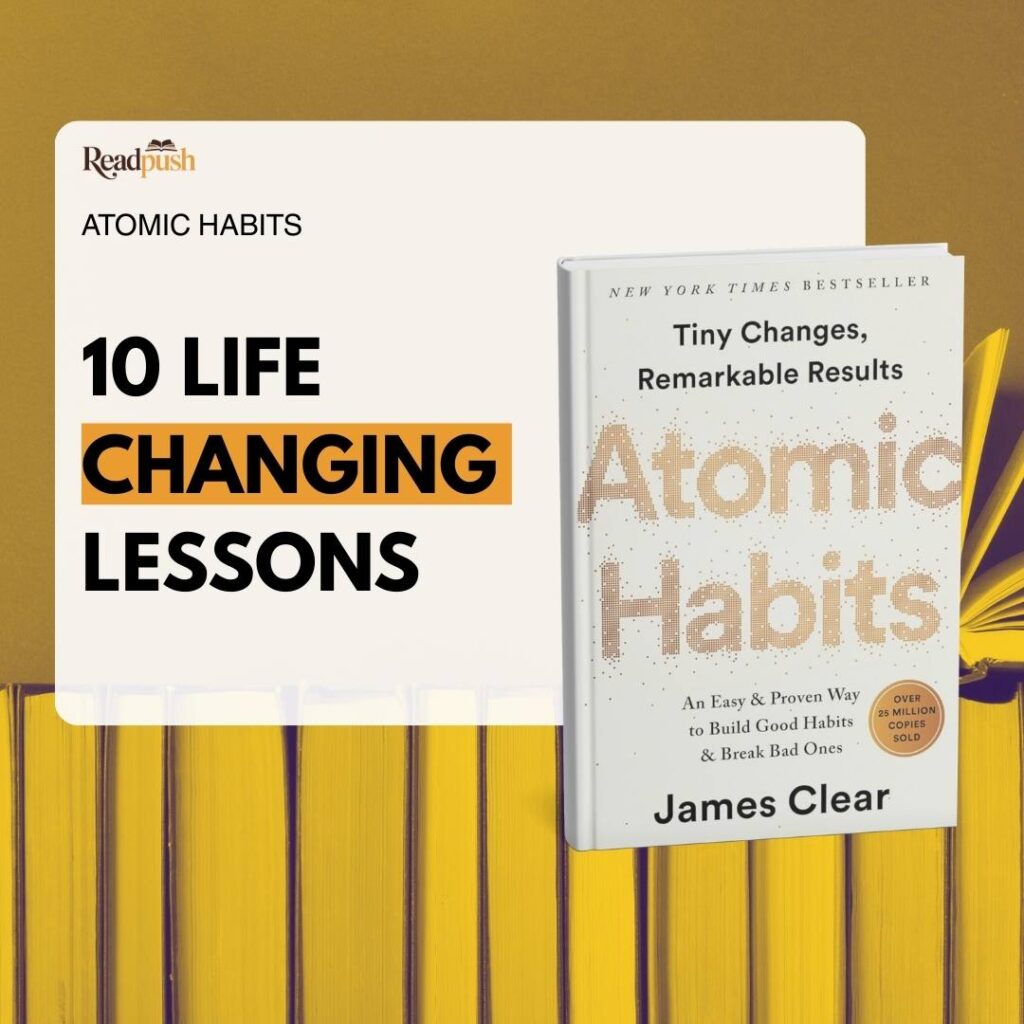
There’s a particular type of book that gets recommended so often it starts to lose meaning. Atomic Habits is one of those. It shows up on every productivity list, every founder’s reading stack, every “books that changed my life” thread. And because of that, it’s easy to assume you already know what it says.
You probably don’t. Or at least, not in the way that actually changes anything.
James Clear isn’t offering a motivational framework. He’s making a quieter argument: that most of us are trying to change the wrong thing. We focus on outcomes when the real leverage is in systems, on results when the real question is identity, on willpower when the real variable is environment. The ten lessons below are the ones worth sitting with — not just nodding at.
Lessons on building a foundation
Lesson 1: small habits create big results
Clear’s central claim is that a 1% improvement each day compounds into something unrecognizable over a year. Not 1% better at one big thing — 1% better at the small repeated actions that make up the work.
What’s worth noticing is how counterintuitive this is to most professional cultures, which reward visible effort, big launches, and dramatic pivots. The compounding Clear describes is invisible for a long time. It looks, from the outside, like nothing is happening. That’s part of why people abandon it.
If you want to apply this: pick one process in your work that happens every day and identify one small thing that would make it marginally better. Not a reinvention — a small upgrade. Then do that for thirty days before looking for results.
Lesson 2: systems beat goals
This is the distinction the book is most known for, and it holds up. Goals are useful for direction — they tell you which way to face. But they don’t move you. The system is what moves you, especially on days when you don’t feel like going anywhere.
Clear’s line is worth keeping close: “You do not rise to the level of your goals. You fall to the level of your systems.” Most people hear this and think it’s about discipline. It’s actually about design. A well-designed system reduces the amount of willpower the task requires. That’s the point. The Four Laws of Behavior Change are Clear’s practical toolkit for building that system — worth reading alongside this lesson if the design question is where you want to go deeper.
In practice: instead of setting a goal, describe the process. Not “I want to grow the newsletter” but “every Tuesday morning I write and schedule one issue, before I open email.” The latter is a system. It tells you what to do on a bad Tuesday, which is the only Tuesday that matters.
Lesson 3: identity drives behavior
This is the lesson most people resist, and also the one that tends to do the most work once they stop resisting it.
Clear argues that the deepest layer of behavior change is identity change. Not “I want to exercise more” but “I’m someone who moves every day.” The habit becomes evidence of who you are, not a task you’re trying to complete. Identity-based habits are self-reinforcing in a way that outcome-based habits aren’t — if you’re trying to be a certain kind of person, each action either confirms or contradicts that, and the question shifts from “did I do the task” to “did I act like the person I’m becoming.”
This sounds abstract until you try it. Then it tends to feel surprisingly concrete.
|
Atomic Habits Lessons 1–3: The foundation — small habits, systems, identity
|
||||||||||||||||||
Lessons on designing effective habits
Lesson 4: make good habits obvious
Clear’s first law of behavior change is “make it obvious,” and it’s less about motivation than about cues. We respond to what’s in front of us. If the thing you want to do isn’t visible, it’s competing with everything else that is.
This is why rearranging your environment is often more effective than trying harder. Put the book on your pillow. Put the guitar on a stand in the room where you spend evenings. Put the running shoes by the door. Not because these are magic, but because removing the friction of retrieval removes a real barrier. The reverse is equally true: if you want to stop a habit, make it invisible. Move the trigger out of easy reach. You’re not relying on willpower. You’re changing what the environment prompts.
Lesson 5: make habits attractive
Habits stick when they’re paired with something you already want. Clear calls this “temptation bundling,” and the idea is straightforward: attach the habit you need to build to something you already enjoy.
Listen to the podcast you love only while doing the thing you’re trying to make routine. Save the coffee for after the task you keep avoiding. It sounds slightly manipulative, and it is — in the best sense. You’re working with your own psychology rather than against it. The deeper point: sustainable habits need to feel rewarding in the present, not just theoretically good for the future. If a habit is pure grind with no immediate payoff, you’ll do it until motivation runs out.
Lesson 6: make habits easy
The two-minute rule is the most practically useful thing in the book. If a habit takes more than two minutes to start, it’s probably not going to start consistently. So Clear suggests scaling the habit down until the starting version takes two minutes or less.
Not “go to the gym” but “put on gym clothes.” Not “write the report” but “open the document and write one sentence.” The goal isn’t to do two minutes of work. The goal is to begin, because beginning is the hardest part and the part most reliably derailed by how you feel. This applies to professional habits too — complicated workflows don’t get done, automated and minimal-friction ones do.
Lesson 7: make habits satisfying
The last of Clear’s four laws, and the one easiest to skip. We tend to think of reward as indulgent, something to add once we’ve earned it. But immediate satisfaction is what the brain uses to decide whether to repeat a behavior. Without it, even well-designed habits erode.
Tracking is one way to provide this. Crossing something off a list, moving a paper clip, updating a habit tracker. The action itself creates a small moment of completion that the brain registers as reward. That small signal is what builds the loop.
Lessons on sustaining momentum
Lesson 8: understand the plateau of latent potential
This might be the most important lesson for anyone who has tried to build a habit and quit before it worked.
Clear describes the plateau of latent potential: the period when you’re putting in the work and nothing visible is happening. Like heating ice — the temperature rises from 25 degrees, 26, 27, 28, 29, 31 — and the ice looks exactly the same. Then at 32, it melts. The change doesn’t happen gradually. It happens all at once, after a lot of invisible preparation.
Most people quit somewhere between 28 and 31. Not because they weren’t doing the work, but because the work didn’t appear to be doing anything. The plateau is not a sign that you’re failing. It’s often a sign that you’re close.
Lesson 9: the Goldilocks rule
We’re most engaged when a challenge is slightly above our current ability — not so easy it’s boring, not so hard it’s demoralizing. Clear calls this the Goldilocks zone, and it explains a lot about why some habits stick and others collapse.
If work is too routine, attention drifts. If it’s too overwhelming, avoidance kicks in. The sweet spot is manageable stretch — tasks that require enough focus to be absorbing but not so much that you feel like you’re failing at them. Practically, this means reviewing your habits periodically for difficulty. Something that was once a stretch becomes easy over time. When it does, it needs updating. A habit that’s too easy isn’t building anything anymore.
Lesson 10: fall in love with the process
The final lesson, and maybe the hardest one to take seriously until you’ve spent some time trying to achieve things through sheer outcome-focus.
Clear’s point is that motivation tied entirely to results is fragile, because results arrive unevenly and often later than expected. The people who stay with something long enough for it to compound are usually the ones who find something genuinely engaging about the doing itself — not just the achieving. This isn’t a call to love everything you do. Some tasks are just tasks. But there’s usually something in the work, if you look for it, that’s more interesting than the scoreboard. Orienting toward that makes the process more durable than any productivity system.
|
All 10 lessons at a glance Atomic Habits — what each lesson is actually asking you to change
|
||||||||||||||||||||||||||||||||||||||||||||||||||||||||||||
The same issue appears from another angle in How to Apply the Complexity Mindset to, where the business trade-off the book is trying to clarify becomes easier to see without turning the book into a slogan.
The same issue appears from another angle in Identity Based Habits, where the question of attention, habits, and what actually changes behaviour becomes easier to see without turning the book into a slogan.
The same issue appears from another angle in How to Build Habits That Stick, where the question of attention, habits, and what actually changes behaviour becomes easier to see without turning the book into a slogan.
A note on putting this together
These ten lessons work differently from most productivity frameworks because they don’t ask you to try harder. They ask you to design better. The environment, the identity, the cues, the rewards — all of it is adjustable. None of it requires motivation you don’t currently have.
That’s what makes the book worth reading slowly rather than skimming for the main points. Clear is showing you how behavior actually works, and once you see it, it’s hard to unsee. You start noticing the cues everywhere. You start asking different questions about why some habits stick and others don’t.
Start with one lesson — the one that felt most like something you already half-knew but hadn’t quite acted on yet. That’s usually the right place to begin. If you want the fuller argument before you commit to the book, the complete Atomic Habits review covers where the system has real limits alongside what it gets right.