|
Quick takeaways
|
I once built a habit tracker so pretty it deserved its own investor update. Color coded. Weekly review tab. Little checkboxes that made me feel like a person with a future.
Then I spent three straight days answering customer emails, fixing a supplier mistake, and doing exactly zero of the meaningful work the tracker was supposed to protect. That is the problem hiding inside the Atomic Habits vs Deep Work debate. You can build a repeatable behavior and still point it at the wrong work. You can block time for deep work and still fail to repeat it after Tuesday.
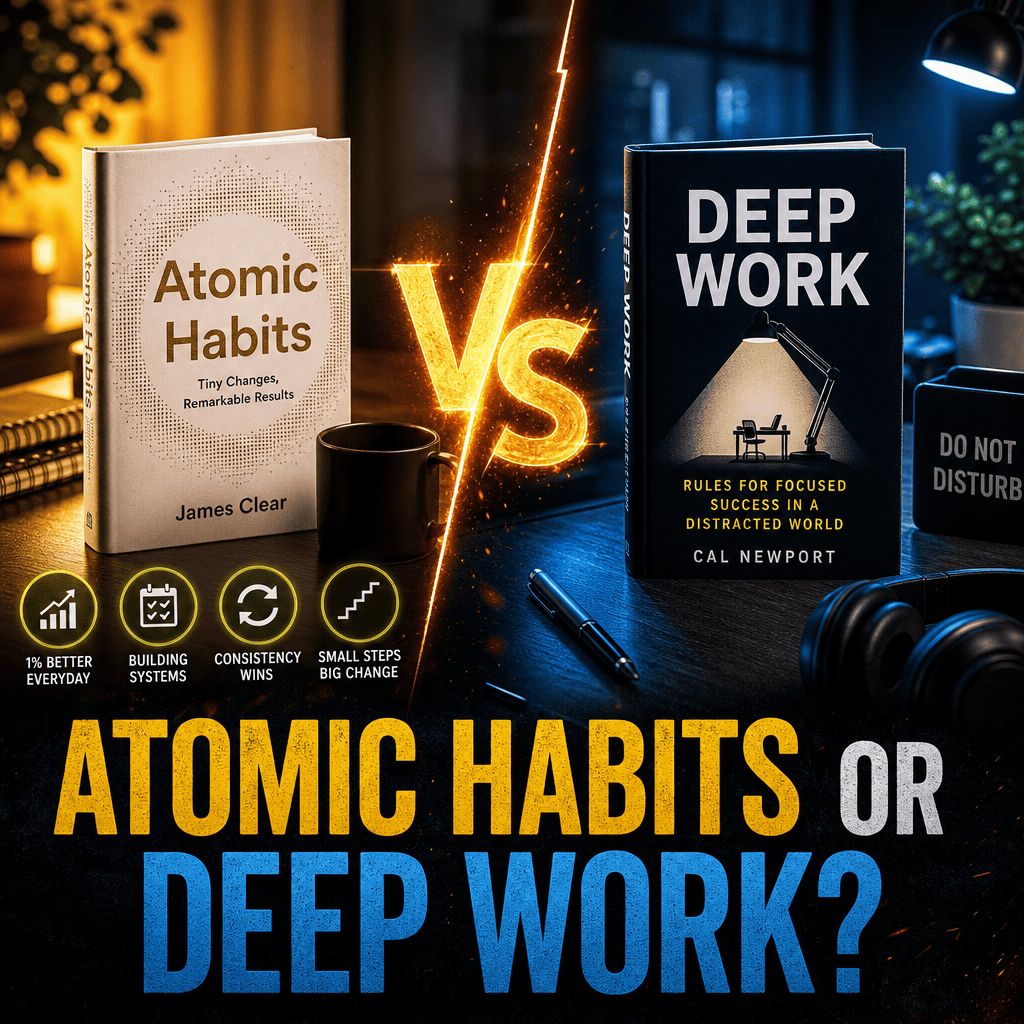
So the short version is this: read Atomic Habits first if your problem is starting and repeating. Read Deep Work first if your problem is attention and valuable output. If both are broken, use Atomic Habits to build the Deep Work habit.
The short answer: read the book that matches your bottleneck
Atomic Habits by James Clear is a behavior design book. It helps you make good actions obvious, attractive, easy, and satisfying. It is best for people who already know what they should do but cannot make themselves do it consistently.
Deep Work by Cal Newport is an attention book. Newport argues that focused, cognitively demanding work is rare and valuable. It is best for people who are busy all day but cannot point to much meaningful output at the end of it.
The mistake is treating them like competitors. They solve different layers. Atomic Habits is the engine. Deep Work is where you drive it.
Atomic Habits vs Deep Work at a glance
|
Habit engine vs focus target
|
What Atomic Habits does better
Atomic Habits is better at making change feel less heroic. Clear’s big move is to stop asking for massive willpower and start redesigning the environment around the behavior. His official page for Atomic Habits frames the book around small changes that compound, and that is the part readers remember for good reason.
The book is especially useful if you keep making plans that collapse after the first bad week. It gives you a way to make the desired behavior easier to start. That can mean setting a cue, reducing friction, pairing the habit with something you already do, or changing the identity attached to the action.
ReadPush already has a deeper breakdown of identity-based habits, which is one of the book’s stickiest ideas. The short version: you are not just trying to do the thing. You are trying to become the kind of person who does the thing without reopening the debate every morning.
|
Pro tip If you cannot repeat a deep work session, do not start by buying a better notebook. Start by making the first five minutes almost embarrassingly easy. |
Where Atomic Habits breaks down
The weakness of Atomic Habits is that it is neutral about the thing you are making repeatable. You can build a beautiful habit around checking analytics every morning and still avoid the hard strategic work your business needs.
This is where habit systems can become motion instead of progress. Tracking the habit feels productive. Tweaking the habit feels productive. Talking about the habit definitely feels productive. None of that guarantees the habit points at something valuable.
The Four Laws of Behavior Change are useful, but they do not choose your priorities for you. That part is still your job. Annoying, I know.
What Deep Work does better
Deep Work is stronger on the question Atomic Habits leaves open: what deserves your best attention? Newport argues that the ability to concentrate without distraction on hard, valuable work is becoming rare. His book page for Deep Work sits inside a broader body of work about focus, technology, and meaningful output.
The best part of Deep Work is that it makes busyness look suspicious. Not evil. Just suspicious. A full calendar can hide a thin day. A fast inbox can hide zero progress on the work that would actually change your business, career, or skill level.
For founders, this is not theoretical. The work that matters most often has no notification attached to it. Positioning. Strategy. Writing the sales page. Building the offer. Thinking through the thing you have been avoiding because nobody is yelling for it yet.
Where Deep Work breaks down
Deep Work can sound clean in a way real jobs are not. Protect four hours of focus? Lovely. Now try that while handling customers, managing a team, answering investor questions, or dealing with the kind of operational mess that does not care about your philosophy.
Newport’s argument is still valuable, but the reader has to translate it. A parent, manager, freelancer, or founder may not get the monk-like version. They may get 45 minutes with the door closed and the phone in another room. That still counts.
The bigger weakness is repeatability. Deep Work tells you focus matters. It does not always give you the behavioral scaffolding to make the session happen again tomorrow. That is where Atomic Habits earns its keep.
|
In plain English Deep Work tells you the work is worth protecting. Atomic Habits helps you become the person who actually protects it on a normal Tuesday. |
The real answer: use Atomic Habits to build a deep work habit
The best version of the Atomic Habits vs Deep Work debate is not a debate at all. It is a stack.
Use Newport to choose the work: the demanding task that creates real output. Use Clear to design the loop around it: same cue, same place, lower friction, visible reward, and a simple scorecard. In other words, Deep Work gives the session a purpose. Atomic Habits gives it a shot at surviving the week.
|
The deep work habit loop
|
Which book should you read first?
If you cannot stay consistent, read Atomic Habits first. You need the behavioral mechanics before the ambitious focus plan.
If you cannot focus, read Deep Work first. You need to see the cost of shallow busyness before another habit tracker gives you the illusion of progress.
If you are a founder or freelancer, I would read Deep Work for the output filter, then Atomic Habits for the ritual. Your danger is not laziness. It is reacting all day to work that feels urgent while the important work waits quietly in the corner, judging you.
If you are burned out or wildly overcommitted, neither book is the clean first fix. You may need Four Thousand Weeks or Essentialism before you need another system. Sometimes the productive move is admitting the workload is broken.
A simple 7-day experiment using both books
Do this before buying more productivity books. Pick one high-value task. Writing. Studying. Strategy. Coding. Sales work. Something that produces a visible result.
- Day 1: choose the output and define what finished means.
- Day 2: design the cue and environment. Same time, same place, one opening action.
- Days 3 to 6: run one 45 to 60 minute deep work block each day.
- Day 7: review what you produced and what friction nearly broke the habit.
That little test will tell you more than another comparison article. Painful but true.
Common misconceptions about Atomic Habits and Deep Work
Myth: Atomic Habits is easier, so it is less serious. Consistency is often the hard part. Anyone can write down a goal. Repeating the boring action for two weeks is where the book earns respect.
Myth: Deep Work means disappearing for four hours every day. Most people do not need the fantasy version. One protected hour can change a day if the task is chosen well.
Myth: you need to pick one system forever. You do not. These books solve different layers. Use the tool that fits the bottleneck.
Myth: productivity books work because you understand them. Understanding is cheap. Behavior is the receipt.
FAQ
Should I read Atomic Habits or Deep Work first?
Read Atomic Habits first if your problem is consistency. Read Deep Work first if your problem is focus and meaningful output.
Is Deep Work better than Atomic Habits for productivity?
Deep Work is better for productivity if the problem is distraction. Atomic Habits is better if the problem is repeating the right behavior.
Can Atomic Habits help me build a deep work routine?
Yes. Use Clear’s habit design ideas to create a cue, reduce friction, and track completed focus sessions. That makes deep work easier to repeat.
Which book is better for entrepreneurs?
Entrepreneurs usually need both. Deep Work helps identify the work that moves the business. Atomic Habits helps make that work repeatable when the week gets chaotic.
Which book is better for students?
Deep Work may give students the faster payoff because study quality depends heavily on attention. Atomic Habits helps make that study routine consistent.
The same issue appears from another angle in Identity Based Habits, where the question of attention, habits, and what actually changes behaviour becomes easier to see without turning the book into a slogan.
The same issue appears from another angle in Productivity books that actually work, where the question of attention, habits, and what actually changes behaviour becomes easier to see without turning the book into a slogan.
The same issue appears from another angle in Best productivity books for ADHD, where the question of attention, habits, and what actually changes behaviour becomes easier to see without turning the book into a slogan.
Choose the constraint, not the celebrity book
The question is not which author is smarter. Both books are useful. The question is where your current system is leaking.
If consistency is broken, read Atomic Habits and change one cue. If attention is broken, read Cal Newport’s Deep Work and protect one serious session. If both are broken, stop comparing and run the 7-day experiment.
You do not need a bigger productivity identity. You need one repeatable block of work that produces something real.