|
Quick takeaways
|
If you’ve ever finished a productivity book and felt like a new person for roughly forty-eight hours, welcome. I’ve been there. I have bought the hardcover, underlined half of it, built the new system on Sunday night, and abandoned it by Wednesday because a client called, the inbox caught fire, and my beautiful little routine did not survive contact with payroll.
That is the problem with most productivity books. They are not useless. Some are genuinely sharp. But the feeling of usefulness is cheap. A book earns its keep only when it changes something you repeat when life is annoying.
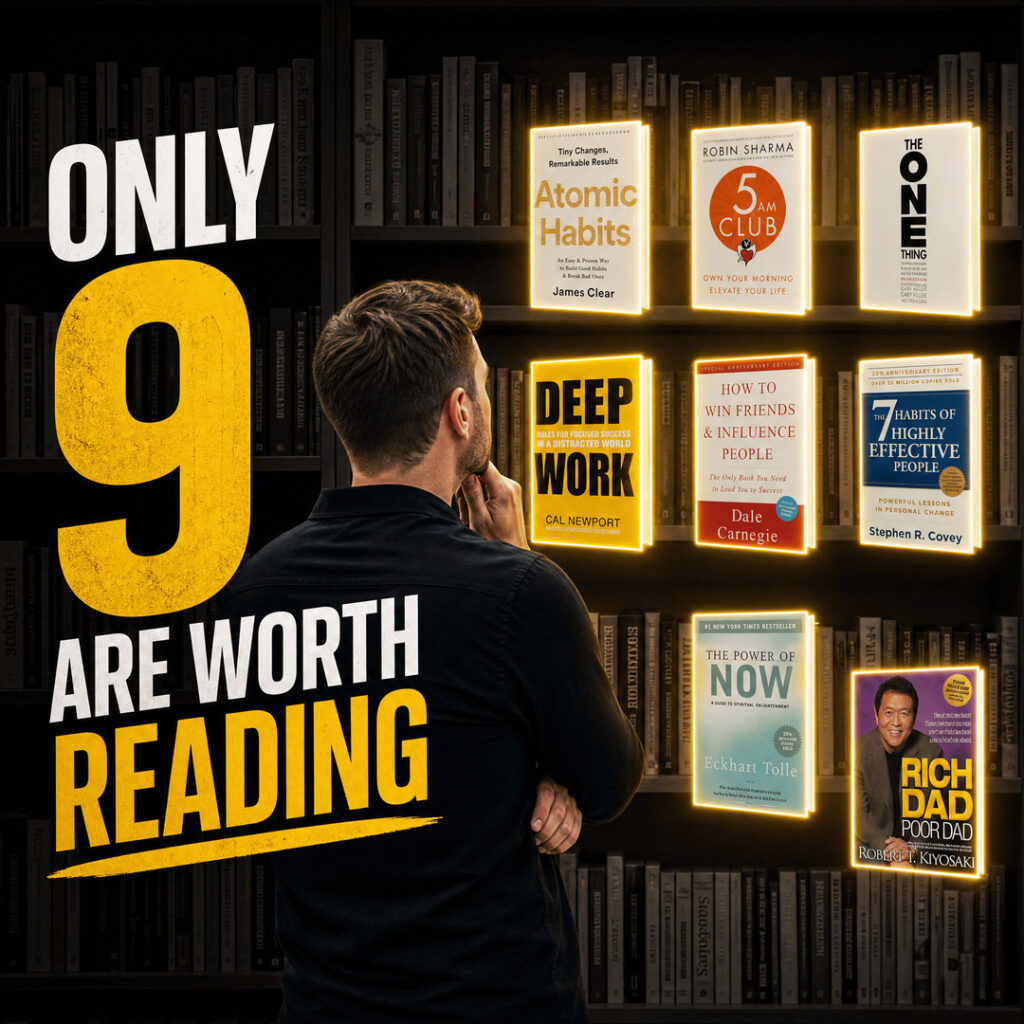
So this is not a list of the most famous titles. It is a list of productivity books that actually work because each one solves a different bottleneck: consistency, focus, overwhelm, prioritization, anxiety, saying no, habit diagnosis, daily planning, or procrastination. Pick the book for the problem. Bestseller status is not a strategy.
Why most productivity books feel useful, then disappear
Productivity books usually fail in the handoff between idea and Tuesday morning. The advice sounds right when you’re reading on the couch. Then you open your laptop, see seventeen half-urgent things, and the system asks you to become a calmer, more organized version of yourself before it can help you.
The good books do something smaller and better. They change one behavior. They help you make a habit easier to repeat, protect one block of focus, capture tasks outside your head, or stop saying yes to work you already know will cost too much.
|
Common mistake Do not judge a productivity book by how motivated it makes you feel while reading. Judge it by whether you can use one idea from it when you’re tired, behind, and slightly irritated. |
The rubric I used to judge productivity books that actually work
I used four questions for every book here. What behavior does it change? How easy is the first experiment? Does the advice survive stress? Where does it break down?
That last question matters. A productivity book with no limitations is either being oversold or reviewed by someone who never tried it on a bad week. Clara from 2017 would have ignored this sentence and bought three notebooks anyway. Clara from now knows better.
|
The behavior-change scorecard
|
1. Atomic Habits by James Clear is best for consistency
Atomic Habits works because it does not ask you to become heroic. It asks you to make the next good action smaller, more obvious, and easier to repeat. Clear’s official description of Atomic Habits is built around small changes that compound, and that is the part of the book people actually use.
The best behavior change here is consistency. If you know what you should do but keep failing to repeat it, start here. The first experiment is simple: change one cue in your environment for seven days. Put the book on your pillow. Put your running shoes by the door. Put your phone in another room before the work block starts.
The book is especially strong on identity-based habits. The idea is not just “do the thing.” It is “become the kind of person who does the thing.” That sounds fluffy until you use it on a real behavior. Then it gets annoyingly useful.
Where it breaks: life is messier than the diagrams. The Four Laws of Behavior Change are clean. Your week may not be. Stress, childcare, illness, deadlines, and plain old boredom can still knock the system sideways.
2. Deep Work by Cal Newport is best for focus
Deep Work is the book for people whose real work keeps getting eaten by shallow work. Newport’s case is simple: focused attention is rare, valuable, and increasingly hard to protect. His page for Deep Work and his other books frames this as a discipline, not a productivity hack.
The behavior it changes is attention protection. Your first experiment: one 60-minute block with notifications off, one clear task, and a written stopping point. Not a fake focus block where you keep Slack open. A real one.
The limitation is also obvious. Deep work is easier when you control your calendar. If you manage customers, kids, support queues, or a team that treats every thought as urgent, Newport’s advice needs translation. Still, even one protected hour can expose how much of your day is performative busyness.
3. Getting Things Done by David Allen is best for overwhelm
Getting Things Done is not sexy. That is part of why it works. David Allen’s method starts with a basic claim: your head is a bad office. The official GTD overview explains the capture, clarify, organize, reflect, and engage workflow, but the core move is even simpler. Get open loops out of your brain.
The behavior it changes is mental capture. If you are carrying tasks, promises, ideas, errands, and vague worries in your head, GTD gives you somewhere to put them. The first experiment: write down everything pulling at your attention, then define the next physical action for five of those items.
Where it breaks: the system can become a hobby. I have absolutely spent more time tuning a task manager than doing the task. If GTD becomes a shrine to your own complexity, you missed the point.
|
In plain English If a book requires you to build a perfect system before it helps, be careful. The first useful action should be small enough to do before your coffee gets cold. |
4. The ONE Thing by Gary Keller and Jay Papasan is best for prioritization
The ONE Thing is useful when your problem is not laziness. It is too many plausible priorities. The book’s focusing question asks which action would make everything else easier or unnecessary. That is a sharp tool when you are building something and every task can pretend to be important.
The behavior it changes is choosing. Your first experiment: before opening email, write down the one meaningful thing that would make the day count. Do it before admin work gets a vote.
Where it breaks: collaborative work is not always that clean. Sometimes the one thing is negotiated with customers, partners, managers, or a team. But even then, the question is useful because it forces trade-offs into the open.
5. Four Thousand Weeks by Oliver Burkeman is best for productivity anxiety
Four Thousand Weeks is the book I would hand to anyone who has turned productivity into a guilt machine. Burkeman’s point is not that time management is useless. It is that you have a finite life, and no system will let you do everything.
The behavior it changes is acceptance. That sounds soft until you try it. The first experiment: leave one low-value task undone on purpose and watch what happens. Sometimes the world does not collapse. Rude, honestly.
The limitation is that readers looking for a crisp operating system may feel underfed. This is more philosophy than checklist. But if you keep trying to optimize your way out of being human, that may be exactly the medicine.
6. Essentialism by Greg McKeown is best for saying no
Essentialism is about the disciplined pursuit of less. I know that phrase sounds like something someone would put on a beige notebook, but the book itself is sharper than that. It forces you to look at the cost of all those little yeses you keep handing out.
The behavior it changes is filtering commitments before they become obligations. Your first experiment: identify one request, meeting, or project that deserves a polite no this week.
Where it breaks: saying no is much easier in a book than when the person asking signs your invoice. Essentialism is still useful, but the reader has to adapt it to power dynamics, money, and family expectations.
7. The Power of Habit by Charles Duhigg is best for understanding habit loops
The Power of Habit is less immediately tactical than Atomic Habits, but it is better at diagnosis. Duhigg’s habit loop, cue, routine, reward, gives you a way to inspect a behavior before trying to replace it.
The behavior it changes is noticing. Your first experiment: pick one habit you dislike and map the cue, the routine, and the reward. Do not fix it yet. Just stop treating it like a character flaw.
The limitation: some readers want a prescription faster. Fair. If you already know your pattern and just need a practical design system, Clear may be the better first read.
8. Make Time by Jake Knapp and John Zeratsky is best for daily experiments
Make Time is useful because it does not pretend one system fits everyone. It gives you tactics to test. That is a relief if you are allergic to productivity religions.
The behavior it changes is day design. The first experiment is choosing one daily highlight and protecting it before feeds, meetings, or message threads flatten the day.
Where it breaks: the menu can become too big. If you try twelve tactics at once, you are not experimenting. You are redecorating your procrastination. Pick one.
9. Eat That Frog by Brian Tracy is best for procrastination, with caveats
Eat That Frog is blunt: do the hardest, most important task first. For some people, that is exactly the shove they need. For others, it is the kind of advice that makes them feel worse because the avoided task is tangled with fear, burnout, unclear goals, or a brain that does not respond to blunt force.
The behavior it changes is starting. Your first experiment: spend 25 minutes on the most avoided meaningful task before admin work. Not the whole task. Just the first bite.
The limitation is important. Procrastination is not always poor discipline. Sometimes it is ambiguity. Sometimes it is anxiety. Sometimes your workload is ridiculous and the frog is actually a whole swamp. Use the book if it helps you start. Do not use it to beat yourself up.
|
Pick the book by the problem
|
Which productivity book should you start with?
If you want the safest first pick, read Atomic Habits. It has the broadest usefulness because consistency sits underneath almost every other productivity problem.
If your work depends on attention, read Deep Work. If your head feels like a junk drawer, read Getting Things Done. If you are successful enough to be constantly overcommitted, read Essentialism. If productivity has become a way to punish yourself, read Four Thousand Weeks before you buy another planner.
|
Pro tip Buy one book. Run one experiment. Give it seven days. If the experiment changes nothing, you learned something useful before building a whole identity around a system you won’t use. |
Common misconceptions about productivity books
Myth: reading the book is the work. Reading can help, but the book starts paying rent only when you test one behavior. Highlighting a chapter is not the same as changing a Tuesday.
Myth: the best productivity book is the most comprehensive. Comprehensive can become heavy. The best book is usually the one that fixes your current bottleneck with the least drama.
Myth: if a system fails, you lack discipline. Maybe. Or maybe the system was built for someone with a calmer calendar, fewer interruptions, and no weird client emergencies at 4:57 p.m.
Myth: productivity means doing more. Several of the best books here argue the opposite. Better productivity often means doing fewer things with less self-deception.
FAQ
What is the best productivity book to start with?
For most readers, Atomic Habits is the best starting point because it gives a practical way to make small behaviors repeatable. If your main problem is overwhelm rather than consistency, start with Getting Things Done.
Are productivity books actually useful?
Yes, but only when you treat them as experiment manuals, not personality upgrades. A useful book should give you one behavior to test immediately.
Which productivity book is best for procrastination?
Eat That Frog is useful for straightforward avoidance. If procrastination comes from unclear priorities, try The ONE Thing. If it comes from stress or shame, a blunt productivity tactic may not be enough.
Which book is best for habits and consistency?
Atomic Habits is the strongest pick for habits and consistency. The Power of Habit is better if you want to understand the psychology behind the pattern before changing it.
What is better for focus: Atomic Habits or Deep Work?
Deep Work is better for focus. Atomic Habits can help you build a focus habit, but Newport’s book is built around attention as the main problem.
The same issue appears from another angle in Your Money or Your Life Quotes, where the money decision underneath the book becomes easier to see without turning the book into a slogan.
The same issue appears from another angle in Is Good to Great still relevant sober, where the business trade-off the book is trying to clarify becomes easier to see without turning the book into a slogan.
The same issue appears from another angle in Atomic Habits vs Deep Work, where the question of attention, habits, and what actually changes behaviour becomes easier to see without turning the book into a slogan.
Read one, then test one thing
The mistake is buying a stack of productivity books and calling that momentum. I say this with affection because I have done it. You feel productive while choosing the books. Then the books arrive, and now you have nine new systems judging you from the nightstand.
Pick the bottleneck. Choose the book that matches it. Run one small test for seven days. If you want consistency, start with James Clear’s habit system. If you want focus, protect one Deep Work block. If you want less overwhelm, capture the open loops before they capture you.
The book only starts working after you close it.