Quick takeaways
- The most important idea in Atomic Habits isn’t about habits at all. It’s about identity. Any system you build will eventually crack if it runs against how you see yourself.
- Tiny habits work not because of momentum or willpower, but because each one adds a small piece of evidence that you’re becoming a different kind of person.
- The book is honest about its limits, mostly. It works best when your environment is shapeable and the behavior you’re trying to change isn’t carrying something heavier underneath it.
- “You don’t rise to the level of your goals. You fall to the level of your systems.” True. Also incomplete. Sometimes the system is fine and something else entirely is the problem.
If you’ve ever known exactly what you should do and still not been able to make yourself do it, you’ll recognize the particular exhaustion that lives in that gap. You’ve read the articles. You understand the logic. You’ve started before, probably more than once. And here you are again, wondering what’s wrong with you.
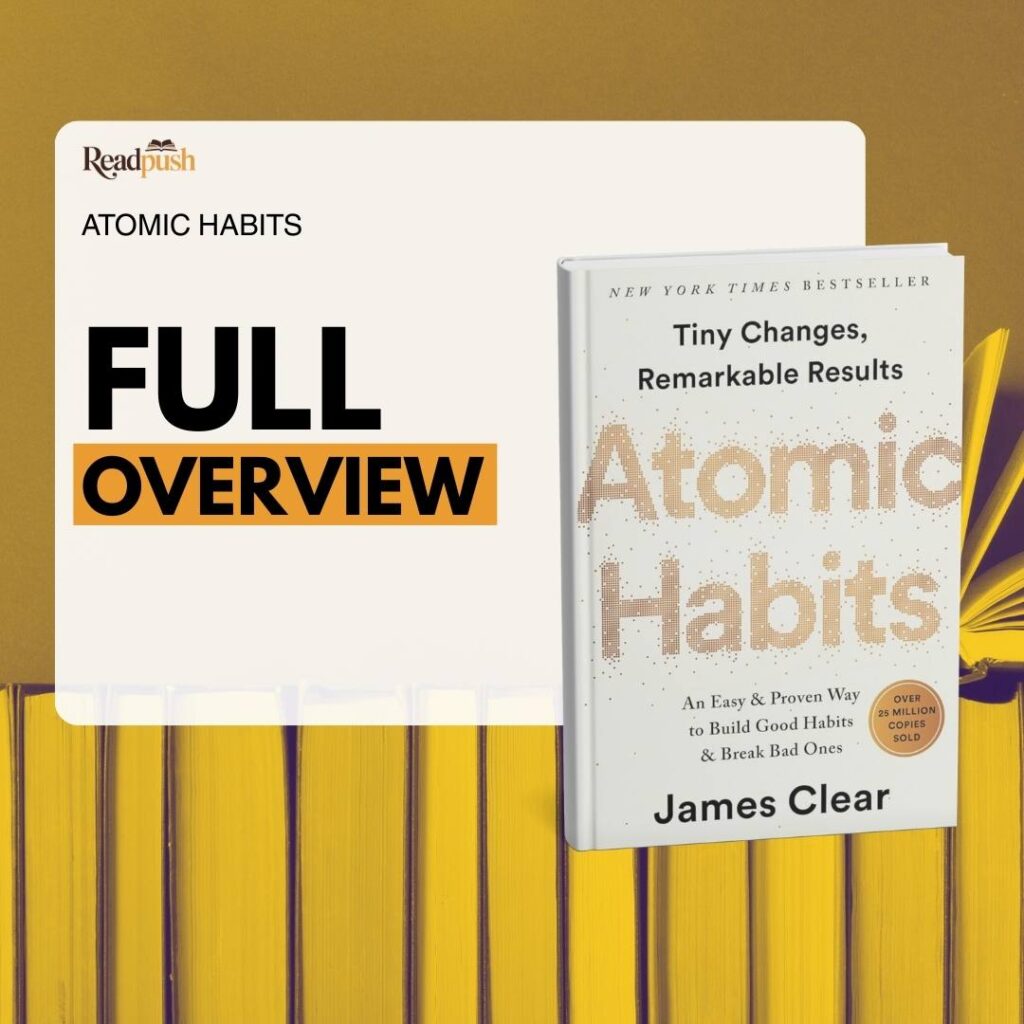
That question, what’s wrong with me, is where most self-help books quietly fail. Atomic Habits by James Clear doesn’t answer it so much as set it aside. His argument is that you’re not asking the right question. The habits aren’t sticking because the system isn’t designed to support them, not because you’re lazy or undisciplined or constitutionally broken. That reframe is genuinely useful, and it’s why this book has sold tens of millions of copies since it came out in 2018.
It isn’t the first book to say this. Habit loops show up in William James’s writing from the 1890s, and Charles Duhigg covered similar territory in The Power of Habit a decade ago. What Clear does is organize the research into something usable, and he grounds the whole thing in a psychological insight that most productivity writing skips entirely: the question of who you’re becoming, not just what you’re doing.
The idea underneath everything: habits as identity
Clear organizes his argument around three layers of behavior change. Most people, he says, try to change from the outside in. They set outcome-based goals, lose ten pounds, finish the book, run the marathon, and build habits meant to serve those goals. This works sometimes. It also fails a lot, and when it does, the failure tends to feel personal in a way that sticks. As if missing the goal revealed something true about you.
Clear’s alternative is to work the other direction. Instead of “I want to run a marathon,” the question becomes “what kind of person am I trying to be?” and, more concretely, “what would that person do today?” A person who exercises doesn’t need to motivate themselves to lace up their shoes. A person who reads doesn’t need to argue themselves into picking up a book. The behavior follows from the identity. The habit is just the accumulated evidence.
What’s worth noticing here is that this isn’t primarily a productivity insight. It’s a psychological one. Identity-based habit change is slower and less satisfying in the short term because it doesn’t produce a scoreboard you can check at the end of the week. But it tends to last longer, because the behavior isn’t fighting your self-image anymore. It’s expressing it.
Each habit you perform, Clear argues, is a vote for a particular identity. Go for the run: that’s a vote for “I’m someone who looks after their body.” Skip it: that’s a vote for something else. No single vote decides anything. But enough votes in the same direction and the story you tell yourself starts to shift. That, in Clear’s framework, is how identity actually changes.
The Four Laws: what makes habits hold
The practical core of the book is the Four Laws of Behavior Change, which Clear organizes from existing habit research into a clean, memorable system. A habit forms when a behavior is cued, craved, easy to perform, and followed by something satisfying. Clear packages these as: make it obvious, make it attractive, make it easy, make it satisfying. For breaking habits, each law inverts.
The thing that makes this framework genuinely useful is that it moves the focus from motivation to environment design. You don’t need more willpower. You need a better setup. Put the running shoes by the door. Move the phone out of the bedroom. Put the water glass on the desk where you want to work. Rearrange the environment so the behavior you want becomes the path of least resistance, and the behavior you don’t want requires enough effort that you’re less likely to fall into it mindlessly.
|
Atomic Habits The Four Laws of Behavior Change
|
||||||||||||||||||||||||
What I keep coming back to is that this framework doesn’t ask you to become a different person first. It starts from where you are and asks what small changes to your surroundings would tilt the odds slightly in your favor. That’s an honest starting point. You don’t need motivation. You need the running shoes by the door.
What the book handles well, and what it quietly sidesteps
Clear is straightforward about the scope of the book. Atomic Habits is a systems book, not a values book. It doesn’t tell you what to want. Within a goal you’ve already chosen, it gives you better tools for getting there. That clarity of scope is useful. It’s also where the limits begin.
The Four Laws work best when your environment is reasonably shapeable. Put the fruit at eye level in the fridge. Keep the phone out of the bedroom at night. These are real changes that produce real results for a lot of people.
But what if the environment shaping your habits isn’t easily redesigned? What if the stress driving the behavior you’re trying to stop is coming from your job, your relationship, your financial situation, something structural that you can’t rearrange? What if the behavior that’s hurting you is also, in some way, the thing that’s getting you through the day?
Clear’s framework doesn’t address this directly, and that’s not a flaw so much as a boundary. Atomic Habits is about behavior design. It isn’t therapy. It doesn’t claim to be. But readers sometimes take its optimism further than the book itself warrants, and that gap is worth naming honestly.
There’s also something worth noticing about how the model handles emotion. Clear’s framework treats anxiety as a cue, boredom as a craving, satisfaction as a reward. That’s a useful lens for designing habit architecture. It can underweight, though, the degree to which emotion isn’t just a variable in the system, but sometimes the thing that’s running the system. If you’re using a habit to manage something harder, getting better at the habit may not be what actually helps.
|
Honest assessment When this book helps most, and when you might need something else alongside it
|
||||||||||||||||
Common misconceptions about Atomic Habits
The two-minute rule doesn’t mean you only ever do two minutes. It’s a starting strategy, not a ceiling. The point is to lower the activation energy so low that beginning is almost thoughtless. “Read one page” is a doorway into reading a chapter. Once the habit is building and the identity is shifting, the duration expands naturally. Starting is the hard part. Two minutes solves the starting problem.
“Never miss twice” is not a moral code. It’s a recovery principle, and the distinction matters. Clear includes it to reduce the psychological weight of a missed day, which often spirals into abandoning the habit entirely. The message isn’t “you have failed if you miss twice.” It’s “missing once is an accident; missing twice is the beginning of a new habit, so catch it differently.” People who read it as a rule tend to feel more shame when they break it, not less, which is the opposite of what the principle is for.
Following the system doesn’t guarantee the habits will stick. Clear is careful about this, but readers sometimes take the book’s energy further than the text itself does. The system works well under a particular set of conditions. When those conditions change, or when the emotional weight of the habit is heavier than the framework accounts for, the tools alone may not be enough. That’s not a criticism. It’s just honest.
This book is not primarily about productivity. The identity-based change model at its center is a psychological argument, not an efficiency one. Atomic Habits has been adopted by the productivity community because its practical tools translate well there. But what Clear is describing underneath the systems and the laws is how people come to see themselves differently over time. That’s a slower, quieter kind of change than most books in this space promise.
The same issue appears from another angle in This Is Marketing by Seth Godin, where the marketing problem behind the framework becomes easier to see without turning the book into a slogan.
The same issue appears from another angle in Why most people misunderstand The Habits book, where the question of attention, habits, and what actually changes behaviour becomes easier to see without turning the book into a slogan.
The same issue appears from another angle in Atomic Habits in context, where the question of attention, habits, and what actually changes behaviour becomes easier to see without turning the book into a slogan.
Who this book is for
It’s for you if you’ve tried to build habits before and kept losing the thread. The reframe that the problem is probably the system, not you, is genuinely useful for anyone who has internalized a story about their own inconsistency. You’re not the only one who has started and stopped. That’s the normal pattern, and it doesn’t mean what you think it means.
It’s for you if you know what you want to change but can’t get traction. The environmental design tools are concrete in a way that most self-improvement advice isn’t. You can actually rearrange a kitchen. You can actually move a phone.
It may not be enough on its own if the behavior you’re trying to change is carrying something heavier underneath it, or if the condition driving it isn’t something you can design your way out of. In those cases, the book is still worth reading. But read it alongside something that helps you understand what’s underneath the behavior, not instead of it. A therapist, a trusted person, something with more room for what’s actually hard.
Read it slowly. Let the identity chapter sit with you before you get to the laws. The question “who am I trying to become” is the more important one, and it deserves more than a quick answer.