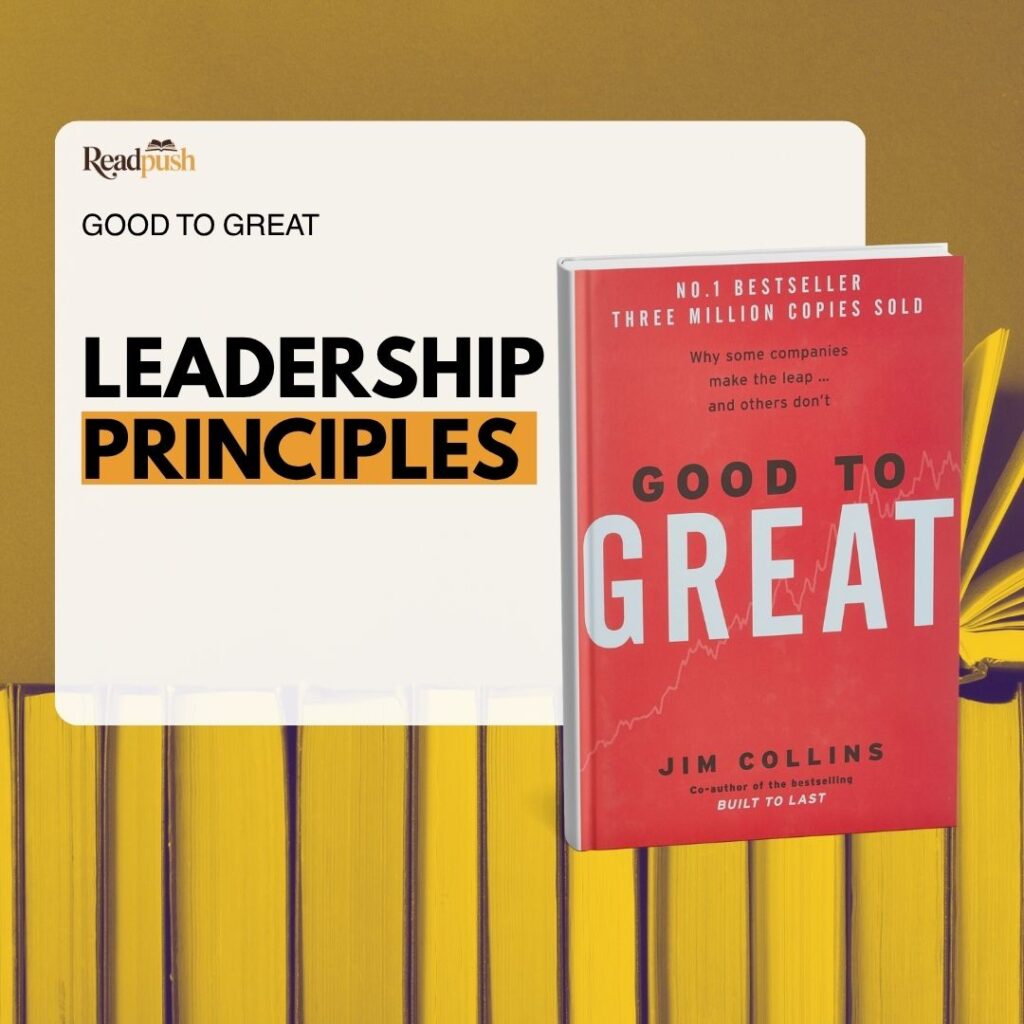
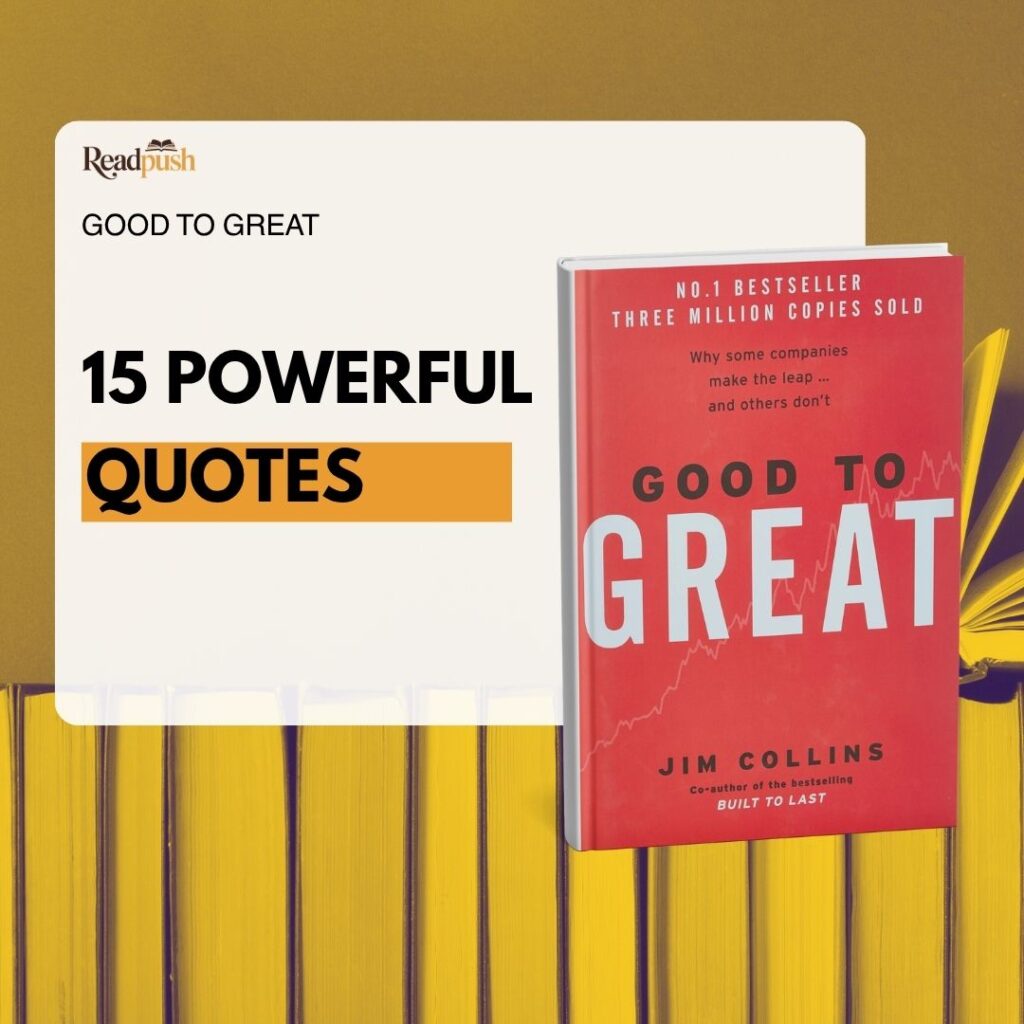
Few business books have shaped leadership thinking as profoundly as good to great by jim collins. Every quote in this book captures a timeless truth about discipline, focus, and transformation. Collins spent five years studying what made ordinary companies rise to greatness uncovering principles that still guide leaders today.
Good to great explores how organizations transition from mediocrity to sustained excellence through clarity, discipline, and leadership. (for a full breakdown of the book’s framework and findings, read our complete good to great summary).
These quotes highlight themes like level 5 leadership, the hedgehog concept, and the flywheel effect core good to great leadership principles that redefine how success really works.
Whether you’re an entrepreneur, manager, or lifelong learner, these quotes are perfect for reflection, journaling, sharing with your team, or fueling your next big idea. Each one offers a concise spark of wisdom you can apply today.
Quotes on leadership and discipline
Quote 1
“good is the enemy of great.”
Jim collins, good to great (page 1)
What this means:
the book begins with this powerful truth. Collins argues that the biggest obstacle to greatness is satisfaction with being merely good. Settling for comfort prevents true growth.
Why it matters:
it’s a reminder to challenge complacency in your business, habits, and mindset. Greatness starts when you refuse to settle for average.
Quote 2
“level 5 leaders are a study in duality: modest and willful, humble and fearless.”
Jim collins, good to great (page 39)
What this means:
level 5 leaders blend personal humility with professional will. They’re not driven by ego but by purpose and results.
Why it matters:
it redefines leadership strength not loud confidence, but quiet resolve. These leaders build enduring greatness.
This insight connects to our deep dive on level 5 leadership principles that explain how humility fuels long-term success.
Quote 3
“when you have disciplined people, you don’t need hierarchy. When you have disciplined thought, you don’t need bureaucracy.”
Jim collins, good to great (page 125)
What this means:
collins discovered that structure and micromanagement become unnecessary when the right people and principles are in place.
Why it matters:
a disciplined culture allows freedom and innovation to thrive. True leaders focus on building discipline, not enforcing control.
Quote 4
“great vision without great people is irrelevant.”
Jim collins, good to great (page 41)
What this means:
the “first who, then what” principle means success starts with people, not ideas. Strategy comes after assembling the right team.
Why it matters:
hiring and developing the right people is the foundation of every great company.
This quote aligns with one of our good to great lessons on prioritizing people over plans see how great companies mastered this mindset.
Quote 5
“a culture of discipline is not a principle of business, it’s a principle of greatness.”
Jim collins, good to great (page 124)
What this means:
discipline isn’t just a business skill it’s a universal trait of all great endeavors.
Why it matters:
it applies to every area of life. Discipline is the silent force that transforms potential into performance.
Quotes on focus and simplicity
Quote 6
“the key is not to prioritize what’s on your schedule, but to schedule your priorities.”
Jim collins, good to great (page 131)
What this means:
success isn’t about doing more it’s about focusing on what matters most and structuring your life around it.
Why it matters:
it’s a reminder that clarity drives productivity. Don’t chase busy work; protect your essential priorities.
Quote 7
“if you have more than three priorities, you don’t have any.”
Jim collins, good to great (page 118)
What this means:
focus requires ruthless simplicity. Too many goals lead to scattered energy and mediocre results.
Why it matters:
this mindset helps teams and entrepreneurs streamline and commit to what truly drives impact.
Quote 8
“stop doing lists are more important than to-do lists.”
Jim collins, good to great (page 130)
What this means:
the most effective leaders know what to eliminate, not just what to pursue.
Why it matters:
it’s an actionable mindset shift success often means subtracting distractions.
This wisdom reflects the heart of the hedgehog concept, where simplicity and focus lead to breakthrough results.
Quote 9
“the good-to-great companies understood that doing what you are best at leads to sustained results.”
Jim collins, good to great (page 117)
What this means:
don’t diversify endlessly. Identify your core strength and master it.
Why it matters:
greatness is built through focus on what you can uniquely excel at.
Quote 10
“technology is never the primary cause of greatness or decline.”
Jim collins, good to great (page 152)
What this means:
collins found that great companies used technology as an accelerator, not a driver. Tools amplify strategy but don’t create it.
Why it matters:
in an age obsessed with tech trends, this quote reminds leaders that principles and people matter more than platforms.
This insight connects with our article on the flywheel effect, showing how disciplined progress, not innovation hype, creates momentum.
Quotes on perseverance and momentum
Quote 11
“good-to-great transformations never happen in one fell swoop. There is no single defining action, no grand program, no miracle moment.”
Jim collins, good to great (page 177)
What this means:
transformation is gradual. Each disciplined step builds momentum over time.
Why it matters:
it’s a reality check for impatient entrepreneurs. Sustainable success is built, not discovered.
Quote 12
“great companies build momentum step by step, action by action, decision by decision.”
Jim collins, good to great (page 178)
What this means:
this reinforces the flywheel effect the idea that consistent, aligned effort compounds into unstoppable momentum.
Why it matters:
consistency beats intensity. Commit to small daily actions that align with your core mission.
Quote 13
“you must maintain unwavering faith that you can and will prevail, regardless of difficulties, and at the same time confront the most brutal facts of your current reality.”
Jim collins, good to great (page 85)
What this means:
known as the stockdale paradox, this mindset balances optimism with realism.
Why it matters:
it’s a crucial leadership principle hope without honesty is fantasy; honesty without faith is defeat.
Quote 14
“you can accomplish anything in life, provided that you do not mind who gets the credit.”
Jim collins, good to great (page 35)
What this means:
true leadership serves the mission, not personal recognition.
Why it matters:
ego kills collaboration. Humility builds lasting impact.
Quote 15
“the purpose of bureaucracy is to compensate for incompetence and lack of discipline.”
Jim collins, good to great (page 127)
What this means:
when teams lack discipline, companies overcompensate with unnecessary rules.
Why it matters:
build disciplined people, and freedom follows. It’s the antidote to complexity and red tape.
How to use these quotes
- Share them on linkedin or twitter to inspire your audience.
- Use them as team meeting openers to spark discussion.
- Reflect on one quote each week in your personal journal.
- Add them to presentations or newsletters for credibility and insight.
- Print your favorite and keep it visible as a daily reminder of focus and discipline.
These quotes are not just motivational they’re practical tools for reflection and action.
The power of timeless simplicity
Every quote from good to great captures a universal truth: greatness isn’t about complexity, it’s about clarity, focus, and discipline.
Whether you lead a startup, manage a team, or shape your personal goals, these words remind you to slow down, simplify, and commit to what truly matters.
Which quote speaks most to you today?
To explore the full framework behind these ideas including deep dives on the hedgehog concept and level 5 leadership visit our good to great summary and key insights.
What this idea changes in practice
The useful way to read this piece is not as a shortcut around the book, but as a way to decide what the book is really asking you to notice. Good to Great is easy to reduce to a phrase. The phrase is helpful, but it is also where many readers stop too early.
The practical question is: what changes after you understand the idea? If the answer is only that you can repeat the concept in a meeting, the idea has not done much work yet. A good business or self-improvement book should change a decision, a habit, a conversation, or a way of measuring progress.
For this article, the change is usually smaller and more concrete than the headline suggests. You stop treating the concept as an inspirational lesson and start using it as a filter. It helps you decide what to ignore, what to inspect more closely, and where your current approach may be wasting effort.
That is where ReadPush readers get the most value. Not from another summary, and not from pretending the book is perfect. The value is in separating the durable idea from the noise around it.
Where readers often get it wrong
The common mistake is to treat the book’s central idea as universal. Most book ideas are not universal. They are conditional. They work better for some people, teams, markets, and seasons than others.
That does not make the idea weak. It makes it usable. Advice becomes more useful when you know its boundary. A habit system helps when your life has enough stability to support repetition. A strategy framework helps when the market conditions match the assumptions behind the framework. A finance lesson helps when it is applied to the right kind of risk, not every risk.
So the better reading is not, is this book right? The better reading is, where is this book right, and what would make it wrong for me? That question protects you from two bad habits: dismissing useful books because they are imperfect, and overusing famous books because they sound confident.
If you take only one thing from this article, take that discipline. Apply the idea where the conditions fit. Leave it alone where they do not.
How to apply the lesson without overcomplicating it
Start with one decision. Do not turn the book into a whole operating system on day one. That is how good ideas become heavy.
- Name the problem. What are you actually trying to improve: focus, growth, cash flow, consistency, leadership, decision quality, or something else?
- Pick the relevant principle. Choose one idea from the book that speaks directly to that problem.
- Define the test. What would look different after two weeks if the idea is working?
- Review the result. Keep what helped. Drop what added friction.
This keeps the lesson grounded. You are not trying to become the kind of person who has mastered the whole book. You are trying to make one part of your work or life less vague.
The same issue appears from another angle in Good to great leadership principles, where the business trade-off the book is trying to clarify becomes easier to see without turning the book into a slogan.
The same issue appears from another angle in Powerful quotes from The page marketing plan, where the marketing problem behind the framework becomes easier to see without turning the book into a slogan.
The same issue appears from another angle in Good to Great by Jim Collins, where the business trade-off the book is trying to clarify becomes easier to see without turning the book into a slogan.
A better final takeaway
The strongest books on ReadPush are rarely the ones that give the neatest answers. They are the ones that improve the quality of your next question. Good to Great is worth returning to for that reason.
Ask what the idea reveals. Ask what it hides. Ask what it would look like in a normal week, with normal constraints, limited time, and imperfect follow-through. If the idea still helps there, it is probably worth keeping.
That is the standard. Not whether the book sounds impressive. Whether it survives contact with real life.