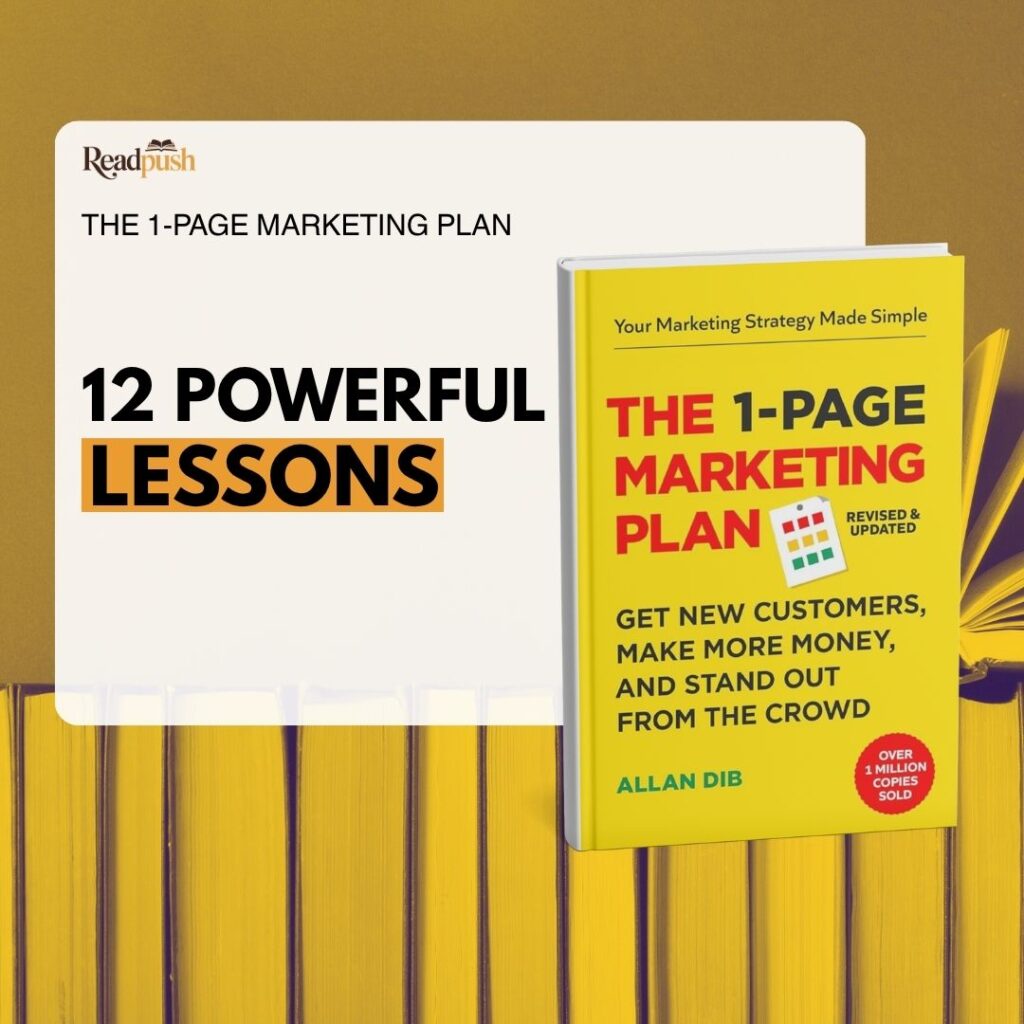
Most entrepreneurs work hard but lack a clear marketing direction. They jump from social media posts to ads to new platforms, hoping something sticks. The problem isn’t effort, it’s focus. Allan Dib’s The 1-page marketing plan solves that problem by offering a simple marketing framework that turns chaos into a clear path for growth.
In The 1-page marketing plan, Dib argues that a small business doesn’t need more marketing tactics, it needs a structured plan that attracts leads, converts them into customers, and builds loyalty long after the sale. Our full breakdown of the book’s system explains how it all fits together (see our [complete summary of The 1-page marketing plan]).
These lessons are powerful because they distill real-world marketing truths into actions anyone can use even without a big budget. You’ll learn how to focus on the right audience, craft messages that convert, and create repeatable results.
Use this guide as a playbook. Read it straight through or bookmark your favorite lessons to revisit when building your next campaign. Every insight adds another layer to your business growth plan.
Lessons on strategy and focus
Lesson 1: Clarity beats complexity
The lesson:
Success starts with a clear marketing direction. Dib’s one-page model proves that simplicity leads to consistency, while long, complex plans end up forgotten.
Why it matters:
When you know exactly what to do next, you act faster and measure progress easily. Complexity kills momentum.
How to apply this:
- Use a single page to map your “Before, During, and After” marketing phases.
- Add short, specific actions for each step.
- Review and refine the page quarterly.
Once the plan is clear, you can decide who your marketing is really for.
Lesson 2: Target one ideal market
The lesson:
Trying to reach everyone means you connect with no one. The best marketing strategy for small business starts with identifying one ideal customer type.
Why it matters:
A precise audience makes your message sharper and your marketing budget more efficient.
How to apply this:
- Define your customer’s top problems and desires.
- Build all your messaging for that single segment.
- Test and refine using direct feedback.
After knowing who you serve, you must understand how to reach them effectively.
Lesson 3: Focus on the 20 percent that drives 80 percent of results
The lesson:
Dib uses the 80/20 principle to show that a small fraction of actions produces most outcomes.
Why it matters:
Doing less but focusing on high-impact tasks brings faster results with less stress.
How to apply this:
- Track where your best customers and profits come from.
- Eliminate low-return marketing activities.
- Reinforce the few actions that create the most sales.
This connects directly to our deep dive on 80/20 rule marketing, which explains how small, focused actions can multiply profits.
With focus established, it’s time to turn attention into measurable leads.
Lessons on lead generation and conversion
Lesson 4: Use direct response marketing, not branding
The lesson:
Big companies can afford brand awareness campaigns. Small businesses need ads that ask for a direct action.
Why it matters:
Every dollar must be trackable. Direct response campaigns show exactly what works and what doesn’t.
How to apply this:
- Include a clear call to action in every ad.
- Track results with promo codes or links.
- Offer valuable lead magnets to capture data.
Once leads come in, nurturing turns them into loyal buyers.
Lesson 5: Nurture leads before selling
The lesson:
Most people won’t buy right away. Dib highlights the power of steady communication before asking for a sale.
Why it matters:
Trust takes time. The more helpful you are, the easier it becomes to convert.
How to apply this:
- Send educational emails or helpful tips.
- Use testimonials to prove results.
- Build a follow-up system that provides value before pitching.
After earning trust, your next challenge is to close with confidence.
Lesson 6: Convert with clarity and confidence
The lesson:
Sales conversion is about guiding prospects, not pushing them. Dib teaches that clear offers and social proof make decisions simple.
Why it matters:
Confusion kills sales. Clear structure creates comfort and confidence in buying.
How to apply this:
- Simplify pricing and remove hidden costs.
- Provide strong guarantees.
- Use stories to show transformation.
Once sales flow consistently, the focus shifts to keeping customers long term.
Lesson 7: Deliver a world-class experience
The lesson:
Dib reminds us that marketing doesn’t end with the sale. The customer experience is a key marketing channel itself.
Why it matters:
Delighted customers refer others, leave reviews, and return often. That’s free advertising.
How to apply this:
- Over-deliver on expectations.
- Follow up after every purchase.
- Fix problems quickly and personally.
This lesson connects to the direct response marketing principle we covered earlier every happy customer becomes a powerful response generator.
Once customers are delighted, the next step is maximizing their lifetime value.
Lessons on retention and growth
Lesson 8: Increase customer lifetime value
The lesson:
Profits grow when customers buy repeatedly. Dib calls this the “After Phase” turning one-time buyers into loyal fans.
Why it matters:
Keeping a customer costs far less than acquiring a new one.
How to apply this:
- Offer upgrades, subscriptions, or loyalty perks.
- Check in regularly with useful updates.
- Celebrate milestones and repeat business.
Once customers stay longer, they become your best marketers.
Lesson 9: Build a referral system
The lesson:
Referrals don’t happen by chance. Dib recommends creating deliberate systems to encourage them.
Why it matters:
Referral customers convert faster and trust you more.
How to apply this:
- Ask for introductions right after positive feedback.
- Offer small incentives for referrals.
- Make sharing effortless with pre-written messages.
Beyond systems, mindset shapes how you lead and grow.
Lessons on entrepreneurial mindset
Lesson 10: Use use to scale faster
The lesson:
Dib says entrepreneurs must buy back time by delegating or automating low-value tasks.
Why it matters:
use lets you scale without burnout. It’s how small businesses compete with large ones.
How to apply this:
- Automate repetitive marketing steps.
- Hire specialists for design or copy.
- Focus on high-value strategy work.
True use comes from clear systems that you refine over time.
Lesson 11: Small businesses have the advantage
The lesson:
Big brands move slow. Small entrepreneurs can adapt instantly.
Why it matters:
Speed and personalization create customer intimacy large companies can’t match.
How to apply this:
- Respond fast to market shifts.
- Personalize outreach and follow-ups.
- Use storytelling to humanize your brand.
All of these lessons tie back to one core truth execution is everything.
Lesson 12: Execution beats ideas every time
The lesson:
Knowledge only matters when put into action. Dib closes with this reminder: plans that stay in notebooks don’t make sales.
Why it matters:
Implementation builds momentum, confidence, and results.
How to apply this:
- Set one action per day from your plan.
- Review progress weekly.
- Celebrate small wins to stay consistent.
Let’s wrap up with a quick reference of everything covered.
Quick reference: Key takeaways
- Simplicity builds momentum.
- Target one clear market.
- Focus energy where results are highest.
- Use direct response marketing for trackable growth.
- Nurture leads patiently.
- Convert with confidence and clarity.
- Create unforgettable experiences.
- Retain and upsell existing customers.
- Build referral systems intentionally.
- Use use to scale smartly.
- Move faster than large competitors.
- Execution turns plans into profit.
Bookmark this list as your 1-Page Marketing Plan cheat sheet.
Every lesson in The 1-page marketing plan builds toward one goal: predictable, sustainable business growth. Together they form a practical marketing framework that covers the full customer process from first contact to loyal fan.
If you start small, even one or two changes can shift results dramatically. Pick a lesson, apply it this week, and measure the outcome. Momentum compounds fast when you focus and execute.
These lessons are only part of The 1-page marketing plan’s full system for entrepreneurs. To explore the entire framework, including templates and real examples, read our [complete summary of The 1-page marketing plan].
What this idea changes in practice
The useful way to read this piece is not as a shortcut around the book, but as a way to decide what the book is really asking you to notice. The 1-Page Marketing Plan is easy to reduce to a phrase. The phrase is helpful, but it is also where many readers stop too early.
The practical question is: what changes after you understand the idea? If the answer is only that you can repeat the concept in a meeting, the idea has not done much work yet. A good business or self-improvement book should change a decision, a habit, a conversation, or a way of measuring progress.
For this article, the change is usually smaller and more concrete than the headline suggests. You stop treating the concept as an inspirational lesson and start using it as a filter. It helps you decide what to ignore, what to inspect more closely, and where your current approach may be wasting effort.
That is where ReadPush readers get the most value. Not from another summary, and not from pretending the book is perfect. The value is in separating the durable idea from the noise around it.
Where readers often get it wrong
The common mistake is to treat the book’s central idea as universal. Most book ideas are not universal. They are conditional. They work better for some people, teams, markets, and seasons than others.
That does not make the idea weak. It makes it usable. Advice becomes more useful when you know its boundary. A habit system helps when your life has enough stability to support repetition. A strategy framework helps when the market conditions match the assumptions behind the framework. A finance lesson helps when it is applied to the right kind of risk, not every risk.
So the better reading is not, is this book right? The better reading is, where is this book right, and what would make it wrong for me? That question protects you from two bad habits: dismissing useful books because they are imperfect, and overusing famous books because they sound confident.
If you take only one thing from this article, take that discipline. Apply the idea where the conditions fit. Leave it alone where they do not.
How to apply the lesson without overcomplicating it
Start with one decision. Do not turn the book into a whole operating system on day one. That is how good ideas become heavy.
- Name the problem. What are you actually trying to improve: focus, growth, cash flow, consistency, leadership, decision quality, or something else?
- Pick the relevant principle. Choose one idea from the book that speaks directly to that problem.
- Define the test. What would look different after two weeks if the idea is working?
- Review the result. Keep what helped. Drop what added friction.
This keeps the lesson grounded. You are not trying to become the kind of person who has mastered the whole book. You are trying to make one part of your work or life less vague.
The same issue appears from another angle in How Apple built tribe of raving fans, where the marketing problem behind the framework becomes easier to see without turning the book into a slogan.
The same issue appears from another angle in How to build complete marketing system using, where the marketing problem behind the framework becomes easier to see without turning the book into a slogan.
The same issue appears from another angle in powerful lessons from good to great for, where the business trade-off the book is trying to clarify becomes easier to see without turning the book into a slogan.
A better final takeaway
The strongest books on ReadPush are rarely the ones that give the neatest answers. They are the ones that improve the quality of your next question. The 1-Page Marketing Plan is worth returning to for that reason.
Ask what the idea reveals. Ask what it hides. Ask what it would look like in a normal week, with normal constraints, limited time, and imperfect follow-through. If the idea still helps there, it is probably worth keeping.
That is the standard. Not whether the book sounds impressive. Whether it survives contact with real life.