Quick takeaways
- Five of Collins’s 11 “great” companies declined, failed, or were absorbed after the book came out. The empirical case doesn’t hold.
- The methodology problems survivorship bias, halo effect, tiny sample are documented and real. Rosenzweig got there in 2007; the failures just confirmed it.
- Level 5 Leadership and the Flywheel are genuinely useful mental models. The Hedgehog Concept is the weakest framework in the book.
- Culture of Discipline looked fine until Wells Fargo opened 3.5 million accounts nobody asked for. Discipline without an ethical constraint isn’t a virtue. It’s a multiplier.
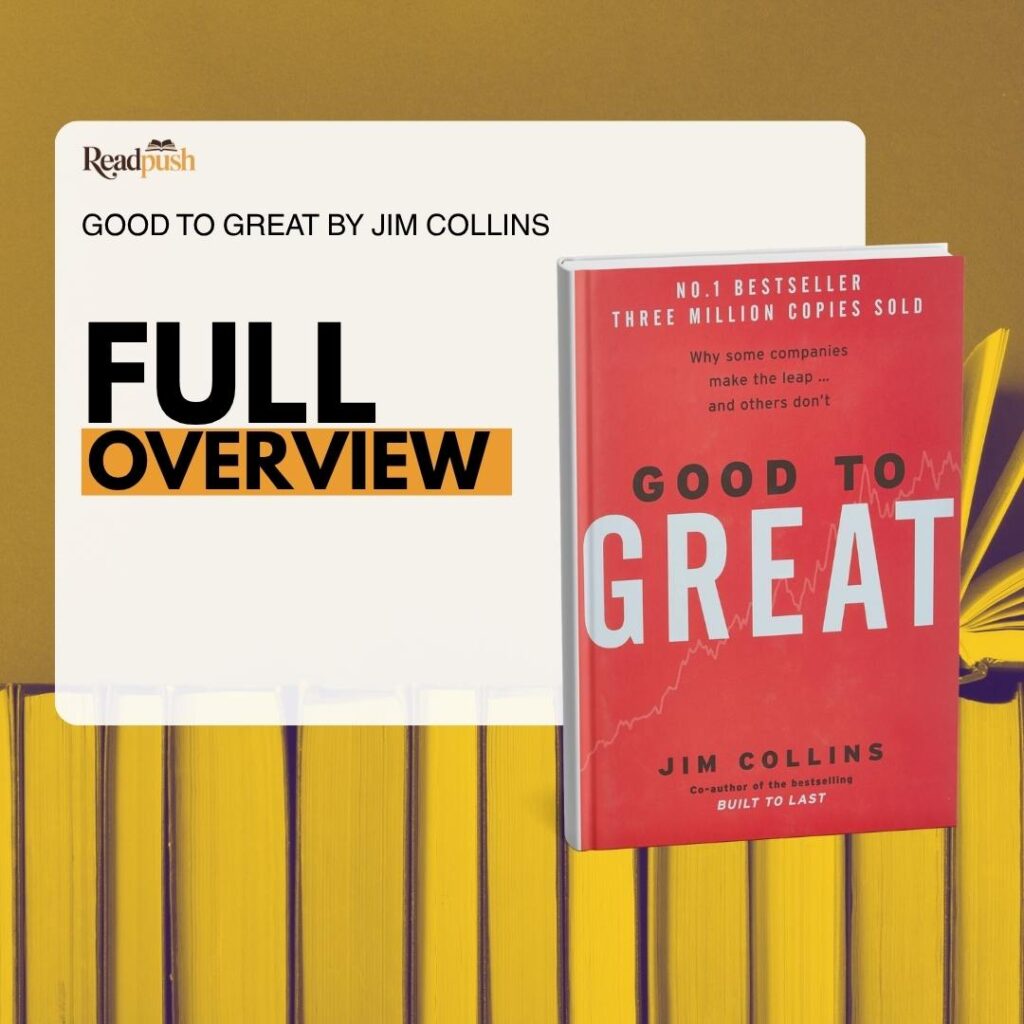
Jim Collins spent five years on Good to Great. His team analyzed 28 companies, found 11 that made a sustained performance leap, matched each with a comparison that didn’t, and looked for patterns. By the standards of business book research, that’s rigorous. By the standards of actual research, it’s a curated list of 11 companies analyzed after the fact by people who already knew which ones won.
The book came out in 2001. Circuit City filed for bankruptcy in 2009. Fannie Mae went into federal conservatorship in 2008, having lost more than 80% of its stock value. Both were celebrated in the book’s pages as exemplars of the very practices that were supposed to produce sustained greatness. That’s not bad luck. That’s a measurement problem.
None of this makes the book worthless. Some of the frameworks hold. Some were always closer to post-hoc storytelling than structural insight. And 25 years is long enough to tell which is which.
The empirical problem no one talks about
Collins’s critics were early. Phil Rosenzweig published The Halo Effect in 2007 before Circuit City collapsed, before the Fannie Mae conservatorship. His argument was structural: when you identify companies that succeeded and then work backward to find what they did differently, you’re not running a controlled experiment. You’re finding confirmation for a story you already decided to tell. The performance of the companies becomes the lens through which every other variable is interpreted. That’s not analysis. It’s narration.
Michael Raynor pushed further. The decisions that look like obvious mistakes in hindsight looked, in real time, exactly as defensible as the decisions that worked. The comparison companies Collins studied made choices that were logically coherent given what they knew. The difference was outcome. You can’t reliably separate cause from coincidence when the outcome is what identifies the cause.
Then there’s the sample. Eleven companies. In a market the size of the S&P 500, across a 15-year window, finding 11 companies that share some behavioral patterns and outperformed tells you almost nothing about whether those patterns caused the outperformance. It’s not a finding. It’s a selection.
|
25-year reckoning What happened to Collins’s 11 “great” companies
Abbott, Gillette (acquired by P&G 2005), Kroger, Walgreens, and Philip Morris round out the 11. Mixed outcomes. Not exactly the endorsement the book implied. |
||||||||||||||||||||||||||||||||||||
Collins published How the Mighty Fall in 2009 partly in response to the criticism reframing decline as a predictable five-stage sequence. It’s a reasonable defensive move. But “great companies can also fail if they later make bad decisions” doesn’t rescue the original thesis. It makes the framework unfalsifiable. Any failure becomes a defection from the model. Any success is the model working. That’s not a theory. That’s a frame that can absorb any result.
Framework verdicts: what to keep
The methodology problems don’t automatically kill the frameworks. A model can be diagnostically useful even when the case studies built around it collapse. The question is which ones survive on their own terms not because Collins proved them, but because they hold up under scrutiny independent of the original research.
Level 5 leadership: keep, with one asterisk
The claim: leaders who combine personal humility with fierce professional will outperform charismatic, ego-driven counterparts over time. Collins found this pattern consistently in the 11 great companies. Absent in the comparison group.
The problem Collins never fully addressed: he didn’t test whether Level 5 leaders also fail. If the same leadership profile sometimes produces mediocre results, it’s not the defining variable it’s a correlation in the sample he chose. Jack Welch is the standing counterexample. GE’s results under Welch were real. Welch, by his own account, was the opposite of a Level 5 leader.
Still, the behavioral description is worth keeping. Leaders who deflect credit and absorb blame, who are fanatical about outcomes and indifferent to their own recognition, tend to build better cultures than leaders who need to be the story. That observation has enough independent support across psychology, organizational behavior, and practical experience to survive the case studies failing. The causal claim is probably overstated. The behavioral model is useful.
First Who, Then What: conditionally right
Get the right people on the bus before you decide where the bus is going. The logic is sensible: great people adapt to changing circumstances; a great strategy executed by the wrong people fails. Collins argues that the “who” comes before the “what” in every sustained performance leap.
Where it breaks: the framework assumes you can afford to hire first and figure out direction second. That’s a premise most early-stage companies can’t meet. It’s an argument for organizations that already have the capital to carry seat-warmers while strategy develops. For a team where every hire has to be productive on day one, it’s a luxury position presented as a universal truth.
For established organizations pivoting strategy, it’s often exactly right. The framework is real. The scope is narrower than Collins claims.
The Flywheel: the most durable idea in the book
Breakthrough performance doesn’t come from a single defining moment or a single correct decision. It comes from consistent, aligned effort that compounds over time. Each push on the flywheel adds to the last. The breakthrough looks sudden from the outside. From inside, you just kept pushing.
The limitation is the timeline assumption. Collins’s examples all come from large, established companies in relatively stable industries, operating across 10 to 20-year horizons. The flywheel is the right model when the market direction is stable and patience is a strategic advantage. It’s a worse model for businesses in markets that are moving faster than a flywheel can build. Which is most markets now.
Directionally right. Watch for the fact that every example is from a slow industry.
Framework verdicts: what to drop
The Hedgehog Concept: intellectually tidy, operationally fragile
Find the overlap between three questions: what you’re deeply passionate about, what you can be the best in the world at, and what drives your economic engine. Commit to that intersection. Operate there.
The first problem is “best in the world.” That phrase does almost no work for most organizations. What does it mean for a regional bank to be “best in the world” at something? The concept requires a definition of “world” that’s usually arbitrary and always self-serving.
The second problem is that the three circles are easier to draw than to inhabit. The intersection shifts. What a company was best at in 2001 may not be what it should be best at in 2026. The framework rewards clarity at the cost of adaptability. That’s a real trade-off Collins mostly ignores. He presents the Hedgehog as a destination. In practice, it’s a snapshot that expires.
Berlin’s fox-hedgehog distinction, which Collins borrowed for the framing, is richer and more ambivalent than the book suggests. Berlin wasn’t arguing hedgehogs win. He was describing a cognitive style. Collins found a metaphor and used it to mean something Berlin never intended.
The real critique: the Hedgehog Concept pressures organizations into false clarity. You’re supposed to commit to the intersection before you can be certain it’s the right intersection. In fast-moving markets, that commitment can become a liability before it becomes a strength. Revisit it every few years. Don’t tattoo it on the org chart.
Culture of Discipline: retire the phrase
Great companies have disciplined people who engage in disciplined thought and take disciplined action. You don’t need hierarchy if you have discipline. Collins argues that this is what makes the flywheel turn.
Wells Fargo was one of Collins’s 11. In 2016, the bank disclosed that employees had opened 3.5 million fraudulent accounts without customer consent. It happened because a sales culture rewarded aggressive cross-selling targets and penalized those who missed them. By any reasonable measure, that’s a culture of extraordinary discipline. It produced one of the worst retail banking scandals in American history.
The framework has no fourth circle for “discipline toward what end.” Collins assumes that disciplined execution of the right strategy is the separating variable. But discipline amplifies whatever direction an organization is pointing. If that direction includes distorted incentives, discipline becomes a factory for misconduct. Not an edge case. A structural gap.
Collins could respond that Wells Fargo “fell from greatness” the framework conveniently allows any failure to be explained as deviation from it. But the point isn’t that Wells Fargo deviated from its culture of discipline. The point is that the culture of discipline produced the fraud. That’s a different thing.
The underlying idea that people matter and systems matter is correct. The framing as a singular defining virtue is not. Retire the phrase.
|
Framework scorecard Which Good to Great frameworks survive 2026
|
||||||||||||||||||||||||||||||
Common misconceptions about Good to Great
Misconception: the research proves the frameworks work. The research identifies correlations in a handpicked set of companies over a specific window. Correlation in a sample of 11 is not proof. The subsequent performance of those companies suggests the correlation wasn’t robust to begin with.
Misconception: Level 5 leadership means being passive or quiet. Collins is describing something precise: fierce ambition channeled entirely toward the organization rather than toward personal recognition. The “humility” is about credit and blame, not about intensity or decision-making style. Level 5 leaders in the book were demanding. Often difficult. The personality was directed outward, not toward ego.
Misconception: the Hedgehog Concept is about focus. It’s actually about identity. Collins argues that great companies know what they are, not just what they’re good at. That’s a more ambitious and more fragile claim. Most of the strategic value people get from the Hedgehog would be better captured by simpler positioning frameworks that don’t require pretending you can be “best in the world” at anything.
Misconception: the book was discredited after Circuit City failed. Rosenzweig’s critique came out in 2007. Levitt’s numbers predated the bankruptcy. The company failures are illustrative they confirm what the methodological critique already said. The structural problem was there from the start.
The same issue appears from another angle in powerful quotes from good to great, where the business trade-off the book is trying to clarify becomes easier to see without turning the book into a slogan.
The same issue appears from another angle in Comparing The Habits with modern leadership books, where the question of attention, habits, and what actually changes behaviour becomes easier to see without turning the book into a slogan.
The same issue appears from another angle in Productivity books that actually work, where the question of attention, habits, and what actually changes behaviour becomes easier to see without turning the book into a slogan.
Should you read it in 2026?
Yes. Once. With a specific filter.
Read it for Level 5 Leadership. The behavioral profile of a leader who is ambitious for the organization and almost uninterested in personal glory is real, underappreciated, and not well-captured anywhere else in management literature. Collins got something there even if the proof didn’t hold.
Read it for the Flywheel as a mental model. If you’re building something that requires sustained effort over a long horizon and most worthwhile things do the idea that momentum compounds and consistency beats episodic brilliance is worth internalizing. It doesn’t need the case studies to be true.
Don’t read it as evidence-based strategy. Retrospective business research, which this book helped popularize, can produce any conclusion if you pick the right companies and the right time window. It’s a framework document dressed as a research report. The dress is convincing. The body underneath is thinner than it looks.
Don’t treat the case studies as proof. Circuit City is a cautionary tale about a book that picked the wrong exemplars. Fannie Mae shows how institutional incentives override cultural platitudes. Wells Fargo shows what discipline produces when pointed at the wrong targets.
For a methodological comparison of how Collins’s empirical approach holds up against Built to Last, the Good to Great vs Built to Last breakdown covers both books’ structural problems side by side.
Keep Level 5. Keep the Flywheel. Watch the Hedgehog. Retire “Culture of Discipline” as a phrase. And when someone cites the 11 companies as evidence of anything, ask what happened to them after 2001.
The answer is embarrassing enough to change the conversation.