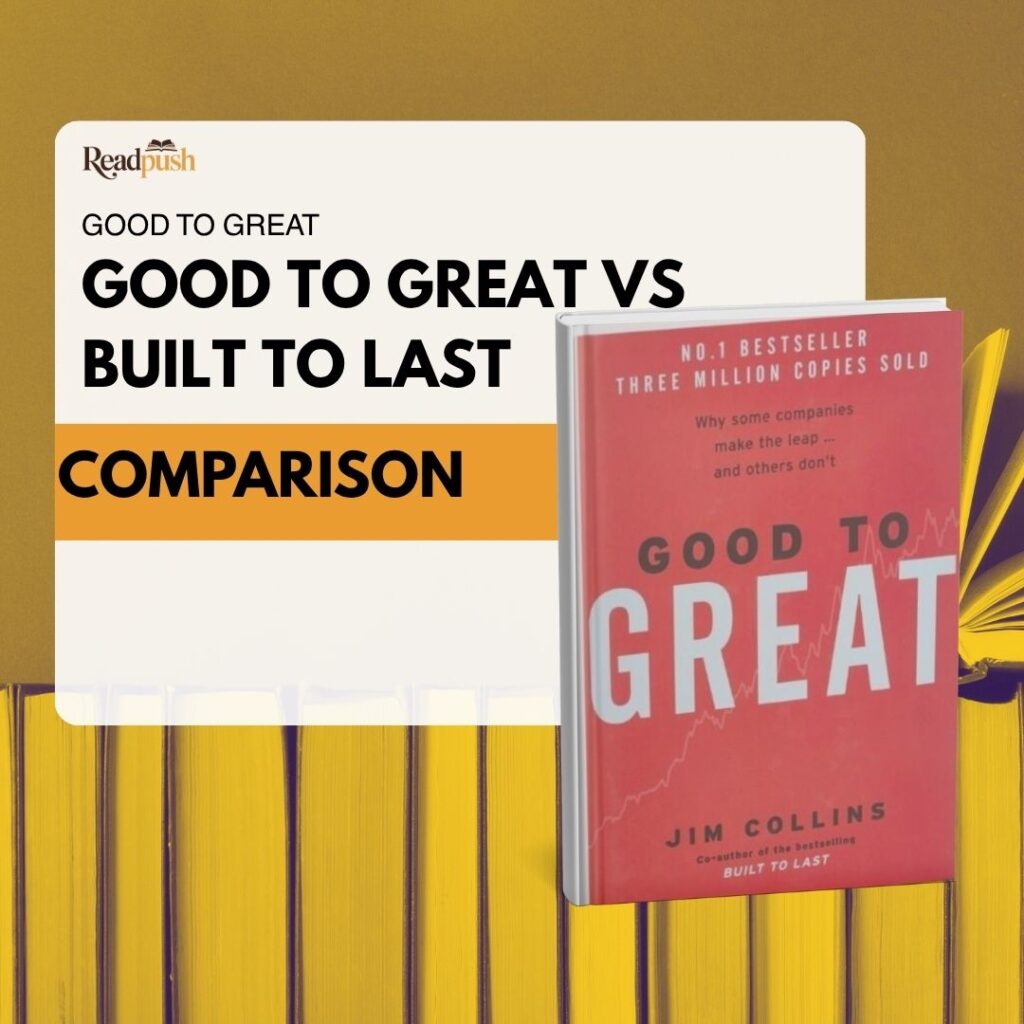
Every ambitious entrepreneur eventually hits a crossroads. Should you focus on building a lasting company from scratch or transforming a good one into something great? Both sound noble. Both sound urgent. But which book good to great or built to last actually helps you get there faster?
Both titles promise to reveal the dna of extraordinary companies. Built to last shows how visionary firms sustain greatness for decades, while good to great explains how ordinary ones can make the leap.
This comparison matters because most leaders aren’t starting at zero anymore they’re scaling or reinventing what already exists.
This approach comes from jim collins’ groundbreaking research on what separates truly great organizations from the rest.
We’ve written full reviews of both good to great and built to last where we unpack their frameworks and leadership principles in depth.
By the end of this article, you’ll know which book best fits your journey and why reading both might be the smartest business move you make this year.
Quick overview of each book
Good to great overview
Author jim collins, a stanford professor turned leadership researcher, spent five years analyzing how some companies make the leap from good to great while others plateau.
Published in 2001 the book identifies clear patterns behind breakthrough performance from level 5 leadership to the hedgehog concept and the flywheel effect.
Its data-driven findings show that greatness isn’t luck it’s the result of disciplined people thought and action sustained over time.
Built to last overview
Co-authored by jim collins and jerry porras, built to last (1994) studied visionary companies like 3m, disney, and hewlett-packard to uncover how they endure for generations.
Rather than focusing on short-term success it explores how core ideology and a strong culture create resilience.
It’s a manual for founders and visionaries designing companies to stand the test of time not just to win a single decade.
Side-by-side comparison
Core philosophy and approach
Good to great starts with realism. It’s about companies that were once average gillette, walgreens, kimberly-clark and turned themselves into outperformers. Its philosophy: greatness is a choice and a discipline not a birthright. The book revolves around data and transformation.
Built to last, on the other hand, starts with inspiration. It celebrates companies that began visionary and stayed that way. The core idea: enduring greatness comes from preserving core values while stimulating progress.
Key difference: good to great teaches you how to become great. Built to last teaches you how to stay great. One focuses on the leap; the other on longevity.
Strength of each
Good to great excels at clarity. Its frameworks the hedgehog concept, flywheel effect, and level 5 leadership translate complex strategy into simple, repeatable processes. For example, walgreens’ focus on “the best convenient drugstore” perfectly embodies the hedgehog concept in action (see our case study on walgreens).
Built to last shines in its depth of vision. It introduces the idea of “preserve the core, stimulate progress,” showing how companies like disney built adaptable yet value-driven cultures. It’s ideal for leaders thinking 20 years ahead.
Verdict: good to great is tactical. Built to last is philosophical. The former gives you movement; the latter gives you meaning.
Writing style and accessibility
Good to great feels more analytical and structured. It’s data-heavy yet readable, making it ideal for professionals who appreciate logic and evidence.
Built to last feels broader and more visionary. It’s slower-paced but richer in narrative, perfect for founders or creative leaders seeking inspiration.
In short, good to great reads like a leadership blueprint, while built to last reads like a company constitution.
Who should read which
Read good to great if:
- You’re leading an established company or team and want a repeatable system for breakthrough performance.
- You value research, data, and case studies over anecdotes.
- You’re interested in frameworks like level 5 leadership or the flywheel effect.
- You want immediate, measurable business transformation.
Read built to last if:
- You’re a founder, visionary, or culture builder creating something to outlive you.
- You care about mission, core values, and legacy.
- You enjoy big-picture thinking and the psychology of enduring success.
- You want to design an organization that lasts generations.
Read both if:
- You want to master both transformation and sustainability.
- You lead a company that’s already growing but wants to endure.
- You prefer learning the “how” from good to great and the “why” from built to last.
Recommended order: start with good to great to learn the disciplines that drive momentum. Then move to built to last to understand how to preserve your greatness over time.
So, which builds better companies in 2025?
If you want to transform performance and see tangible results, good to great wins.
If you want to create an enduring legacy and culture, built to last holds the key.
Both books remain timeless because they complement each other. Together, they form a complete growth philosophy from the spark of transformation to the structure of sustainability.
Explore our full good to great summary and built to last summary for deep dives into each framework, including leadership principles, case studies, and actionable strategies you can apply today.
What this idea changes in practice
The useful way to read this piece is not as a shortcut around the book, but as a way to decide what the book is really asking you to notice. Good to Great is easy to reduce to a phrase. The phrase is helpful, but it is also where many readers stop too early.
The practical question is: what changes after you understand the idea? If the answer is only that you can repeat the concept in a meeting, the idea has not done much work yet. A good business or self-improvement book should change a decision, a habit, a conversation, or a way of measuring progress.
For this article, the change is usually smaller and more concrete than the headline suggests. You stop treating the concept as an inspirational lesson and start using it as a filter. It helps you decide what to ignore, what to inspect more closely, and where your current approach may be wasting effort.
That is where ReadPush readers get the most value. Not from another summary, and not from pretending the book is perfect. The value is in separating the durable idea from the noise around it.
Where readers often get it wrong
The common mistake is to treat the book’s central idea as universal. Most book ideas are not universal. They are conditional. They work better for some people, teams, markets, and seasons than others.
That does not make the idea weak. It makes it usable. Advice becomes more useful when you know its boundary. A habit system helps when your life has enough stability to support repetition. A strategy framework helps when the market conditions match the assumptions behind the framework. A finance lesson helps when it is applied to the right kind of risk, not every risk.
So the better reading is not, is this book right? The better reading is, where is this book right, and what would make it wrong for me? That question protects you from two bad habits: dismissing useful books because they are imperfect, and overusing famous books because they sound confident.
If you take only one thing from this article, take that discipline. Apply the idea where the conditions fit. Leave it alone where they do not.
How to apply the lesson without overcomplicating it
Start with one decision. Do not turn the book into a whole operating system on day one. That is how good ideas become heavy.
- Name the problem. What are you actually trying to improve: focus, growth, cash flow, consistency, leadership, decision quality, or something else?
- Pick the relevant principle. Choose one idea from the book that speaks directly to that problem.
- Define the test. What would look different after two weeks if the idea is working?
- Review the result. Keep what helped. Drop what added friction.
This keeps the lesson grounded. You are not trying to become the kind of person who has mastered the whole book. You are trying to make one part of your work or life less vague.
The same issue appears from another angle in The lean startup vs good to great, where the business trade-off the book is trying to clarify becomes easier to see without turning the book into a slogan.
The same issue appears from another angle in The Psychology of Money vs The Power, where the question of attention, habits, and what actually changes behaviour becomes easier to see without turning the book into a slogan.
The same issue appears from another angle in Rich Dad Poor Dad vs The Total, where the money decision underneath the book becomes easier to see without turning the book into a slogan.
A better final takeaway
The strongest books on ReadPush are rarely the ones that give the neatest answers. They are the ones that improve the quality of your next question. Good to Great is worth returning to for that reason.
Ask what the idea reveals. Ask what it hides. Ask what it would look like in a normal week, with normal constraints, limited time, and imperfect follow-through. If the idea still helps there, it is probably worth keeping.
That is the standard. Not whether the book sounds impressive. Whether it survives contact with real life.
What to reread in the original book
If you go back to the source, reread the chapters around the core framework rather than the promotional parts around it. Most business and personal development books repeat themselves. The useful material is usually clustered where the author explains the mechanism: why the idea works, when it fails, and what kind of behaviour it is meant to change.
When you reread, mark examples differently from principles. Examples are there to clarify. Principles are there to travel. Trouble starts when readers copy the example and miss the principle underneath it.
That distinction is especially important with Good to Great. The surface lesson is easy to remember. The deeper value comes from noticing the assumptions behind the lesson. Once you see those assumptions, you can apply the idea with more judgement and less imitation.