Quick takeaways
- Habit stacking and the two-minute rule are the two most transferable tools from Atomic Habits. They work on the same principle: remove the cost of starting, and the habit follows.
- Environment design does more work than motivation. The habits that survive difficult weeks are almost always the ones with a visible cue and a low barrier to entry.
- The most common reason habits collapse isn’t lack of discipline. It’s that the system was asking too much too soon. Start smaller than feels necessary.
- Identity matters more than tracking. You can tick every box and still lose the habit if you haven’t quietly decided you’re the kind of person who does this.
The failure cycle for new habits is remarkably consistent. You start with genuine motivation. You make it through the first week, maybe the second. Then something interrupts — a long day, a disrupted schedule, a few nights of poor sleep — and the habit breaks. You come back to it a few weeks later with fresh resolve, and the same thing happens. After enough repetitions you start to believe the problem is you.
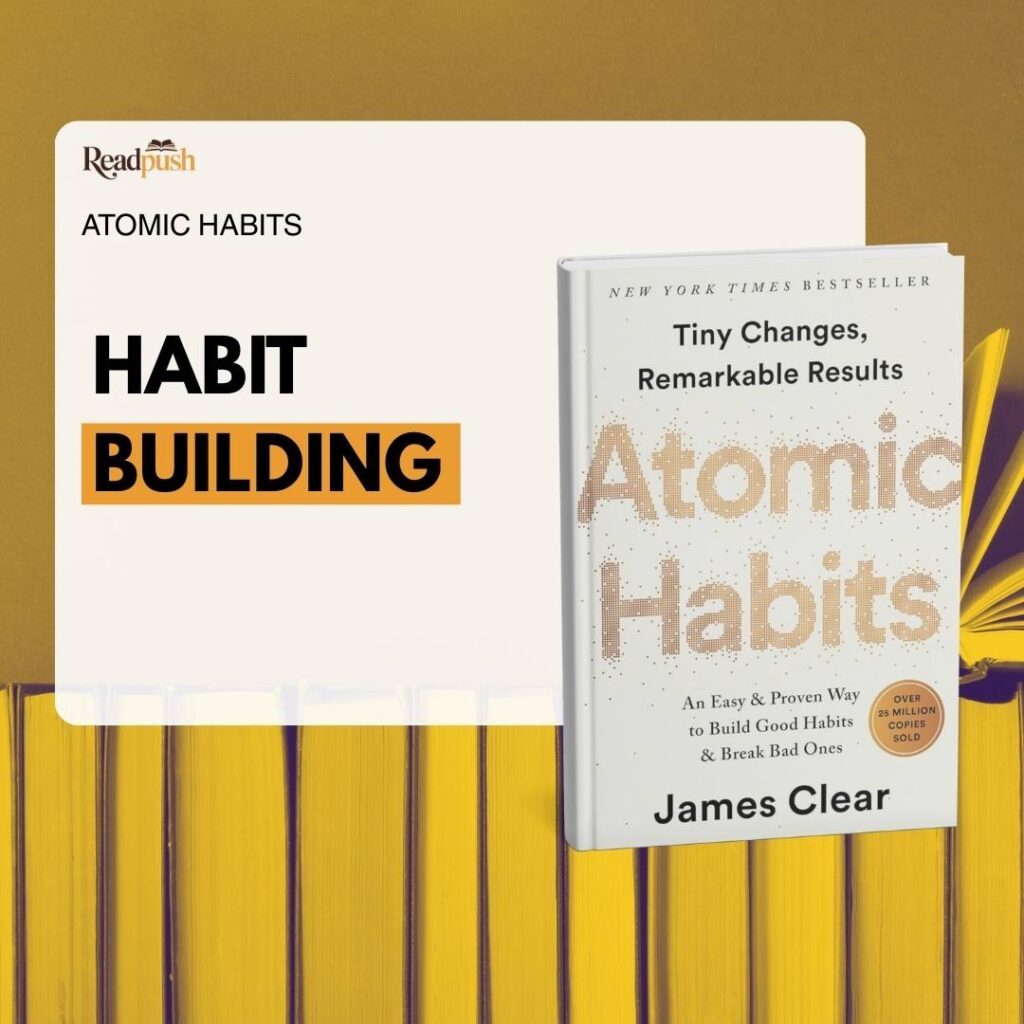
It usually isn’t. What breaks most habits isn’t a character flaw. It’s a design flaw. The system was built on motivation rather than structure, and motivation runs out. James Clear’s Atomic Habits makes this case methodically and well: the habits that survive are the ones embedded in an environment that makes them easier to do than to skip, not the ones backed by the strongest initial intention.
This guide works through two of the book’s most practically useful frameworks — habit stacking and the two-minute rule — and shows how to build them into a system that holds up on the low-energy days, not just the good ones.
Why motivation isn’t the problem
Most people who struggle with habits have no shortage of motivation at the start. They want to change. They’ve thought about it carefully. They’ve decided this time will be different. And then it isn’t, and the story they tell themselves is: I just don’t have the willpower.
What’s worth noticing is that willpower is genuinely unreliable — not as a character trait but as a resource. It depletes through the day. It’s lower when you’re stressed, hungry, tired, or overloaded. A habit that requires willpower to initiate will eventually hit a day when the reserves aren’t there, and on that day, it breaks.
Clear’s argument, and the research behind it, is that durable habits don’t depend on willpower. They depend on design. The question to ask about any habit you want to build isn’t “how much do I want this?” It’s “how easy is it to start?” Those are different questions, and they lead to different solutions.
The Four Laws of Behavior Change from Atomic Habits — make it obvious, attractive, easy, satisfying — are essentially a checklist for that question. Before trying to build more discipline, check whether the habit is visible, whether starting it is frictionless, whether something satisfying follows quickly. Fix those first.
Habit stacking: using what you already do
Habit stacking is the practice of linking a new behavior to one you already perform reliably. The formula is simple: After I [existing habit], I will [new habit]. After I pour my morning coffee, I will write one sentence. After I sit down at my desk, I will open the document. After I close my laptop at the end of the day, I will take a five-minute walk.
The reason this works is that your existing habits already have triggers embedded in your day. You don’t need to remember to do them; the environment cues them automatically. When you attach a new behavior to an existing one, you borrow that trigger. The new habit inherits the reliability of the old one.
A few things that help when building a stack:
The anchor habit should be genuinely automatic — something you do every day without thinking, at roughly the same time and place. Morning coffee works for most people. Sitting down to start work. Brushing teeth at night. The more consistent the anchor, the stronger the cue.
The new habit should follow immediately. A five-minute gap gives the brain a chance to redirect. Do the old thing, then the new thing, with no buffer between them.
If the stack breaks — the anchor routine doesn’t happen one day, or the sequence gets disrupted — restart it exactly as designed. Don’t modify the formula mid-stream. The reliability of the stack comes from its consistency.
The two-minute rule: making starting the only job
The two-minute rule is disarmingly simple. Take any habit you want to build and reduce it to a version that takes less than two minutes. Not “read for thirty minutes” — read one page. Not “meditate for twenty minutes” — sit down and close your eyes. Not “go to the gym” — put on your workout clothes.
People sometimes misread this as advice to do less. It isn’t. The two-minute rule is about removing the activation cost of starting, which is almost always the hardest part. Once you’re already reading, continuing is easy. Once you’re already in your workout clothes, going to the gym has much less resistance than it did five minutes ago. The rule doesn’t limit how long you do something. It just guarantees you begin.
There’s something else worth understanding about why this matters over time. Identity builds through repeated action, not through the scale of any single action. A person who reads one page every day for a year has built more durable evidence of being “a reader” than someone who reads for three hours once a month. The frequency matters more than the duration, especially in the early stages.
|
The two frameworks Habit stacking and the two-minute rule
|
||||||||||||||||||||||||
Building the system: a practical sequence
These two frameworks work best together. Here’s a simple sequence for putting them into practice.
Choose one habit only. Not three. Not two. Pick the one that, if it became reliable, would have the most meaningful impact on your work or life right now. Write it down in a single clear sentence: not “be healthier” but “exercise for ten minutes before work.”
Apply the two-minute rule to it. Take your chosen habit and shrink it until starting takes less than two minutes. If it still feels like it requires effort, shrink it further. The version you’re looking for is the one where the main obstacle to doing it is just the decision to start — and nothing else.
Find an anchor habit to stack it on. Identify an existing routine that happens daily, at a predictable time, in the right context. Write the stack formula out explicitly: After I [anchor], I will [new habit]. Put it somewhere you’ll see it in the moment — a sticky note, a phone reminder, a note in your calendar.
Design the environment. Place a physical cue in the right spot. Running shoes by the door. A book on the kitchen counter. A journal open on the desk. The cue should be impossible to miss when the anchor moment arrives. Your environment should be doing as much of the work as possible before you’ve made a single active decision.
Track completion, not duration. For the first two weeks, the only metric that matters is whether you did the habit. Not how long. Not how well. Just whether it happened. A simple checkmark on a calendar is enough. This builds the identity reinforcement — the accumulating evidence that you’re the kind of person who does this — before you worry about scale.
Expand slowly, only when it feels automatic. After ten to fourteen days of consistent completion, increase the duration or scope slightly. One page becomes three. Five minutes becomes ten. The expansion should feel natural, not pressured. If it starts to feel effortful again, you’ve grown too fast — pull back to the version that felt automatic.
The mistakes that break systems
A few patterns come up consistently in habits that break down, and they’re worth naming directly.
Starting too big. The most common one. The initial version of the habit should feel almost embarrassingly easy. If it doesn’t, it’s still too large. The instinct to make it meaningful from day one is understandable, but it’s usually the thing that kills the system in week two.
Running multiple new habits at once. Each new habit draws on the same limited attention. One new habit has a reasonable chance of sticking. Three compete for the same cue-setting, the same environment design, the same tracking attention. Let one become genuinely automatic before introducing another.
Using motivation as the cue. “I’ll do it when I feel like it” is not a system. Motivation is useful for getting started but terrible as a trigger. The cue needs to be external and reliable — a time, a preceding action, a physical object in your environment. Something that happens whether you feel like it or not.
Breaking twice. Missing a day is human. Missing two days in a row is the beginning of a new habit — the habit of not doing the thing. Clear’s “never miss twice” isn’t a rule to feel guilty about; it’s a design principle. When you miss once, the system absorbs it. When you miss twice, the friction rebuilds and starting again costs more than it did the first time.
|
Common failure points Why habits break — and the design fix for each
|
||||||||||||||||||||
The same issue appears from another angle in Lessons from Atomic Habits, where the question of attention, habits, and what actually changes behaviour becomes easier to see without turning the book into a slogan.
The same issue appears from another angle in The Psychology of Money, where the money decision underneath the book becomes easier to see without turning the book into a slogan.
The same issue appears from another angle in How to build habits that actually stick, where the question of attention, habits, and what actually changes behaviour becomes easier to see without turning the book into a slogan.
The identity layer underneath the system
All of this — the stacking, the two-minute rule, the environment design — is scaffolding. It helps a lot. But the habits that last aren’t just well-designed. They’re backed by a quiet shift in how you see yourself.
Clear’s most important claim is that every repetition of a habit is a small vote for an identity. You aren’t trying to run every morning. You’re accumulating evidence that you’re the kind of person who runs. That distinction sounds subtle, but it changes how you relate to missed days, to hard weeks, to the moments when the habit is annoying and you’d rather not. A person who is trying to build a running habit has to keep convincing themselves to do it. A person who thinks of themselves as a runner just goes.
The systems matter. And the identity matters more. The practical work of the two-minute rule and habit stacking is useful precisely because it creates the conditions for that identity to build — through repetition, through small visible evidence, through showing up on the days when motivation isn’t there. That’s where the habit becomes genuinely yours rather than something you’re forcing yourself to do.
If you want to understand the identity argument in more depth, the full analysis of Atomic Habits on this site covers it thoroughly, including where Clear’s framework has real limits and what the research actually says about how identity shifts over time.