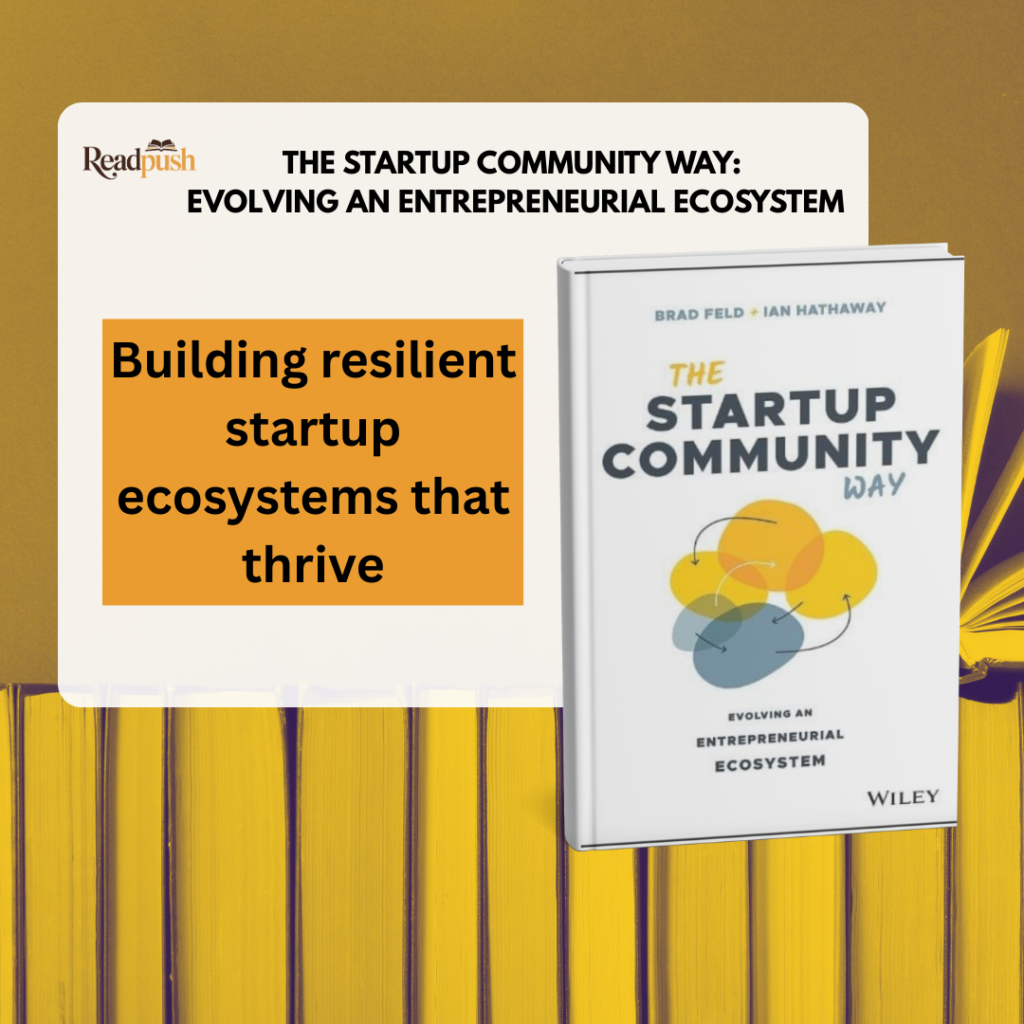
If you’re an entrepreneur ; marketer ; or community leader you’ve likely grappled with the challenge of building a successful startup ecosystem. The common impulse is to control every aspect with rigid plans but The Startup Community Way offers a counterintuitive insight: thriving startup communities are complex adaptive systems that cannot be micromanaged. Instead success depends on embracing uncertainty nurturing grassroots leadership and running constant experiments to foster organic growth. This book solves the dilemma of managing complexity without losing sight of practical implementation making it indispensable for anyone looking to cultivate vibrant entrepreneurial communities over the long term.
For a complete breakdown ; see our full review of the startup community way.
Book overview
The Startup Community Way is co-authored by Brad Feld, a veteran entrepreneur and co-founder of Techstars and Ian Hathaway an economist and startup ecosystem expert. Published in 2020 ; the book builds on Feld’s earlier work but expands it by integrating complexity science to explain why startup communities thrive or fail. The authors bring decades of personal experience and research to offer an informed and practical framework that sees ecosystems as living networks not machines. This makes their work uniquely relevant for entrepreneurs ; government officials and ecosystem builders who want to understand how to nurture innovation through collaboration and decentralized leadership.
Unlike many business books focused on tactics or isolated strategies. This book’s strength lies in combining scientific insight with real-world examples . offering a holistic view that requires patience and a long-term vision.
KEY LESSONS
I group the lessons into four themes so your future listicle is already structured.
Theme 1. Think in systems not projects
Lesson 1. Treat your startup community as a complex system not a machine to control.
The book insists that startup communities are complex adaptive systems with nonlinear and unpredictable dynamics. Trying to fix one part in isolation often creates new problems elsewhere. You get better results when you look at connections between actors, factors and time rather than chasing isolated KPIs.Category. Systems thinking.
Lesson 2. Focus on interactions not parts.
Real leverage comes from changing how people interact, share information and support each other. Mapping relationships, tracking collaboration and understanding who connects whom often reveals more than counting startups or events.Category. Systems thinking.
Lesson 3. Be holistic with measurement and avoid the rankings trap.
The book warns against over reliance on simple rankings or vanity metrics. It recommends wide ranging, pragmatic measurement that combines quantitative data network analysis and qualitative insight and focuses on changes over time in one place.Category. Measurement and strategy.
Theme 2. Put founders first and lead from the bottom up
Lesson 4. Make “founders first” a non negotiable value.
Successful communities consistently prioritize entrepreneurs over institutions. Programs media sponsorship and policy all orbit around the needs of founders instead of the agenda of feeders. This founders first principle is explicit in the Startup community way values.Category. Culture and values.
Lesson 5. Entrepreneurs must lead, institutions must support.
Feld’s Boulder Thesis is clear. Entrepreneurs lead the community. Institutions such as government universities and corporates play a support role even when they bring resources. When feeders dominate the community becomes bureaucratic and less effective.Category. Leadership.
Lesson 6. Practice a give first mindset.
The book promotes giving before you get as a core behavior. Mentoring, making introductions and sharing knowledge without expecting immediate payback builds trust and long term influence. Over time this generosity compounds into dense networks of support.Category. Culture and values.
Theme 3. Play the infinite long term game
Lesson 7. Use a “20 years from today” horizon.
The foreword explains that Brad evolved his original 20 year timeline toward a rolling “20 years from today” view. Innovation work never ends. You expect slow uneven progress not quick wins. This mindset prevents disappointment and keeps leaders patient. Category. Time horizon and expectations.
Lesson 8. Think in generations not electoral cycles.
The book shows how families, long term investors and committed local leaders can catalyze change when they accept that real community transformation takes decades. Durham’s American Underground story illustrates this generational view in action. Category. Time horizon and expectations.
Lesson 9. Keep activities continuous for the entire entrepreneurial stack.
The Boulder Thesis insists on ongoing activities that engage people at different stages from aspiring founders to experienced entrepreneurs. Regular meetups programs and informal gatherings create rhythm and density that keep the community alive between big events. Category. Community design.
Theme 4. Build capital that compounds over time
Lesson 10. Invest in networks of trust, not just infrastructure.
Strong communities spend as much energy building trust relationships and shared norms as they do on physical spaces or funds. Durham and Madison examples show how dense collaborative networks outperform scattered transactional interactions. Category. Social capital.
Lesson 11. Use storytelling to legitimize startups and attract allies.
The Kansas City case shows how entrepreneurial media and storytelling raise the perceived legitimacy of founders attract attention and pull more people into the ecosystem. Stories become fuel that moves resources and energy toward startups. Category. Narrative and communication.
Lesson 12. Use measurement as a learning tool not a weapon.
The book tells you to use data to inform decisions rather than drive them blindly. It recommends a cycle of define and align; gather and convene ; praise and raise; refine and repeat so that measurement strengthens collaboration instead of creating fear or gaming. Category. Measurement and learning.
Lesson 13. Embrace diversity as a core feature not a checkbox.
Diversity and inclusion are treated as structural advantages not side topics. Complex problems require many perspectives so inclusive communities that welcome anyone who wants to participate are better equipped to innovate and adapt. Category. Diversity and inclusion.
Lesson 14. Aim for community and ecosystem fit.
The book introduces community ecosystem fit as an analogy to product market fit. When the startup community and the broader ecosystem align resources flow more easily and a virtuous cycle takes off. Misalignment slows everything down no matter how much money is present. Category. Strategy and alignment.
Lesson 15. Use local context instead of copying other cities.
The authors argue that each place must build on its own history, actors and culture. Blindly copying Silicon Valley playbooks or chasing top ranking status ignores local constraints and opportunities. Complex systems cannot be cloned by template. Category. Strategy and positioning.
These themes and lessons give you a solid spine for a listicle like “15 lessons from The startup community way” and can each link back to more detailed explainers or case studies.
MEMORABLE QUOTES
I keep quotes short enough to respect copyright and tag which concept they support. I also mark the ten strongest ones so you know what to feature.
Quote 1. “Startup communities are complex adaptive systems.”
Theme. Systems thinking.
Why it is impactful. In one line it reframes the entire problem. You stop looking for a linear plan and start thinking in networks and feedback loops.
Top 10. Yes.
Quote 2. “The system part of ecosystem is important, but it is treated too casually.”
Theme. Systems thinking.
Why it is impactful. It calls out the gap between trendy language and real practice and challenges leaders who only use the word ecosystem as buzzword.
Top 10. Yes.
Quote 3. “Putting founders first, giving before you get, and having an intense love of place are essential values.”
Theme. Culture and values.
Why it is impactful. This line compresses the cultural DNA of healthy communities into a simple triad that can guide behavior.
Top 10. Yes.
Quote 4. “The startup community must be inclusive of anyone who wants to participate.”
Theme. Diversity and inclusion.
Why it is impactful. It sets a clear standard. Inclusion is not a side project but a defining rule for system health.
Top 10. Yes.
Quote 5. “Stories are the fuel.”
Theme. Storytelling and narrative.
Why it is impactful. The image is simple and easy to remember. It positions storytelling as infrastructure, not decoration.
Top 10. Yes.
Quote 6. “If you want to change a complex system you change the interactions not the parts.”
Theme. Systems leverage.
Why it is impactful. This line gives a practical rule of thumb for where to focus effort as a community leader.
Top 10. Yes.
Quote 7. “Talented; motivated individuals should be able to create and grow businesses wherever they choose.”
Theme. Geographic opportunity.
Why it is impactful. It challenges the idea that you must move to a global hub to succeed and speaks to founders in smaller cities.
Top 10. Yes.
Quote 8. “Great communities are built with a consortium of diverse and passionate leaders.”
Theme. Leadership.
Why it is impactful. It rejects the hero founder myth at the community level and highlights shared leadership.
Top 10. Yes.
Quote 9. “Complex systems cannot be gamified.”
Theme. Measurement and rankings.
Why it is impactful. It is a direct warning against chasing rankings or superficial scorecards.
Top 10. Yes.
Quote 10. “We believe that, through entrepreneurship the world can become a better place.”
Theme. Purpose and belief.
Why it is impactful. It states the deeper motivation behind all the tactics and frameworks and speaks to values driven founders.
Top 10. Yes.
Quote 11. “Startup communities are the beating heart of entrepreneurship in a city.”
Theme. Community versus ecosystem.
Why it is impactful. It clarifies the relationship between the tight community core and the broader ecosystem that wraps around it.
Quote 12. “Benchmarking is helpful but do not fall into the rankings trap.”
Theme. Measurement.
Why it is impactful. Leaders see themselves in this line and are pushed to rethink how they report progress.
Quote 13. “The work of innovation is continuous.”
Theme. Time horizon.
Why it is impactful. It supports the idea of a rolling 20 year game and lowers the anxiety around short term swings.
Quote 14. “Storytelling is powerful.”
Theme. Narrative.
Why it is impactful. Short, sharp, and easy to reuse in presentations or internal memos.
Quote 15. “Communities require more than just sharing information.”
Theme. Collaboration.
Why it is impactful. It pushes you to move from passive information flow to active convening and decision making.
FRAMEWORKS AND PROCESSES
I focus on the three practical frameworks that show up repeatedly in The startup community way. Each can support a full how to article and step by step guide.
Framework 1. The Boulder Thesis
Problem it solves. Communities often try to copy big city playbooks or rely on institutions to lead. The Boulder Thesis gives a durable foundation for any place starting or rebooting its community.
Steps.
- Entrepreneurs must lead.
- The community must take a long term view.
- The community must be inclusive of anyone who wants to participate.
- The community must have continual activities that engage the full entrepreneurial stack.
Chapter. Introduced in the foreword and reinforced across Part III.
Framework 2. Community ecosystem fit
Problem it solves. Communities often have strong founders but weak alignment with feeders or vice versa. This framework helps diagnose mismatches and design better alignment.
Steps.
- Understand the values, purpose and identity of the startup community.
- Map incentives and constraints across universities; government; corporates and other feeders.
- Identify misalignment and friction points that block collaboration.
- Create activities and communication loops that tighten the connection between layers.
Chapter. Explained in Part I when defining communities versus ecosystems.
The Startup Community Way Evolv…
Suggested how to article title. How to achieve community ecosystem fit in your ecosystem.
Framework 3. The measurement loop (define ; gather ; convene ; refine)
Problem it solves. Leaders often drown in rankings or vanity metrics. This loop helps them create a healthy; shared measurement practice.
Steps.
- Define and align on goals with the community.
- Gather data across actors; factors; network activity and perception.
- Convene people to discuss and interpret the data collaboratively.
- Refine programs, behavior and focus based on insights. Then repeat.
Chapter. Introduced in Part II in the measurement discussion.
Suggested how to article title. How to build a measurement system for your startup community.
CASE STUDIES AND EXAMPLES
The book includes many stories but a few have enough depth for full case study articles. I list them with details pulled from the text.
Case study 1. Madison and startingblock
Company or person. Capital Entrepreneurs ; StartingBlock ; Madison entrepreneurs.
Challenge. Balancing the entrepreneur only ethos of Capital Entrepreneurs with the financial contributions of institutional feeders without losing trust.
Concept applied. Founders first leadership, values protection, openness to collaboration once the community reached maturity.
Results. Madison created a capstone entrepreneurial center that amplified startups while keeping founders visible and leading.
Chapter or pages. Part II around the discussion of communities versus ecosystems.
Standalone article potential. Yes. You can write a full deep dive on how Madison balanced founders first with institutional support.
Case study 2. Kansas city and startland news
Company or person. Startland News.
Challenge. Raising the legitimacy of startups, creating visibility and attracting allies across the city.
Concept applied. Storytelling as fuel for ecosystems, media competition as a driver of legitimacy and participation.
Results. Increased exposure for startups, more engaged citizens, stronger connections between founders and the broader ecosystem.
Chapter or pages. Part II, storytelling section.
Standalone article potential. Yes. This is a strong narrative focused case.
Case study 3. Durham and american underground
Company or person. American Underground, Goodmon family, Durham leaders.
Challenge. Turning a fragmented early stage scene into a dense, collaborative network.
Concept applied. Entrepreneur led vision, long term investment, willingness to let bottom up leaders drive shape and culture.
Results. Expansion to multiple spaces, hundreds of startups, a stronger identity and more tightly woven networks.
Chapter or pages. Part III, Think in Generations.
Standalone article potential. Yes. This is a flagship case for long term generational leadership.
Case study 4. Boulder and the evolution of the boulder thesis
Company or person. Boulder community and Brad Feld.
Challenge. Explaining why Boulder thrived without many of the typical resources.
Concept applied. Entrepreneurs leading, inclusivity, long time horizons, and dense trust networks.
Results. Boulder became one of the most recognized startup communities despite its small size.
Chapter or pages. Introduced early and revisited throughout.
Standalone article potential. Yes, especially for a piece comparing past and updated Boulder principles.
Case study 5. Las Vegas downtown project
Company or person. Tony Hsieh, Downtown Project.
Challenge. Revitalizing a neglected business district and turning it into a startup hub.
Concept applied. Concentrated entrepreneurial density, strong values, bottom up energy.
Results. Major urban revival, global attention to Las Vegas as an experimental ecosystem.
Chapter or pages. Foreword and early narrative.
Standalone article potential. Moderate. Works better as part of a “multiple city transformations” piece.
Case study 6. Raleigh durham informal founder gatherings
Company or person. Adam Klein, Startup Factory leaders, Durham Chamber, CED.
Challenge. Establishing common vision between diverse actors without a central blueprint.
Concept applied. Regular informal gatherings, trust building, collaboration, density.
Results. Alignment among key leaders, coordinated investments, growth of American Underground and stronger founder networks.
Standalone article potential. Good. Works as supporting case to the American Underground story.
COMPARISON HOOKS
These will give you strong angles for comparison style satellite articles. I anchor each hook in what the book actually argues.
Comparison set 1. The lean startup
Why it relates. Both books come from practitioners who emphasize experimentation long term thinking and continuous learning. Eric Ries even wrote the foreword.
What makes the startup community way different. Lean Startup focuses on how individual companies innovate. The Startup Community Way scales that thinking up to entire cities and networks. It deals with relationships trust time horizons and systems rather than product validation.
Potential article idea. Lean Startup versus Startup Community Way for ecosystem builders.
Comparison set 2. Startup communities (Feld’s 2012 book)
Why it relates. This is the precursor and introduces the Boulder Thesis.
What makes this book different. Startup Community Way deepens the theory by adding systems thinking, measurement guidance and practical strategies for navigating complexity. It also updates the original 20 year timeline to a “20 years from today” mindset.
Potential article idea. What changed between Startup Communities and the startup community way.
Comparison set 3. The startup way
Why it relates. Eric Ries extends Lean Startup principles into large organizations.
What makes this book different. The Startup Community Way zooms out even further to the civic level. It describes how organizations, founders, institutions and culture interact. It is about ecosystems, not enterprise teams.
Potential article idea. The startup way versus startup community way for innovation leaders.
Comparison set 4. Zero to one
Why it relates. Both books challenge traditional assumptions about entrepreneurship.
What makes this book different. Zero to One is about contrarian thinking and product strategy. The Startup Community Way deals with relationships, trust networks and community level cycles rather than individual company ideation.
Potential article idea. Zero to One versus Startup Community Way on building real entrepreneurship.
Comparison set 5. The rainforest
Why it relates. The Rainforest also leans on culture, trust and networks as drivers of innovation.
What makes this book different. The Startup Community Way gives a more structured, repeatable and practitioner friendly toolkit grounded in systems thinking rather than sociological metaphor.
Potential article idea. Rainforest versus Startup Community Way on ecosystem culture.
These hooks help you create comparison pieces that can link back to Big Ideas, frameworks and case studies.
SEO KEYWORD FOUNDATION
I keep this clean so you can build your entire content hub without second guessing the search intent or topical clusters
Primary keyword
The Startup Community Way. Evolving an Entrepreneurial Ecosystem summary
Use cases. Pillar post, Big Idea pages, long form guides, comparison articles.
Secondary keywords
Startup Community Way review
Startup community systems thinking
Startup ecosystem complexity
Boulder Thesis principles
Founders first startup community
Give first culture startups
Startup ecosystem trust networks
Measure startup ecosystems
Entrepreneur led community building
Startup community leadership
Startup community case studies
Long term startup ecosystem strategy
Startup ecosystem storytelling
Satellite article keyword sets
For Big Idea 1
Startup community complex systems
Systems thinking entrepreneurship
Nonlinear growth startup ecosystems
Startup ecosystem feedback loops
How complex systems inform startup communities
For Big Idea 2
Entrepreneurs lead communities
Founders first principle
Startup ecosystem leadership
Twenty year startup community strategy
Give first startup culture
For Big Idea 3
Startup ecosystem trust networks
Social capital entrepreneurship
Startup community collaboration
Network capital startup communities
For frameworks
Boulder Thesis explained
Community ecosystem fit
Startup ecosystem measurement framework
For case studies
Madison StartingBlock case study
Kansas City Startland News ecosystem
Durham American Underground case
Las Vegas Downtown Project entrepreneurship
Long tail keyword opportunities
How to build a startup community in a small city
Why startup ecosystems fail
How to measure startup community health
Examples of trust building in entrepreneurial ecosystems
What makes a strong startup community
How to apply systems thinking to entrepreneurship
How to strengthen founder networks
How to create a give first culture
Steps to build community ecosystem fit
Stories of successful startup ecosystems
Why diversity matters in startup communities
How long does it take to build a startup community
Startup community best practices
Real world startup ecosystem examples
How to support entrepreneurs locally
This set covers both informational and guide oriented search intent.
CONTENT SUMMARY FOR PILLAR POST
I compress the essentials so your pillar can close strong or serve as a standalone reference page.
Three paragraph overview
The Startup Community Way. Evolving an Entrepreneurial Ecosystem argues that startup communities behave as complex adaptive systems. They evolve through relationships, trust and ongoing activity, not through top down strategies or quick fixes. Feld and Hathaway draw from decades of work in cities like Boulder, Durham, Madison and Kansas City to show what actually moves communities forward.
At the core of the book is a simple assertion. Entrepreneurs must lead. Institutions must support. Progress takes decades. Strong communities practice inclusivity ; long term commitment and give first behavior. The authors also introduce community ecosystem fit ; a way to align founders with the broader network of universities; government and corporates.
The book stands out for its blend of systems thinking and real stories. It explains complexity in clear language and offers practical ways to work with it rather than fight it. Readers learn how to diagnose misalignment, build trust networks and understand the invisible forces that shape entrepreneurial outcomes.
Main concepts
- Startup communities as complex systems.
- Entrepreneurs lead and feeders support.
- Networks of trust as central capital.
- Twenty years from today horizon.
- Boulder Thesis as a foundation.
- Community ecosystem fit.
- Give first, include everyone, continuous activity.
- Measurement loop for learning.
- Storytelling as legitimacy builder.
Key strengths
- Clear synthesis of systems thinking.
- Strong examples from real cities.
- Practical principles that scale across contexts.
- Honest about time horizons and delays.
- Combines theory and practitioner insight.
Who should read it
- Ecosystem builders.
- Founders who want to understand their environment.
- Public sector leaders involved in innovation.
- Corporate and university partners who want better alignment.
- Community organizers and accelerators.
- Anyone trying to build local entrepreneurial capacity.
One limitation
The book offers depth on principles but less on operational playbooks for early stage community builders who want very concrete step by step instructions. It explains the why clearly but leaves the tactical how to for complementary guides.