Quick takeaways
- Financial independence in the YMYL framework is not a retirement account balance. It is the crossover point: the specific month your investment income exceeds your monthly expenses.
- Most people are trading more of their time than they realize for spending that does not move the needle. The tracking step makes this visible before the math becomes irreversible.
- Freedom of time outlasts income freedom. A high earner who cannot choose their hours is less free than a moderate earner who can. The crossover point is when that changes.
- The crossover calculation and the three evaluation questions work whether or not you follow the full nine-step system. Run them on your own numbers first.
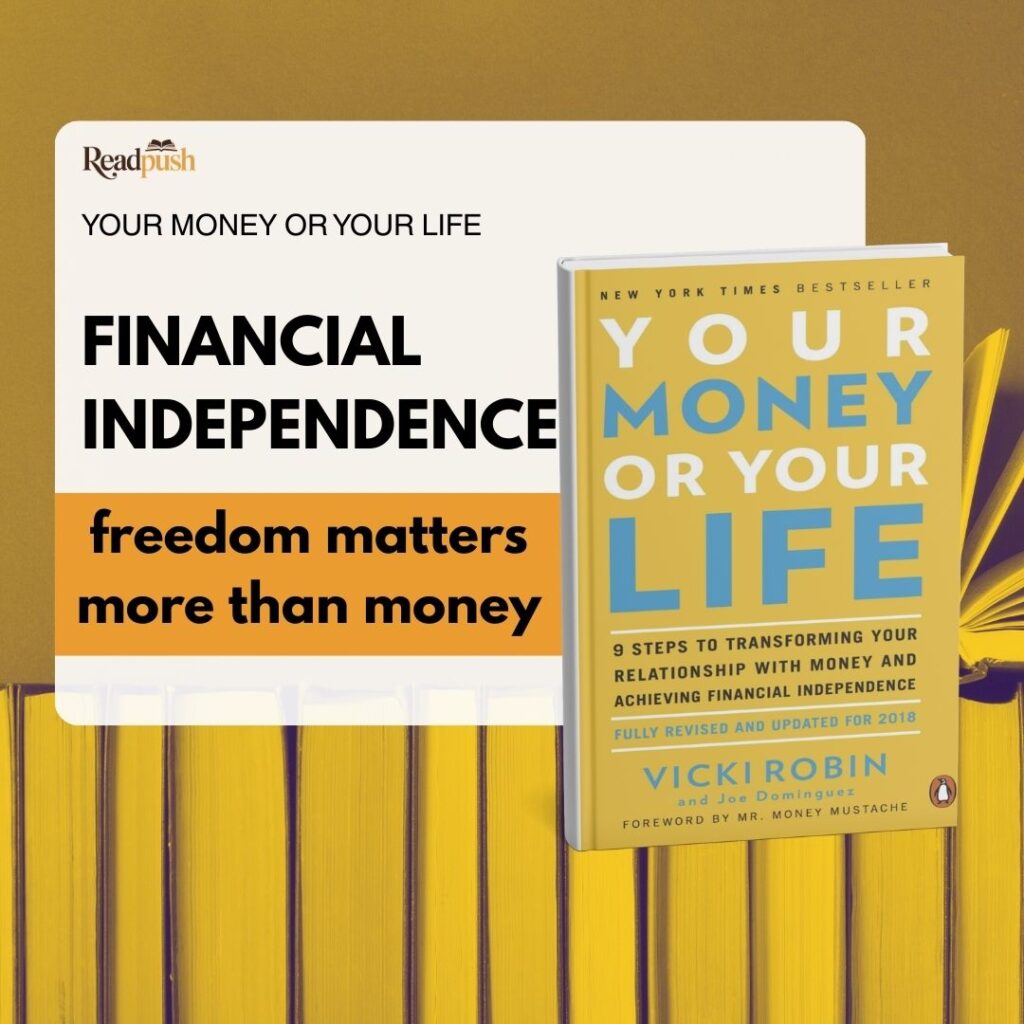
Your Money or Your Life gives financial independence a specific, concrete definition: the month your passive investment income exceeds your monthly expenses. Not a ballpark retirement number. Not a vague sense of security. A specific month on a chart where two lines cross. That precision is one of the more useful things Vicki Robin and Joe Dominguez do in the book.
The underlying idea is simpler: money represents your time, and most people are trading more of it than they realize for things that do not improve their lives much. The Your Money or Your Life summary covers the full nine-step system. This piece focuses on the financial independence argument specifically: what it actually means, why the crossover point is the right finish line, and what derails people before they get there.
Wealthy versus financially independent
Robin and Dominguez draw a line most financial books do not bother with. Wealth is accumulated assets. Financial independence is the specific state where those assets generate enough passive income to cover your expenses without active work. You can have both, or either one independently.
High assets, high expenses: wealthy but not free. You still need the income to hold it together. Cut the income and the lifestyle follows. High earners fall into this category more often than they expect.
The YMYL framework reorients the question. Instead of “how much do I need to accumulate,” it asks: what is the ratio between what your assets generate and what you actually spend? That reframing matters because it opens a second lever. Reducing expenses accelerates the crossover just as much as increasing investment income does. Often faster.
How the crossover calculation works
The crossover point is the finish line of the YMYL system. It is the month on the wall chart when your investment income line crosses your monthly expense line. From that point, active income is optional.
You can estimate how far away yours is. Monthly expenses times 300 gives you the portfolio target (based on a 4% annual withdrawal rate, which is about 0.33% monthly). Subtract your current portfolio. That is the gap. Divide by your monthly investment capacity. That is a rough timeline in months. It does not account for returns on your existing portfolio, so the actual number is often shorter.
Most people who run this for the first time land in one of two places: it is closer than they thought, or it is more specific than “someday” had felt. Both are useful. Knowing the actual number changes the decisions you make around it.
|
The crossover calculation Estimate your timeline to financial independence
|
||||||||||||||||||||||||
Why time freedom is the actual goal
The book is not really about retirement. It is about work becoming a choice rather than an obligation. A high earner who cannot decline projects, cannot take three months off, cannot change jobs without blowing up the household budget, is less free than someone earning half as much who controls their calendar. The crossover is the moment that flips.
This is a different frame than conventional retirement planning. The standard question is: how large does the portfolio need to be? YMYL asks two questions at once: how low can your expenses go, and how fast can you grow investment income to meet them? Working both sides simultaneously shortens the path. Most people only think about one side.
For context on how tracking life energy and money feeds into this calculation, that piece covers the conscious spending framework in more detail. It changes how you see the expense side of the equation.
What actually gets in the way
Four failure modes. They are not complicated, but they compound.
Lifestyle inflation. Income goes up, spending goes up, the investment gap stays the same. The crossover date stays exactly as distant as it was last year. This is the most common one. The tracking step in YMYL is designed to catch it before the math becomes a fait accompli.
No specific target. “Become financially independent” is not a plan. A portfolio number and a monthly expense number are. Most people who stall have not made the calculation concrete. Abstract goals do not produce specific decisions.
All earned income, no passive income gap. Earned income requires your time. The crossover is reached through investment income, which does not. The gap between what you earn and what you spend is what gets invested. If the gap is zero, the crossover date does not move.
Annual-only review. Life changes. Expenses drift. Income shifts. Running the numbers once a year misses the kind of slow creep that compounds into a large gap over time. Quarterly is the minimum that catches problems early enough to correct them. Compare this to how The Total Money Makeover handles debt elimination first, then investing, which is a sequencing decision worth understanding before you run the crossover math.
|
What gets in the way Four failure modes and the fix for each
|
||||||||||||||||
Common misconceptions about the crossover point
It requires a high income. It does not. The crossover is about the ratio, not the number. Someone earning $50k with $1,500 in monthly expenses can reach the crossover faster than someone earning $200k with $12,000 in monthly expenses. Income accelerates it; low expenses make it structurally possible.
It means stopping work. Robin and Dominguez are explicit: the crossover point is about work becoming optional, not about never working again. Most people who reach it keep doing things. The difference is that they can stop without a financial crisis.
The 4% rule is too conservative. For some situations it is. For the planning exercise here, it is the right number to use because it is durable. Being wrong with a conservative estimate costs you time. Being wrong with an optimistic one costs you the crossover.
It only works for frugal people. Frugality helps, but the framework works for anyone willing to make the calculation explicit and take the expense side seriously. You do not have to optimize every line item. You do have to stop pretending you do not know where the money goes.
Who this framework is actually for
YMYL is most useful for people who already earn a reasonable income and cannot figure out why financial independence still feels distant. The tracking step usually reveals where the gap is going. The crossover calculation usually makes the timeline specific enough to motivate actual decisions.
If you are in debt, the sequencing question matters before you run this math. The Psychology of Money covers some of the behavioral side of why people sabotage good financial plans, which is a useful frame to have before you commit to a system.
For the full nine-step implementation, the nine-step guide covers how to run the system from your actual numbers, including the updated investment approach the original book does not cover.
Run the crossover calculation first. Everything else follows from knowing your number.
A practical way to use this idea
The simplest way to make this article useful is to turn the idea into one decision. After reading The Crossover Point Explained: How Your Money or Your Life Defines Financial Independence, ask what you would actually do differently this week. If the answer is vague, the lesson is not ready yet.
Try this: name the situation where the idea matters, choose one signal to watch, and decide in advance what response would be wiser than your usual one. That keeps the lesson from becoming another interesting thought with nowhere to go.
The best ReadPush takeaways are practical in that ordinary sense. They do not need drama. They need a place in a normal week.
The same issue appears from another angle in Life Energy and Money, where the money decision underneath the book becomes easier to see without turning the book into a slogan.
The same issue appears from another angle in Money Master the Game Quotes That Are, where the money decision underneath the book becomes easier to see without turning the book into a slogan.
The same issue appears from another angle in Your Money or Your Life Lessons, where the money decision underneath the book becomes easier to see without turning the book into a slogan.
What to watch for
Be careful not to overuse the idea. A good book concept becomes less useful when it is applied to every problem. Use it where the fit is natural, and leave it alone where another framework would explain the situation better.
That kind of restraint is part of good reading. It lets the book help without asking it to become a complete philosophy of work, money, habits, or life.