Quick takeaways
- The quotes that stick from Money Master the Game are not about tactics. They are about the beliefs underneath your financial decisions, and those are worth examining.
- Robbins keeps coming back to two things: clarity and simplicity. Most people struggle with money not because they lack information but because they have not gotten honest with themselves about what they actually want.
- Emotions, particularly fear and panic, do more damage to a portfolio than most market downturns do. Several of these quotes address that directly.
- You do not have to apply all fifteen at once. One quote, taken seriously, can be enough to shift something.
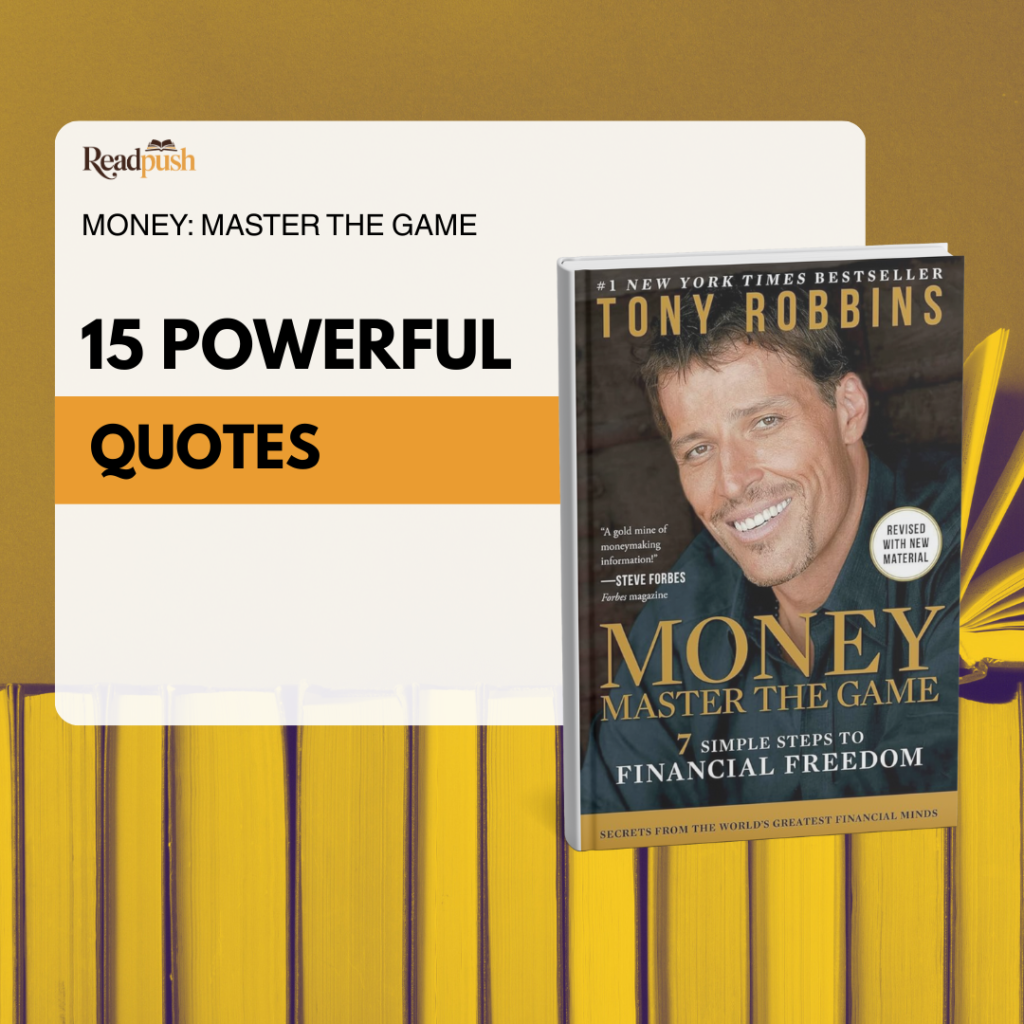
There is a particular kind of book that people buy at a turning point. Money Master the Game is often that book. Tony Robbins wrote it after spending years interviewing some of the world’s most successful investors, and the result is dense, sometimes overwhelming, and also genuinely useful in places most financial books avoid: the emotional and psychological side of money.
The quotes below come from that book. They are not pulled out to impress you. They are here because some of them say things worth sitting with, especially if your relationship with money has felt tangled or stuck. If you want the full picture of Robbins’ framework, the Money Master the Game summary walks through the strategy in depth. This piece is just the quotes, and what they are actually getting at.
Quotes on mindset and how you think about money
“Clarity is power.”
It sounds simple. Most people read it and nod. But it is worth asking: are you actually clear about what you want financially? Not in a vague “I want to be comfortable” way. In a specific, numbered, dated way. Robbins is not being inspirational here. He is pointing at something most people skip because it feels uncomfortable to want a real thing and risk not getting it.
“The quality of your life is in direct proportion to the quality of your decisions.”
The word “quality,” not “number.” Robbins is not saying you need more decisions or faster decisions. He is saying that improving the thinking behind your choices, taking a beat, asking what you are actually reacting to, compounds over time just the way money does.
“Money is just a tool. It is not the end. It is the means to living life on your terms.”
This one often gets brushed past. Take a second with it. If money is a tool, then the question becomes: what is it for? If you have not answered that clearly, the tool has no target. And tools without targets tend to sit in drawers.
“The biggest enemy of your financial success is not the market. It is your emotions.”
If this sounds familiar, it is because most people know it in theory and forget it completely in practice. Fear makes people sell at the bottom. Greed makes them buy at the top. Robbins spent years talking to traders and investors, and nearly all of them said some version of this. Why most investors fail to beat the market explores the behavioral side of this in more detail, and it is a harder read than it sounds.
Quotes on wealth and investing
“You will never earn your way to financial freedom. You must invest your way there.”
This is probably the most practically important quote in the book, and also the one that creates the most resistance. People who have built an identity around working hard find it uncomfortable. But Robbins is not criticizing work. He is pointing at a ceiling. Income from labor stops when you do. Income from assets keeps going. The two are structurally different, and knowing that changes how you think about where your money goes each month.
“You cannot control the market, but you can control your risk.”
There is something genuinely calming about this one, if you let it land. Most financial anxiety comes from trying to predict or control something that cannot be controlled. Robbins redirects that energy toward what is actually within reach: how much you expose yourself to downside. That is a lever you can pull.
“Diversification is the only free lunch in investing.”
Robbins borrows this line from Nobel laureate Harry Markowitz, and it holds up. Spreading risk across uncorrelated assets does not cost you anything, and it protects against the single worst outcome: being concentrated in the wrong thing at the wrong time. The all seasons portfolio framework from the same book is built on exactly this principle.
“Fees are the one thing you can control that almost no one pays attention to.”
Quietly one of the most useful lines in personal finance writing. A 1% annual fee sounds meaningless. Over thirty years, on a growing portfolio, it can represent hundreds of thousands of dollars in lost compounding. Robbins hammers this because most people are paying more in fees than they realize, and because it is one of the few variables entirely within their control.
Quotes on planning and the long game
“Most people dream of wealth but never make a plan to achieve it.”
You are not the only one who has stayed vague about money on purpose. Sometimes the vagueness feels safer than making a specific plan and possibly failing it. But vagueness is its own kind of failure, just a slower one. Robbins is gentle here, but the point is firm: dreaming and planning are not the same thing.
“A goal without a plan is merely a wish.”
Similar territory. The distinction Robbins is drawing is between intention and structure. He pushes readers to name a specific number, a timeline, and the steps between here and there. That idea connects directly to his framework around the financial freedom number, which gives the wish a shape.
“You become financially rich when what you earn works harder than you do.”
The turning point most people are aiming for, whether or not they name it this way. When passive income covers your life, work becomes a choice rather than an obligation. That shift is less about a dollar amount and more about the ratio between what your assets produce and what you spend. Getting there requires building the gap, month by month, and not spending it.
“Success leaves clues.”
Robbins uses this throughout his work. The idea is not to imitate blindly but to study what people who have reached where you want to be actually did, not what they say they did, not their brand story, but their actual decisions. It is a more useful frame than starting from scratch and hoping for the best.
Quotes on staying steady when it gets hard
“Volatility is not the enemy. Panic is.”
Markets fall. That part is not the problem. The problem is the decisions people make during the fall. Selling in a downturn locks in the loss. Staying invested through volatility, which takes more discipline than it sounds, is where the long-term gains accumulate. This quote is worth keeping somewhere visible if you know you are prone to checking your portfolio too often.
“Complexity is the enemy of execution.”
This one applies well beyond money. If your financial plan requires you to make seventeen decisions a month and track twenty variables, you will not follow it. The plans that work are simple enough to actually do. Robbins pushes toward automation and simplicity for this reason. A strategy you actually implement beats a perfect strategy sitting in a spreadsheet.
“If you cannot make money while you sleep, you will work until you die.”
Blunt, deliberately so. Robbins is not trying to scare you. He is trying to make the stakes concrete. This is the core argument for building assets rather than relying solely on earned income, and it is hard to argue with the math. No one’s labor compounds the way invested capital can.
Common misconceptions about what these quotes are saying
That they are motivational filler. Some of Robbins’ other work earns that criticism. This book is different. These quotes come from interviews with serious investors, not from a stage script, and they hold up when you press on them.
That “clarity is power” means something motivational. It does not. Robbins means something specific: your number, your timeline, your next concrete step. Discomfort is part of building that kind of clarity, which is probably why most people stay vague.
That “you cannot beat the market” means you should give up. It means you should stop trying to pick stocks and start thinking about asset allocation and fees, which are the two variables that actually move the needle for most people.
That the emotional quotes are soft filler around the real advice. The emotional quotes are the real advice. The mechanics of investing are learnable in an afternoon. The behavior, staying invested, not panicking, not chasing returns, is what separates people who build wealth from people who read about it.
The same issue appears from another angle in Why You Cannot Control Startup Community and, where the business trade-off the book is trying to clarify becomes easier to see without turning the book into a slogan.
The same issue appears from another angle in The Crossover Point Explained, where the money decision underneath the book becomes easier to see without turning the book into a slogan.
The same issue appears from another angle in Total Money Makeover Quotes That Hit Differently, where the money decision underneath the book becomes easier to see without turning the book into a slogan.
How to actually use these quotes
The short answer: pick one that landed and do something with it this week. Not fifteen. One.
If “clarity is power” caught you, spend twenty minutes writing down your actual financial number: what would it cost you to live the way you want to live, without needing to work? If you have never written that down, do it now. The discomfort is information.
If “fees are the one thing you can control” landed, log into your investment accounts and look at the expense ratios. If you do not know what they are, find out. This is not a complicated task; it just requires looking.
If “volatility is not the enemy, panic is” resonated, consider whether your current setup puts you in a position to panic. Do you check your portfolio too often? Are you too concentrated in assets that fluctuate sharply? What would help you stay calm?
The quotes in Money Master the Game are most useful when they lead to a question you take seriously, not when they become decoration. Read it slowly. Let one of them meet you where you actually are right now.