
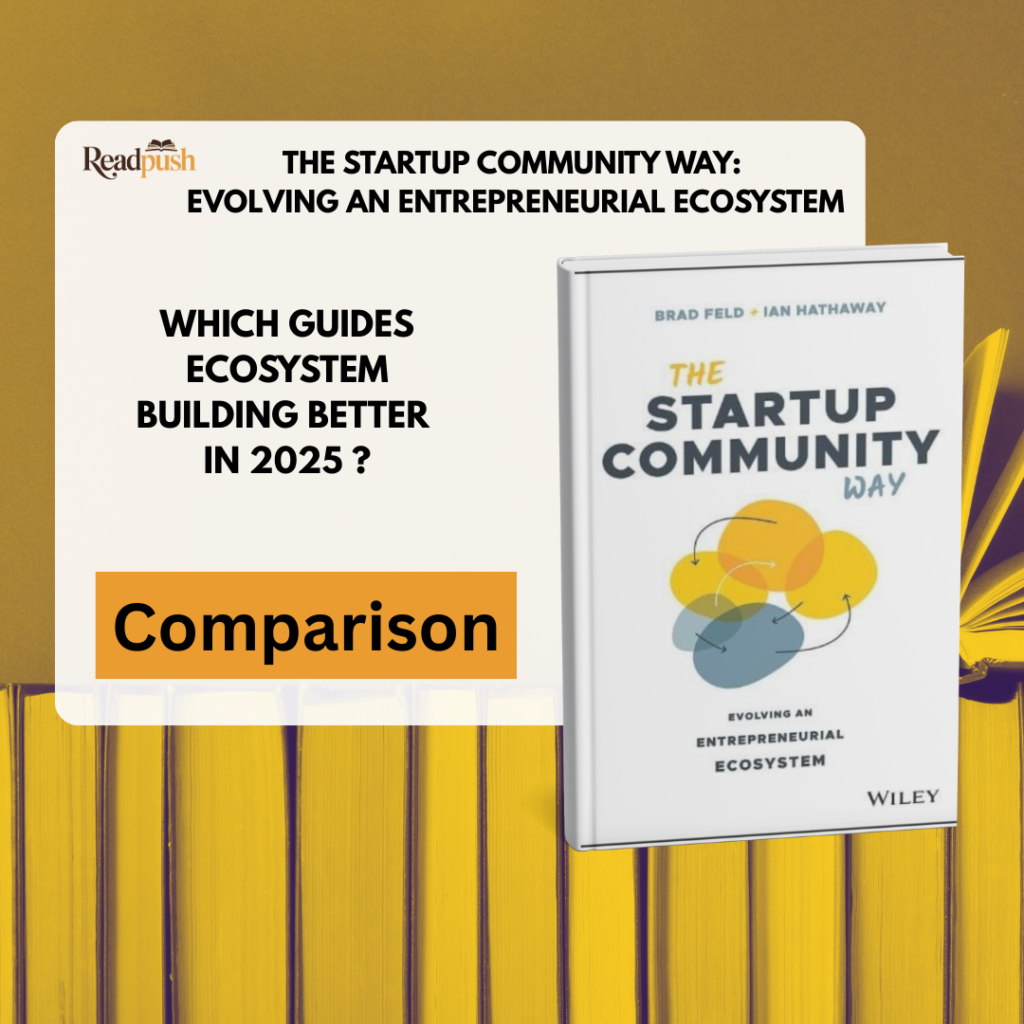

When it comes to building vibrant startup ecosystems, you might face a tough choice between different thinkers and frameworks. Two popular but distinct approaches are The startup community way and the implicit relations to complexity science foundations. Both offer valuable insights for community leaders entrepreneurs and policymakers eager to foster innovation and collaboration. But how do you decide which one to follow ?
The startup community way promises a practical roadmap for guiding startup communities through experimentation and grassroots leadership. Meanwhile complexity science foundations reveal why ecosystems behave like living systems full of unpredictable and adaptive dynamics. We have written comprehensive reviews of both The startup community way and implicit relations to complexity science foundations to help you navigate their ideas.
These approaches are comparable because they share an understanding that startup ecosystems are not machines to be controlled but complex networks to be nurtured. In this comparison you’ll learn the core philosophies strengths and applications of each. By the end you will know which guide better suits your goals for healthy ecosystem building .
Quick overview of each book
He startup community way overview
Written by Brad Feld and Ian Hathaway two renowned entrepreneurs and ecosystem builders The startup community way presents a hands-on guide grounded in real-world startup communities. The book emphasizes “complex entrepreneurial ecosystems” describing them as living systems that thrive on resilience and adaptability. Published in 2019 it offers practical steps to embrace uncertainty foster leadership emergence and build feedback-driven communities. Its American context makes it especially relevant for cities like Boulder and San Francisco.
Implicit relations to complexity science foundations overview
This body of work refers to key concepts from complexity science theorists such as Stuart Kauffman and Brian Arthur who study how complex adaptive systems evolve. While not a single authored book these scientific foundations influence ecosystem thinking by explaining the unpredictable emergent properties of interconnected systems. Often published in academic journals and applied in economics and biology this approach provides theoretical rigor explaining why ecosystems self-organize and adapt over time but it tends to be less prescriptive and more conceptual than The startup community way.
Side-by-side comparison
Core philosophy & approach
The startup community way sees startup ecosystems as dynamic adaptive communities where leadership acts like gardeners enabling conditions for growth rather than controlling outcomes. It focuses on actionable guidance for community engagement iterative experiments and organic leadership development within practical timeframes (typically 3-5 years).
By contrast implicit relations to complexity science foundations frame ecosystems as complex adaptive systems governed by principles such as emergence feedback loops and self-organization. The approach is more about understanding the underlying scientific reasons ecosystems behave unpredictably and how decentralized interactions produce systemic patterns.
The key difference lies in application: The startup community way translates complexity theory into concrete steps for ecosystem builders, whereas complexity science foundations provide the theoretical basis explaining why those steps matter. One is a practical manual, the other a conceptual framework.
Strength of each
The startup community way excels at offering community leaders a straightforward, repeatable roadmap with real case studies showing how cities like Boulder succeeded by stepping back and encouraging founder-led innovation. Its strength is in making complexity tangible and manageable for practitioners. For example The startup community way‘s case study of Boulder’s ecosystem demonstrates how letting leadership emerge organically strengthened the network over time [link to case study].
On the other hand complexity science foundations shine by revealing the scientific dynamics that govern emergent behavior. They help leaders appreciate the limits of prediction and control and encourage systems thinking that applies beyond entrepreneurship useful for policymakers or academics seeking depth. This approach sets the foundation for recognizing nonlinear growth and systemic resilience.
Writing style & accessibility
The startup community way is written in an approachable, engaging style with plenty of practical examples and clear actionable advice. It appeals to entrepreneurs and community builders looking for hands-on guidance.
The complexity science foundations tend to be more technical and abstract, often published in academic formats. While intellectually rich their language can be dense and less immediately accessible for practitioners without a background in systems theory or related fields .
For most readers interested in ecosystem building The startup community way is easier to digest and apply directly .
Who should read which
Read the startup community way if:
- You are a community leader or ecosystem builder looking for a practical step-by-step guide to startup ecosystem development.
- You want clear advice on facilitating innovation through small experiments and adaptive leadership.
- You prefer learning from actionable case studies and real startup communities.
- Your focus is on creating a self-sustaining entrepreneurial environment within 3-5 years.
Read implicit relations to complexity science foundations if:
- You want a deep theoretical understanding of why ecosystems behave like living, adaptive systems.
- You are an academic, policymaker, or strategist interested in the scientific principles behind ecosystem dynamics.
- You appreciate conceptual frameworks that explain emergence, feedback, and self-organization in complex systems.
- You aim to apply complexity thinking beyond startups in economics or urban planning.
Read both if:
- You want to combine practical ecosystem-building tactics with foundational systems-thinking.
- You aim to develop both hands-on skills and theoretical insight to adapt to complex environments effectively.
- We recommend reading The startup community way first for practical grounding then exploring complexity science literature to deepen conceptual understanding.
Both The startup community way and the implicit relations to complexity science foundations offer invaluable perspectives on startup ecosystems. While the former provides a practical guide to implement complexity principles on the ground, the latter offers the essential scientific background explaining why these methods work. Together, they equip ecosystem builders with tools and insights to thrive in uncertain, dynamic environments.
Explore our complete guides to The startup community way and implicit relations to complexity science foundations ; including lessons ; frameworks and quotes from both.