Quick takeaways
- The 7 Habits is a character development framework, not a productivity system. Readers expecting tactics will be disappointed.
- The book’s biggest weakness is its examples: most come from late-20th-century corporate environments and require translation for modern readers.
- Habits 1 through 3 hold up well independently of context. Habits 4 through 6 depend heavily on organizational culture that may not exist in your workplace.
- The framework has no built-in mechanism for failure. When the habits don’t produce results, Covey offers no diagnostic beyond “you weren’t really doing it.”
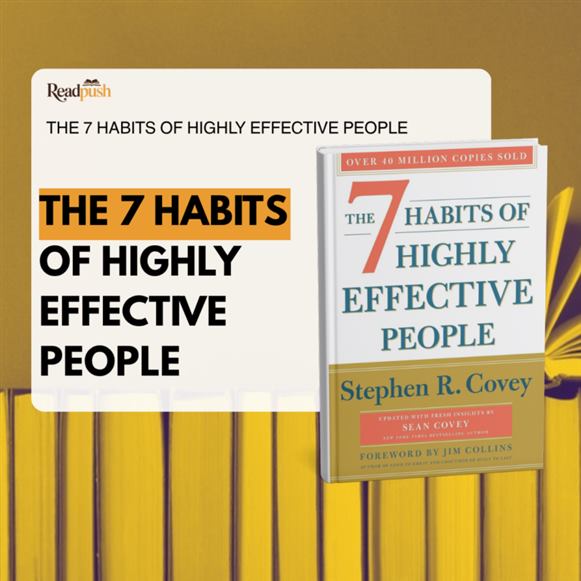
The 7 Habits of Highly Effective People was published in 1989. It has sold more than 40 million copies across multiple decades. It is still cited in business schools, still assigned in corporate training programs, and still read by people who take personal development seriously. That level of longevity is worth something. It also means the book has had long enough to show its limitations.
A critical review in 2026 isn’t about dismissing a classic. It’s about reading it accurately understanding what the framework actually offers, where it holds up under scrutiny, where it requires adaptation, and who is likely to benefit from reading it versus who is likely to find it frustrating. Covey’s book deserves that kind of honest assessment more than it deserves either uncritical praise or reflexive dismissal.
What the book is actually doing
The central argument of The 7 Habits is that lasting effectiveness comes from character, not from technique. Covey calls this the “character ethic” and explicitly contrasts it with the “personality ethic” the idea that success is primarily a matter of skills, social tactics, and image management. His claim is that the personality ethic produces short-term results at the cost of long-term integrity, while the character ethic produces sustainable effectiveness because it works from the inside out.
The seven habits are organized sequentially across three stages. Habits 1 through 3 (be proactive, begin with the end in mind, put first things first) address personal mastery the shift from dependence to independence. Habits 4 through 6 (think win-win, seek first to understand, synergize) address interpersonal effectiveness the move from independence to productive interdependence. Habit 7 (sharpen the saw) addresses renewal across all four dimensions of a person: physical, mental, social-emotional, and spiritual.
To put it plainly: the book is a philosophy of character development organized as a practical guide. The habits are the expression of underlying principles, not the principles themselves. Covey is explicit about this. Readers who treat the habits as a checklist rather than as a framework for understanding how effectiveness actually works will get less from the book than it offers.
Where the book holds up
The first three habits are the strongest part of the book and the most durable across time. “Be proactive” Covey’s term for taking responsibility for your responses rather than blaming circumstances is grounded in a genuine psychological insight about the gap between stimulus and response. The language Covey uses (circle of concern versus circle of influence) gives readers a practical mental model for redirecting attention toward what they can actually affect. This idea hasn’t aged.
“Begin with the end in mind” asks readers to develop a personal mission statement and use it as the filter through which daily decisions are made. The exercise of writing a mission statement has become something of a cliche, but the underlying logic is sound: without clarity about values and long-term direction, it’s easy to climb efficiently toward the wrong destination. Covey attributes this idea to the principle that all things are created twice first in the mind, then in reality. The habit is really about deliberate authorship of your own life rather than drifting into whatever circumstances produce.
“Put first things first” introduces Covey’s time management matrix, which organizes tasks by urgency and importance into four quadrants. The key argument is that most people spend too much time in Quadrant I (urgent and important) and Quadrant III (urgent but not important) and too little time in Quadrant II (not urgent but important the quadrant where planning, relationship-building, and prevention live). This matrix has been reproduced widely and taught in management programs for good reason. It’s a clean, useful tool.
|
Habit 3 Put first things first Covey’s time management matrix
|
||||||||||||
The interpersonal habits think win-win, seek first to understand, synergize are also genuinely valuable, though they depend more on organizational context than the first three. “Seek first to understand” is a restatement of empathic listening principles that have substantial independent support in communication research. The habit of listening to understand rather than listening to respond is harder than it sounds and more consequential than most people give it credit for.
Where the book shows its age
The most honest criticism of The 7 Habits is that its examples are dated. The book draws heavily on corporate case studies and social contexts from the 1970s and 1980s. The workplace Covey describes hierarchical, office-based, built around long tenure at a single organization bears limited resemblance to environments that involve remote work, freelance arrangements, flat structures, or rapid organizational change. Readers in those environments have to do significant translation work to apply the habits, and Covey offers little guidance for it.
The values-language is another friction point for some readers. Covey writes from an explicitly principle-centered worldview that draws on natural law and, implicitly, on his own religious background as a member of the Church of Jesus Christ of Latter-day Saints. He never forces this on readers, but the moral vocabulary of the book (“correct principles,” “the character ethic,” “integrity”) assumes a shared framework that not all readers bring. Secular readers may find the language slightly foreign even when they agree with the underlying ideas.
The book also lacks a failure mode. When the habits don’t produce the expected results, Covey’s implicit answer is that you weren’t really applying them that more consistency, more depth, more internalization is needed. This isn’t entirely wrong, but it makes the framework unfalsifiable in practice. A reader who applies the habits for six months without visible improvement has no diagnostic from the book to explain why or what to adjust.
Who benefits most and who doesn’t
The readers who get the most from The 7 Habits tend to share a few characteristics. They’re at a point in their lives where they’re asking questions about direction, purpose, and values not just about how to accomplish more. They’re willing to invest time in reflection rather than looking for immediate tactics. They work in environments where interpersonal trust and long-term relationships matter. And they come to the book open to the idea that their own character is a variable, not a fixed input.
Readers who tend to struggle with it are those looking for practical, immediately applicable techniques. The book is long (380 pages in most editions), dense with principle-level discussion, and light on the kind of step-by-step implementation guidance that newer productivity and habit books provide. A reader who needs to change specific behaviors quickly will likely find Atomic Habits more immediately useful, even if Covey’s framework is richer.
The book is also less useful for readers whose primary challenges are organizational rather than personal. If the problem is that your team doesn’t communicate well, or that your company’s incentive structures are misaligned, or that you’re operating under a manager whose behavior is the constraint, the inward-focused habits don’t address the external variables directly. That’s not a flaw in the book it wasn’t written to be an organizational design guide but it’s worth being clear about.
|
Critical review scorecard The 7 Habits what holds, what doesn’t
|
||||||||||||||||||||||||||||||
Common misconceptions about The 7 Habits
Misconception: the habits are independent and can be adopted one at a time. Covey’s framework is sequential. The private victory habits are meant to precede the public victory habits because the argument is that interpersonal effectiveness built on an underdeveloped character is unstable. Picking up Habit 4 (“think win-win”) without having worked through Habit 1 (“be proactive”) is possible, but you’re missing the foundation the author considers essential.
Misconception: “synergize” is just a corporate buzzword for teamwork. Covey’s definition is more specific. Synergy, in his framework, means that the combined result of genuine collaboration exceeds what any participant could have produced individually not because of division of labor, but because different perspectives and strengths interact to produce something genuinely new. The habit is about valuing difference as a creative resource rather than a problem to manage. Whether your environment allows for that kind of collaboration is a separate question the book doesn’t fully address.
Misconception: “sharpen the saw” is about self-care and rest. Covey’s seventh habit is about renewal across four specific dimensions: physical (exercise, nutrition, stress management), mental (reading, learning, planning), social-emotional (relationships, service, empathy), and spiritual (values clarification, commitment to principles). Rest is part of it, but the habit is really about sustained investment in your own capacity to perform, across all four areas. Readers who take it only as permission to take breaks are getting a fraction of what Covey is describing.
Misconception: the book is outdated and has been replaced by newer research. The habits that operate at the character and values level are not the kind of thing behavioral science supersedes. They’re not empirical claims about how habits form; they’re arguments about how to live and work with integrity. Behavioral research (Dweck on growth mindset, Clear on habit mechanics) adds important tools that Covey’s book lacks. It doesn’t invalidate the underlying framework.
The same issue appears from another angle in Deep analysis of The Habits of Highly, where the question of attention, habits, and what actually changes behaviour becomes easier to see without turning the book into a slogan.
The same issue appears from another angle in Applying The Habits in real business scenarios, where the question of attention, habits, and what actually changes behaviour becomes easier to see without turning the book into a slogan.
The same issue appears from another angle in Comparing The Habits with modern leadership books, where the question of attention, habits, and what actually changes behaviour becomes easier to see without turning the book into a slogan.
Final assessment
Read it if you’re at a point in your life where questions of direction, values, and long-term effectiveness matter more to you than short-term tactical improvement. The first three habits in particular offer a durable framework for personal responsibility and intentional living that hasn’t been meaningfully improved upon by the literature that followed.
Approach the interpersonal habits with the understanding that they describe how effective people ideally interact, not how most organizations actually function. The gap between Covey’s model and your specific workplace may require adjustment. The principles are sound. The application is yours to work out.
Set aside the case studies. They’re illustrative, not evidence. The workplaces and social contexts they describe belong to a different era. The principles they’re used to illustrate are still worth engaging with on their own terms.
If you want three books to read alongside it: Atomic Habits for the behavioral mechanics Covey doesn’t provide, Mindset for the psychological foundation his character ethic assumes but doesn’t explain, and Deep Work by Cal Newport for a practical application of Habit 2 in a distracted environment. None of them replace The 7 Habits. They fill the gaps it leaves open.