Quick takeaways
- The most common misreading of the book is treating it as a productivity manual. It isn’t. It’s a character development framework that happens to improve productivity as a side effect.
- Habit 1 gets misread as “take initiative.” Covey means something more precise: choose your response to circumstances deliberately, rather than reacting automatically.
- Habit 4 (“think win-win”) is widely misread as an instruction to always compromise. Covey explicitly says “win-win or no deal” sometimes walking away is the right outcome.
- The private victory (Habits 1-3) is almost always underweighted. Most readers rush to the interpersonal habits before doing the personal foundation work the framework requires.
Almost every article about The 7 Habits of Highly Effective People gets the main idea wrong. Not in dramatic ways. In quiet, persistent ways that make the habits less useful than they should be and leave readers wondering why they’re not getting the results the book promised.
The misreadings aren’t random. They follow predictable patterns the same simplifications that happen when a framework built on principles gets compressed into a list of behaviors. Understanding exactly where those compressions happen, and what gets lost in each one, is more useful than another summary of what the habits are supposed to mean.
Misreading 1: the book is about habits
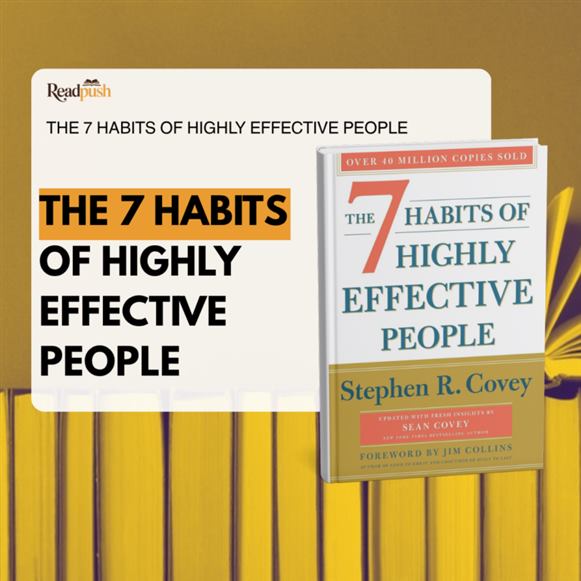
The title says “seven habits.” The cover shows a list. The chapter headings are each a habit. So readers come to it expecting a habit-formation guide and leave slightly confused about why it reads more like philosophy than productivity advice.
Covey’s framework is built on a specific argument: that effectiveness is a function of character, not of technique. He calls this the “character ethic” and spends the first quarter of the book contrasting it with the “personality ethic” the idea that success is primarily about skills, image, and social tactics. His claim is that books oriented around technique and personality produce real but unstable results, because they optimize the surface without addressing the foundation.
The habits are expressions of underlying principles, not the principles themselves. “Be proactive” is a habit a pattern of behavior. The underlying principle is that human beings have the freedom to choose their responses to circumstances, and that exercising that freedom responsibly is the foundation of effective living. The habit is what the principle looks like in practice. Understanding the principle makes the habit coherent. Without it, “be proactive” is just a vague instruction to do things before you’re asked.
This distinction matters because it changes how you engage with the book. A reader looking for behavioral tips will find some (the time management matrix in Habit 3 is genuinely practical). A reader looking for a framework for understanding effectiveness will find much more. The book rewards the second kind of reading.
Misreading 2: “be proactive” means take initiative
This is the most universal misreading of the book, and it strips the first habit of most of its usefulness.
In common usage, “proactive” means getting ahead of things acting before being told, anticipating problems, moving fast. That’s a fine quality, but it’s not what Covey means. His definition is more specific and more interesting: a proactive person recognizes that between stimulus and response, there is a space, and in that space lies the freedom to choose. Proactivity, for Covey, is the exercise of that freedom the ability to respond to circumstances based on values and deliberate choice rather than reacting automatically based on mood, conditioning, or other people’s behavior.
The practical implication is very different depending on which definition you’re working with. “Take initiative” tells you to move faster and anticipate more. “Choose your response deliberately” tells you to develop self-awareness about your automatic reactions and build the capacity to pause between stimulus and response. These are not the same skill, and training for one doesn’t develop the other.
Covey borrows this idea directly from Viktor Frankl, who developed it observing prisoners in Auschwitz people in conditions of extreme constraint who nonetheless retained the capacity to choose their inner response to what was happening to them. The concept is about freedom and responsibility at a deep level. Reducing it to “take initiative” flattens something philosophically serious into a career tip.
Misreading 3: “begin with the end in mind” is goal-setting
Habit 2 gets taught in corporate training as a goal-setting exercise: define your destination before you start moving. That captures one layer of what Covey is saying but misses the more important one.
Covey’s version of this habit starts with a specific exercise: imagine your own funeral. What do you want people to say about you? What kind of person do you want to have been? What relationships do you want to have invested in? The habit is not primarily about professional goals or project outcomes. It’s about values clarification developing a personal mission statement that reflects what genuinely matters to you, which then serves as the standard against which you evaluate all your decisions.
Goal-setting is downstream of this. Once you know what you value, you can set goals that are actually aligned with those values rather than goals that reflect what your industry rewards, what your parents wanted, or what you thought you were supposed to want at 25. The habit, done fully, asks a harder question than “what do you want to achieve.” It asks “who do you want to be” and uses that answer to filter everything else.
The misreading matters because it produces a different kind of goal-setting. Goals derived from a genuine values-clarification exercise tend to be more stable and more motivating when things get hard. Goals set without that foundation tend to shift when circumstances change or external pressure moves.
|
The misreading map What people think the habit says vs what Covey actually argues
|
||||||||||||||||||||||||||||||||||||||||||
Misreading 4: “think win-win” means always compromise
This misreading is so pervasive it has probably done more damage to the habit’s usefulness than any other. “Think win-win” has become a management cliche meaning “be agreeable” or “find the middle ground.” That’s not what Covey argues.
Covey’s win-win is a higher standard than compromise. Compromise means both parties get less than they wanted each gives something up to reach an agreement. Win-win means finding a solution that genuinely works for both parties, where neither party has had to sacrifice something important. The difference is that compromise splits an existing pie; win-win looks for a way to make the pie larger before dividing it.
Critically, Covey explicitly includes a fifth option that most people don’t associate with this habit: “win-win or no deal.” If a genuine win-win isn’t available if the interests of the two parties are incompatible enough that any agreement would require one of them to take a meaningful loss Covey’s position is that no agreement is the right outcome. Walking away preserves the relationship and the integrity of both parties better than a resentful compromise does.
The misreading matters because “always compromise” and “win-win or no deal” produce very different behavior. Someone applying the compromise version will accept agreements that don’t actually work for them in order to avoid conflict, then feel resentful. Someone applying the win-win version will invest more time in understanding both parties’ real interests before proposing any solution, and will be willing to decline an agreement that doesn’t meet both parties’ genuine needs.
Misreading 5: the private victory is optional
The sequence of the habits is not arbitrary, and the most consequential misreading of the whole framework is skipping or rushing through Habits 1 through 3 to get to the “more interesting” interpersonal habits.
Covey calls Habits 1 through 3 the “private victory” the internal work of developing proactivity, clarity about values, and disciplined prioritization. He argues that the interpersonal habits (4 through 6) built on top of underdeveloped private victory habits are structurally unstable. A person who tries to practice “think win-win” without having developed genuine personal responsibility tends to collapse into accommodation when the negotiation gets difficult agreeing to things that don’t work for them because they haven’t developed the internal stability to hold their own values under pressure. A person who practices “seek first to understand” without having developed clarity about their own values can lose themselves in other people’s perspectives.
The private victory habits are harder than the interpersonal ones in a specific way: they have no external feedback loops. Nobody congratulates you for becoming more proactive in your inner life. There’s no visible output from clarifying your personal mission statement. The work is internal and slow, and the returns are indirect. That’s precisely why it gets skipped and precisely why Covey puts it first.
Misreading 6: “sharpen the saw” is about self-care
The seventh habit has been absorbed into the broader wellness conversation in ways that significantly narrow its scope. “Sharpen the saw” has become a permission slip for rest, recovery, and self-care all legitimate things, but only a fraction of what Covey is describing.
Covey’s renewal framework has four distinct dimensions. Physical (exercise, nutrition, rest this is the part that gets all the attention). Mental (continuous learning, reading, planning, writing developing and maintaining intellectual capacity). Social-emotional (investing in relationships, service, empathy maintaining the human connections that sustain everything else). Spiritual (values clarification, prayer or meditation, commitment to principles maintaining clarity about what you stand for).
The mental, social-emotional, and spiritual dimensions receive almost no attention in popular summaries of this habit. They’re harder to operationalize than “exercise and sleep,” and they don’t map neatly onto the wellness industry’s categories. But Covey’s argument is that all four are necessary and interdependent that a person who maintains physical health while letting their intellectual life atrophy, or who exercises regularly while neglecting their important relationships, is not sharpening the whole saw.
|
Habit 7 The full picture Four renewal dimensions most summaries cover only one
|
The same issue appears from another angle in Atomic Habits by James Clear, where the question of attention, habits, and what actually changes behaviour becomes easier to see without turning the book into a slogan.
The same issue appears from another angle in Deep analysis of The Habits of Highly, where the question of attention, habits, and what actually changes behaviour becomes easier to see without turning the book into a slogan.
The same issue appears from another angle in The Habits of Highly Effective People, where the question of attention, habits, and what actually changes behaviour becomes easier to see without turning the book into a slogan.
Why these misreadings persist
Most of the misreadings above follow a predictable pattern: the habit’s label gets retained, but the principle underneath it gets replaced with something simpler and more immediately actionable. “Be proactive” becomes “take initiative” because initiative is concrete and teachable in a 20-minute workshop. “Think win-win” becomes “compromise” because compromise is a recognizable social norm. “Sharpen the saw” becomes “rest and self-care” because those are the dimensions most legible to a wellness-oriented culture.
The simplifications happen because Covey’s actual argument is demanding. He’s asking readers to do inner work to clarify values, to develop genuine empathy, to build character over years rather than skills over weeks. That’s harder to teach, harder to measure, and harder to sell in a corporate training context than the simplified versions. So the habits get extracted from their philosophical foundation and applied as techniques, which produces the thin, unsustaining results Covey predicted the personality ethic would produce.
The remedy is straightforward, if slow: read the opening chapters on the character ethic and the paradigm shift before engaging with the habits. Understand what Covey is arguing before evaluating whether the habits work. And when a habit feels obvious or easy to apply, look harder Covey almost always means something more precise than the label suggests.
Three things to read alongside the book if you want the full argument: Frankl’s Man’s Search for Meaning for the philosophical foundation of Habit 1; Rogers’ On Becoming a Person for the listening theory behind Habit 5; and Aristotle’s Nicomachean Ethics for the character ethic tradition Covey is working in. None of them are self-help books. All of them make The 7 Habits more legible.