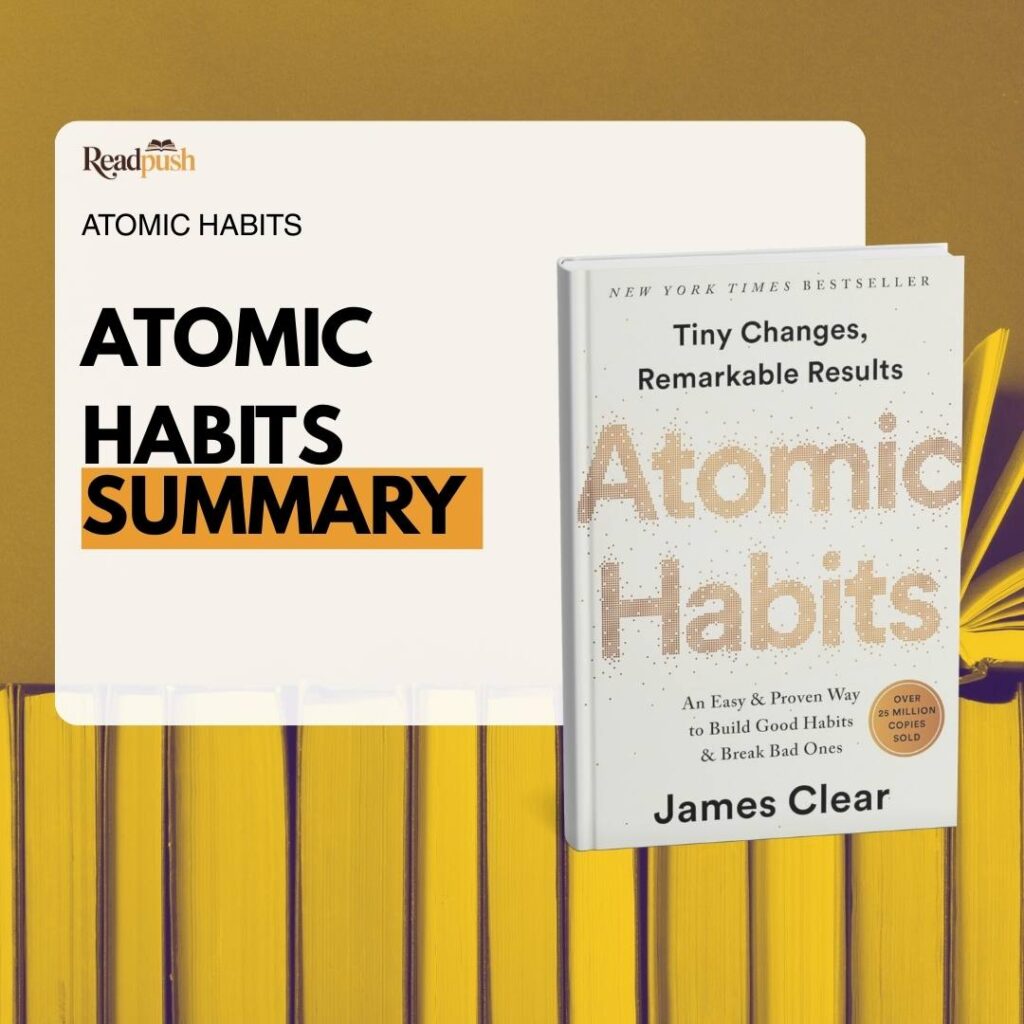
Quick takeaways
- Clear’s central argument is that lasting change starts with identity, not goals. You don’t change your habits and then become a different person. You become a different person, one small vote at a time, and the habits follow.
- The Four Laws of Behavior Change (obvious, attractive, easy, satisfying) are more useful as an environment design checklist than as a motivation system.
- Habit stacking and the two-minute rule are the two most practically transferable tools in the book. Both work by lowering the cost of starting.
- The book’s limits are real: it works best when your environment is changeable and when the behavior you want to shift isn’t carrying something heavier underneath it.
If you’ve picked up Atomic Habits because something in your life isn’t working the way you want it to, you’re probably in good company. James Clear wrote a book for people who have already tried to change and found it harder than it should be. That’s most of us.
Published in 2018, Atomic Habits has sold over twenty million copies. Not because the ideas are entirely new, but because Clear does something rare: he organizes existing research on behavior change into a system that’s actually usable, and he grounds it in a psychological insight that most self-help books skip. The question isn’t just what you do. It’s who you think you are.
This summary covers the book’s core ideas, its two most practical frameworks, and where the system has real limits. It won’t replace reading the book, but it should give you a clear sense of whether it’s the right book for where you are right now.
The central argument: identity before outcomes
Most habit advice starts with outcomes. You want to lose weight, sleep better, write more, spend less. You set the goal, build a plan, try to stick to it. When it doesn’t stick, the usual explanation is motivation: you didn’t want it badly enough, or you ran out of willpower.
Clear’s reframe is that the problem is usually upstream of motivation. It’s identity. The question to ask isn’t “what do I want to achieve?” It’s “what kind of person do I want to be?” A person who exercises doesn’t need to convince themselves to go for a run. A person who reads doesn’t need to argue themselves into picking up a book. The behavior flows from the identity. The habit is just the evidence.
Each action you take is a small vote for a particular self-image. Go for the run: vote for “I’m someone who moves my body.” Skip it without rescheduling: vote for something else. No single vote decides anything. But identity-based habit change is cumulative. Enough votes in the same direction and the story you tell yourself starts to shift. That, in Clear’s framework, is how lasting change actually works.
The Four Laws of Behavior Change
Clear organizes the practical core of the book around four laws, drawn from existing habit research and packaged into a memorable system. A habit forms when a behavior is cued, craved, easy to perform, and followed by a satisfying result. His four laws map directly to these stages: make it obvious, make it attractive, make it easy, make it satisfying. To break a habit, you invert each one.
What makes this useful in practice is that it shifts the focus from willpower to environment. You don’t need more motivation. You need a better setup. The Four Laws work as an environment design checklist: is the behavior visible? Is starting easy? Is there something satisfying that follows quickly? If the answer to any of these is no, that’s your actual problem, not your discipline.
|
The Four Laws Build a habit or break one
|
||||||||||||||||||||||||
Two frameworks worth taking with you
Beyond the Four Laws, the book offers two practical tools that are simple enough to use without a complete system overhaul.
Habit stacking links a new behavior to something you already do reliably. The formula is: after I do X, I will do Y. After I pour my morning coffee, I will write one sentence. After I sit down at my desk, I will open the document. The existing habit becomes the cue. You don’t need to build a new trigger from scratch because you already have one.
The two-minute rule reduces any habit to the smallest possible version of itself. You don’t meditate for twenty minutes; you sit with your eyes closed for two. You don’t go to the gym; you put on your workout clothes. The point isn’t to stop at two minutes. The point is that starting is usually the hardest part, and this removes the activation cost of starting. Once you’re in it, continuing is much easier than beginning.
The compounding idea: small improvements over time
Clear makes a mathematical point early in the book that tends to stay with readers. One percent better every day compounds into something significantly larger over a year. One percent worse every day compounds in the other direction. He isn’t being literal, exactly, but the principle is real. Small consistent gains accumulate in ways that large, intermittent efforts don’t.
What this means practically is that visible progress isn’t the right metric for early habit formation. For a while, nothing looks different. Then it does. Clear calls this the Plateau of Latent Potential: results lag behind the work. The habits that look like overnight successes are usually built on a long, invisible runway.
|
Atomic Habits Frameworks The two tools most people find genuinely usable
|
Common misconceptions about the book
That it’s primarily about productivity. The identity-based change model at the book’s center is a psychological argument. Clear is describing how people come to see themselves differently over time. The productivity community has adopted it because its tools translate well to that context, but the book’s deepest claim isn’t about output. It’s about who you’re becoming.
That “never miss twice” is a strict rule. It’s a recovery principle. Missing once is an accident. Missing twice is the beginning of a new pattern, so treat it differently. The message is about reducing the psychological weight of a slip, not adding another rule to feel guilty about breaking.
That the two-minute rule means you only ever do two minutes. The rule is about making starting nearly thoughtless. Once you’re in the habit and the identity is building, the duration expands naturally. Two minutes solves the starting problem, not the sustaining one.
That if you follow the system, your habits will definitely stick. Clear is careful about this, but readers sometimes take the book’s optimism further than the text itself does. The framework works well under a particular set of conditions: your environment is shapeable, the behavior isn’t emotionally loaded, and you already know what you want to change. When any of those conditions isn’t met, the tools still help, but they may not be enough on their own.
The same issue appears from another angle in Rich Dad Poor Dad, where the money decision underneath the book becomes easier to see without turning the book into a slogan.
The same issue appears from another angle in The Total Money Makeover, where the money decision underneath the book becomes easier to see without turning the book into a slogan.
The same issue appears from another angle in Atomic Habits, where the question of attention, habits, and what actually changes behaviour becomes easier to see without turning the book into a slogan.
Who this book is actually for
It’s for you if you’ve tried to build habits before and kept losing the thread. Clear’s reframe, that the problem is probably the system and not a character flaw, is genuinely useful for people who’ve built a story about their own inconsistency. You’re not the only one who has started and stopped. That’s the normal pattern.
It’s for you if you understand what you want to change but can’t get traction on it. The practical tools in this book are concrete in a way that most self-help advice isn’t. You can actually rearrange a kitchen. You can actually move a phone to a different room.
It may not be enough on its own if the behavior you’re trying to change is carrying something heavier underneath it, whether that’s stress that isn’t redesignable, or an emotional function the habit is serving that you haven’t named yet. In those cases, the book is still worth reading. Pair it with something that helps you understand what’s actually underneath, not instead of it.
If you want to go deeper after this, the fuller analysis in our Atomic Habits review covers Clear’s arguments in more detail, including where the framework has real limits and what the identity chapter gets right that the rest of the genre usually skips.