Quick takeaways
- The strategy document approach to ecosystem building fails predictably because it imports tools appropriate to complicated problems into a context where they do not apply.
- Your goal as an ecosystem builder is not to produce outcomes but to create conditions. The distinction determines everything about what you actually do.
- Relationships are the unit of analysis, not institutions or events. A small city with high-trust connections is a more productive ecosystem than a larger one with more infrastructure and fewer genuine relationships.
- The complexity frame is diagnostic more than prescriptive. It tells you what is wrong with the conventional approach and orients you toward better questions. The specific work still requires local judgement.
The standard approach to building a startup community goes something like this: a city or region identifies entrepreneurship as a priority, convenes stakeholders, commissions a strategy document, funds an accelerator or two, and waits for results. It is a reasonable-sounding plan. It also tends not to work, or to work much more slowly and unpredictably than the strategy document suggested it would.
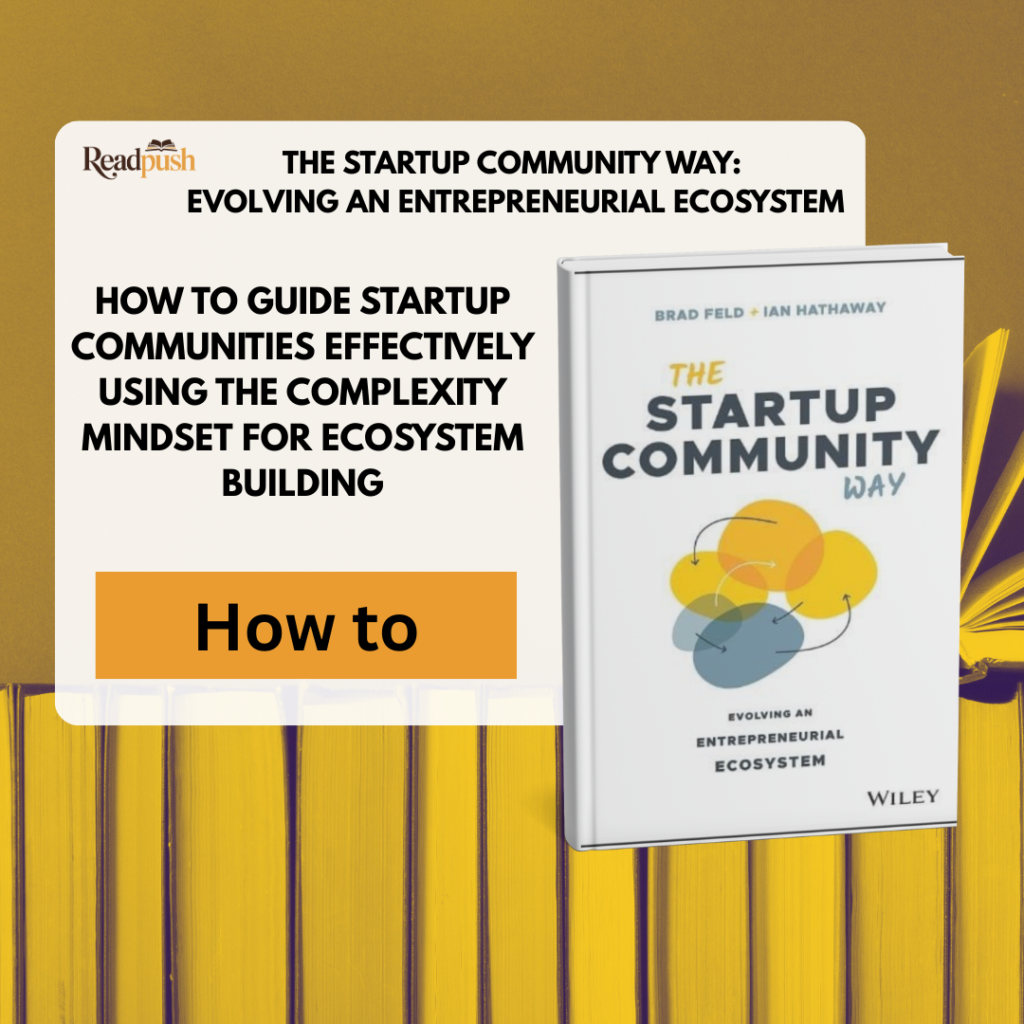
Brad Feld and Ian Hathaway’s explanation for this pattern, developed at length in The Startup Community Way, rests on a conceptual distinction that is simple to state and difficult to internalise: startup communities are complex systems, not complicated ones, and the two types of system respond to intervention in fundamentally different ways. Understanding the difference does not solve the problem of ecosystem building, but it does clarify why so many well-resourced efforts fall short and what a more productive approach might look like. The core arguments of The Startup Community Way are worth reading in full before the practical application; this piece works through what the complexity frame implies for day-to-day practice.
The distinction that matters
A complicated system, a jet engine or a hospital supply chain, can in principle be fully understood. It has many parts and those parts interact, but the interactions follow rules that, with sufficient expertise, can be mapped and predicted. An expert who knows the system can diagnose failures and design improvements. Linear thinking works here because the relationship between cause and effect is, at least theoretically, traceable.
A complex system is different in kind. It is composed of agents who adapt to one another and to their environment, producing emergent outcomes that cannot be deduced from their inputs. The agents in a startup ecosystem, founders, investors, mentors, universities, government bodies, cultural norms, interact continuously, and the results of those interactions feed back into the system and change the behaviour of its participants. No single actor controls this process. No external observer can fully model it. And crucially, interventions that treat a complex system as though it were complicated, trying to direct it, measure it against predetermined targets, optimise it through management, tend to suppress precisely the self-organisation and adaptive behaviour from which resilience grows.
This is why the strategy document approach fails as reliably as it does. It imports the tools appropriate to complicated problems into a context where they do not apply.
Five practical implications
If you accept that a startup community is a complex system, several practical implications follow. Not as a step-by-step methodology, but as a shift in orientation that changes what you actually do.
1. Create conditions, not outcomes
The distinction is meaningful. Producing outcomes requires control over the variables that generate them, which you do not have in a complex system. Creating conditions means identifying what the system needs to function well: density of relationships, trust, accessible capital, cultural legitimacy for entrepreneurship, and working to supply or remove barriers to those things. You are not building the ecosystem directly. You are building the environment in which it can build itself.
2. Run small experiments rather than large plans
In a complex system, you cannot predict with confidence what an intervention will produce. A new programme, a new event format, a new way of convening people: these may work or may not, and the only way to find out is to try them at low cost and low risk, observe what happens, and adjust. The Madison Capital Entrepreneurs group, which Feld cites in the book, began as five founders meeting for coffee. There was no strategic rationale; there was an experiment. The willingness to experiment continuously, and to abandon what does not compound, is a more durable capability than any particular programme design.
3. Distribute leadership rather than concentrating it
Complex systems are fragile when they depend on single points of control. Ecosystems organised around one charismatic individual, one well-funded institution, or one dominant accelerator have a structural vulnerability: when the central node changes or disappears, the network that depended on it weakens. Healthy ecosystems develop multiple sources of leadership, people who run events, who mentor, who make introductions, who tell the community’s stories, so that the whole is more resilient than any of its parts. The practical implication is that ecosystem builders should actively develop and support new leaders rather than consolidating influence.
4. Measure relationships, not institutions
It is easy to measure the wrong things: attendance at meetups, number of startups incorporated, square footage of co-working space. These metrics are not useless, but they are proxies for what actually matters, which is the density, quality, and reach of the relationships within the community. A small city with a high-trust, well-connected network of founders and mentors is a more productive ecosystem than a larger city with more institutions but fewer genuine relationships. The question worth asking, regularly, is not “what have we built?” but “who is connected to whom, and how well?”
5. Hold a genuinely long time horizon
Not five years. Feld’s original formulation was twenty years; the version in this book is “twenty years from today,” a rolling horizon that has no endpoint. This is not arbitrary. It reflects something true about how trust accumulates, how culture changes, and how the feedback loops of a complex system take time to compound. Ecosystems do not respond on grant cycles. The pressure to demonstrate impact within two or three years produces exactly the kind of short-term, high-visibility interventions that complex systems resist.
|
The complexity mindset Five shifts in orientation for ecosystem builders
|
||||||||||||||||||||||||||||||
On the give-first culture
Running through all of these principles is what Feld calls the give-first ethos: the practice of making introductions, sharing knowledge, and giving time without expectation of return. This is not a nice-to-have feature of a healthy community; it is a structural requirement. Trust, the foundational resource of any startup ecosystem, is built through repeated acts of generosity, and it compounds in the same way that financial capital does: slowly and then faster than anticipated. Communities where give-first behaviour is widespread generate more information flow, more serendipitous connections, and more resilience to the inevitable setbacks that complex systems produce.
The corollary is that transactional cultures, where introductions are made only for mutual benefit and knowledge is hoarded for competitive advantage, undermine the very network effects that make ecosystems valuable. This is one reason why government-led ecosystem programmes often struggle: they operate within accountability frameworks that make give-first behaviour structurally difficult. Every resource must be justified, every introduction recorded, every outcome attributed. The generosity that builds trust is hard to account for. The argument for guiding rather than controlling startup communities develops this structural point further.
Measuring health without the rankings trap
Feld and Hathaway are usefully direct about the limits of conventional ecosystem measurement. The rankings that cities use to assess their ecosystems, venture capital deployed, startups founded, unicorns produced, are lagging indicators that systematically advantage established hubs. A community in its third decade of development will look better on these metrics than one in its first, for reasons that have little to do with the quality of what is currently being built.
A more honest measurement approach tracks change within a single community over time: is the network denser than it was three years ago? Are founders more likely to stay than to leave? Is the give-first culture strengthening or eroding? Are new leaders emerging? These questions are harder to answer with a spreadsheet, but they are more directly related to ecosystem health than any external benchmark.
The practical implication for anyone who has to report progress to funders or political stakeholders, which is most people doing this work, is that building a narrative around longitudinal evidence and qualitative indicators requires more effort than citing a ranking, and is considerably more accurate.
The same issue appears from another angle in How Madison Wisconsin Built Its Startup Community, where the business trade-off the book is trying to clarify becomes easier to see without turning the book into a slogan.
The same issue appears from another angle in How to Build Money Plan You Can, where the money decision underneath the book becomes easier to see without turning the book into a slogan.
The same issue appears from another angle in Lessons from Atomic Habits, where the question of attention, habits, and what actually changes behaviour becomes easier to see without turning the book into a slogan.
What this does not solve
The complexity frame is a more accurate model of startup communities than the project management one it replaces. It is not a complete answer. It tells you that you should create conditions rather than direct outcomes, but it is less specific about which conditions matter most in a community with minimal capital and limited entrepreneurial precedent. It tells you that patience is necessary, but it does not tell the public official with a two-year mandate what to say to their minister about progress.
These are genuine limitations and worth acknowledging. The value of The Startup Community Way‘s framework is diagnostic more than prescriptive: it tells you what is wrong with the conventional approach, and it orients you toward more productive questions. The specific work of building a particular community in a particular place still requires local knowledge, local relationships, and the kind of judgement that no framework can fully supply.
What it reliably produces is better questions. In ecosystem building, that tends to be where the useful work begins. The full critical assessment of The Startup Community Way examines both what the framework gets right and where the prescriptive gap is sharpest.
|
Honest limits What the complexity frame does well, and where it asks you to go further alone
|
||||||||||||||||