Quick takeaways
- The book’s main lever: stop measuring income in dollars and start measuring it in hours of your life. That one reframe changes most of the spending math.
- The crossover point is the finish line: the month your passive investment income exceeds your expenses. Everything in the book is oriented toward getting there.
- Useful if you feel trapped in a job you would not choose freely. Less useful if you want a tactical investing guide. Not the same book.
- The nine steps are sequential. The book works because it builds on itself. Do not skip the tracking steps to get to the investing part.
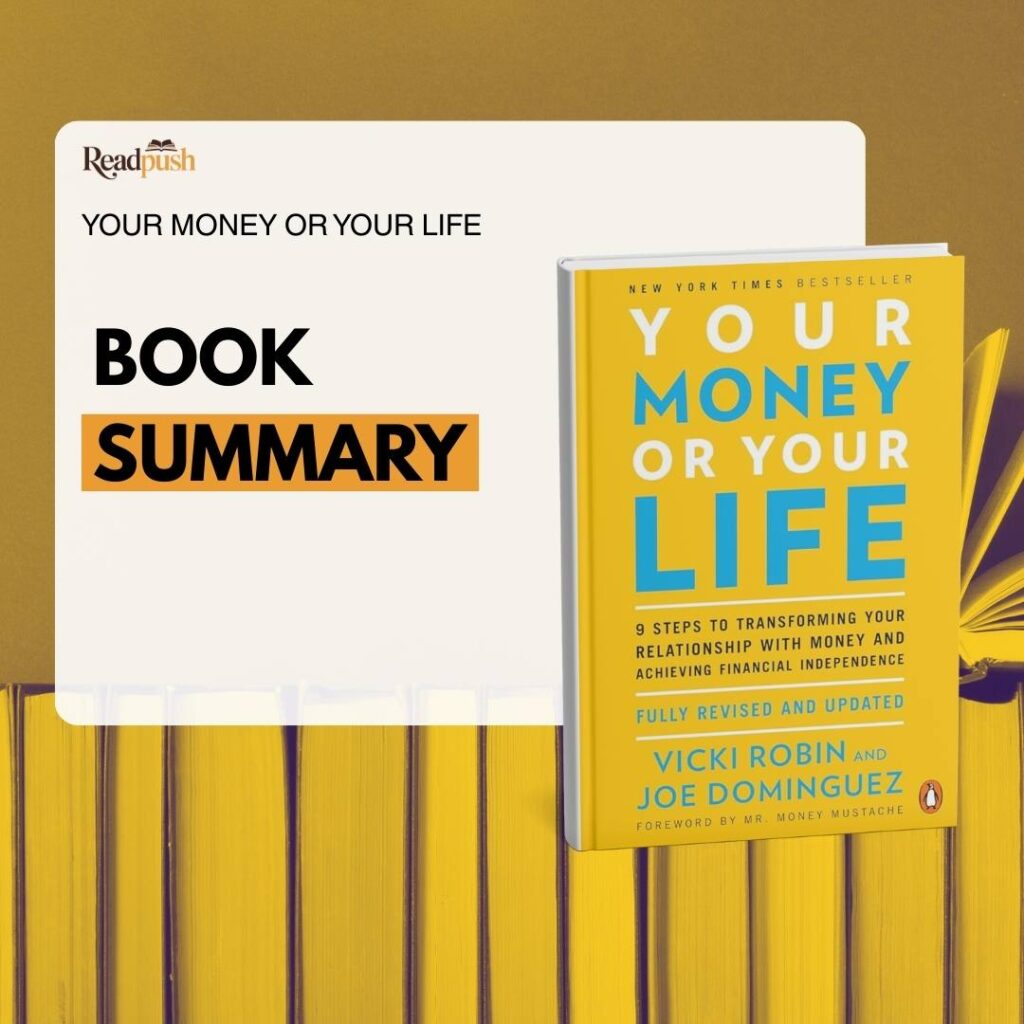
Your Money or Your Life is a book about one idea: every dollar you earn represents a piece of your time on earth. Here is the short version, and here is what to do with it.
Vicki Robin and Joe Dominguez wrote the original in 1992. Robin updated it in 2008 and again in 2018. The core framework has not changed much, which tells you something about how durable it is. It is not a budgeting book. It is not an investing book. It is a philosophy of work and money that happens to have a practical nine-step system attached to it.
The one idea the book is built on
Life energy. That is the term Robin and Dominguez use for your time. Every dollar you earn costs you some amount of time and effort. When you reframe money in terms of life energy, the spending math changes.
The calculation is not your hourly rate. It is your real hourly rate: take your actual take-home pay, then subtract the money you spend to maintain your job (commuting, work clothes, stress spending, decompression costs), and divide it into actual hours worked (including all the commuting, overtime, mental load). For most people, the real rate is considerably lower than the stated one. That coffee might cost thirty minutes of actual life energy rather than the eight minutes the arithmetic suggests.
That reframe is uncomfortable, and deliberately so. The point is to make every spending decision visible in terms that do not hide how much it costs. Once you see it that way, some purchases look different.
The nine steps, compressed
The book walks through nine steps. Here is the structure:
Steps 1-3 are about building awareness. Calculate your life energy rate. Track every cent in and out. Create a monthly accounting of where your life energy is actually going. Most people find surprises in this stage. That is the point.
Steps 4-6 are about evaluation. For each spending category, ask three questions: Did this bring me satisfaction? Did it align with my values? Would I feel differently about this spending if I did not need to work for money? These questions identify the gap between what you are spending money on and what you actually care about.
Steps 7-9 are about building toward financial independence. This means reducing unnecessary spending, increasing income, and investing the gap in a way that generates passive income. The book’s original investment recommendation (long-term government bonds) is dated. The underlying goal is not: build a portfolio that generates enough passive income to cover your expenses permanently. Robin calls the moment you reach that state the crossover point.
|
Your Money or Your Life Nine steps. Three phases. One destination.
|
||||||||||||||||||
Who this is useful for
Useful if you feel like your job is running your life rather than the other way around. Useful if you earn a decent income but have no idea where it goes. Useful if the idea of financial independence genuinely appeals to you and you want a framework, not just a vague concept.
Less useful if you are looking for a detailed investing guide. The book’s original investment advice is specific to a market environment that no longer exists. Read the book for the awareness and evaluation framework; use other sources for the portfolio construction.
Also less useful if you are in a financial crisis. The tracking and evaluation stages work best when you have some stability and some margin. If consumer debt is the main problem right now, the Total Money Makeover addresses that more directly. The two books are complementary: Ramsey gets you stable, Robin gives you the philosophy for what to do once you are.
The three evaluation questions
These are the most practically useful thing in the book. For any spending category, ask:
1. Did this bring me fulfillment relative to what it cost in life energy?
2. Does this align with my values and life purpose?
3. How would I feel about this spending if I did not need to work for money?
The third question is the sharpest one. A lot of spending turns out to be maintenance: the things you buy to recover from work, to reward yourself for working, to manage the stress of working. When you ask how you would spend if you did not need to work, that category often looks different. Not wrong, necessarily, but worth examining. The Psychology of Money covers the happiness-versus-expectation dynamic that sits underneath these questions if you want the academic backing.
What “enough” means in this framework
One of the book’s more useful ideas is that happiness and spending are not proportional. There is a point at which more spending does not produce more satisfaction. The book calls this “enough,” and the tracking work is partly designed to help you find where that point actually is for you, rather than assuming it is always higher than where you currently are.
The crossover point is where this becomes concrete: the month your passive investment income exceeds your monthly expenses. From that month forward, work becomes optional. Not necessarily something you stop doing, but something you choose to do rather than something you have to do. That distinction matters to a lot of people more than the number itself.
|
Decision guide Should you read this book? Depends on these three things.
|
||||||||||||
The verdict
Worth reading if you are in the right situation for it. The life-energy reframe is genuinely useful and it does not exist quite this clearly anywhere else. The nine-step system is more thorough than most people need, but working through the awareness and evaluation stages is worth the time even if you do not plan to pursue the financial independence angle.
Pair it with something that covers the investing mechanics (Bogle, Collins, or Bernstein are the standard references) since Robin’s investment advice is dated. The philosophy is the part worth keeping. The specific portfolio construction is not.
Read chapters 1 and 2 to get the core framing. Run the steps in sequence for at least 90 days before deciding whether to continue. Most people find the tracking stage reveals enough to make the whole exercise worthwhile, even if they do not go all the way to step nine.
What this idea changes in practice
The useful way to read this piece is not as a shortcut around the book, but as a way to decide what the book is really asking you to notice. Your Money or Your Life is easy to reduce to a phrase. The phrase is helpful, but it is also where many readers stop too early.
The practical question is: what changes after you understand the idea? If the answer is only that you can repeat the concept in a meeting, the idea has not done much work yet. A good business or self-improvement book should change a decision, a habit, a conversation, or a way of measuring progress.
For this article, the change is usually smaller and more concrete than the headline suggests. You stop treating the concept as an inspirational lesson and start using it as a filter. It helps you decide what to ignore, what to inspect more closely, and where your current approach may be wasting effort.
That is where ReadPush readers get the most value. Not from another summary, and not from pretending the book is perfect. The value is in separating the durable idea from the noise around it.
Where readers often get it wrong
The common mistake is to treat the book’s central idea as universal. Most book ideas are not universal. They are conditional. They work better for some people, teams, markets, and seasons than others.
That does not make the idea weak. It makes it usable. Advice becomes more useful when you know its boundary. A habit system helps when your life has enough stability to support repetition. A strategy framework helps when the market conditions match the assumptions behind the framework. A finance lesson helps when it is applied to the right kind of risk, not every risk.
So the better reading is not, is this book right? The better reading is, where is this book right, and what would make it wrong for me? That question protects you from two bad habits: dismissing useful books because they are imperfect, and overusing famous books because they sound confident.
If you take only one thing from this article, take that discipline. Apply the idea where the conditions fit. Leave it alone where they do not.
How to apply the lesson without overcomplicating it
Start with one decision. Do not turn the book into a whole operating system on day one. That is how good ideas become heavy.
- Name the problem. What are you actually trying to improve: focus, growth, cash flow, consistency, leadership, decision quality, or something else?
- Pick the relevant principle. Choose one idea from the book that speaks directly to that problem.
- Define the test. What would look different after two weeks if the idea is working?
- Review the result. Keep what helped. Drop what added friction.
This keeps the lesson grounded. You are not trying to become the kind of person who has mastered the whole book. You are trying to make one part of your work or life less vague.
The same issue appears from another angle in Money Master the Game, where the money decision underneath the book becomes easier to see without turning the book into a slogan.
The same issue appears from another angle in Rich Dad Poor Dad, where the money decision underneath the book becomes easier to see without turning the book into a slogan.
The same issue appears from another angle in The Total Money Makeover, where the money decision underneath the book becomes easier to see without turning the book into a slogan.
A better final takeaway
The strongest books on ReadPush are rarely the ones that give the neatest answers. They are the ones that improve the quality of your next question. Your Money or Your Life is worth returning to for that reason.
Ask what the idea reveals. Ask what it hides. Ask what it would look like in a normal week, with normal constraints, limited time, and imperfect follow-through. If the idea still helps there, it is probably worth keeping.
That is the standard. Not whether the book sounds impressive. Whether it survives contact with real life.