Quick takeaways
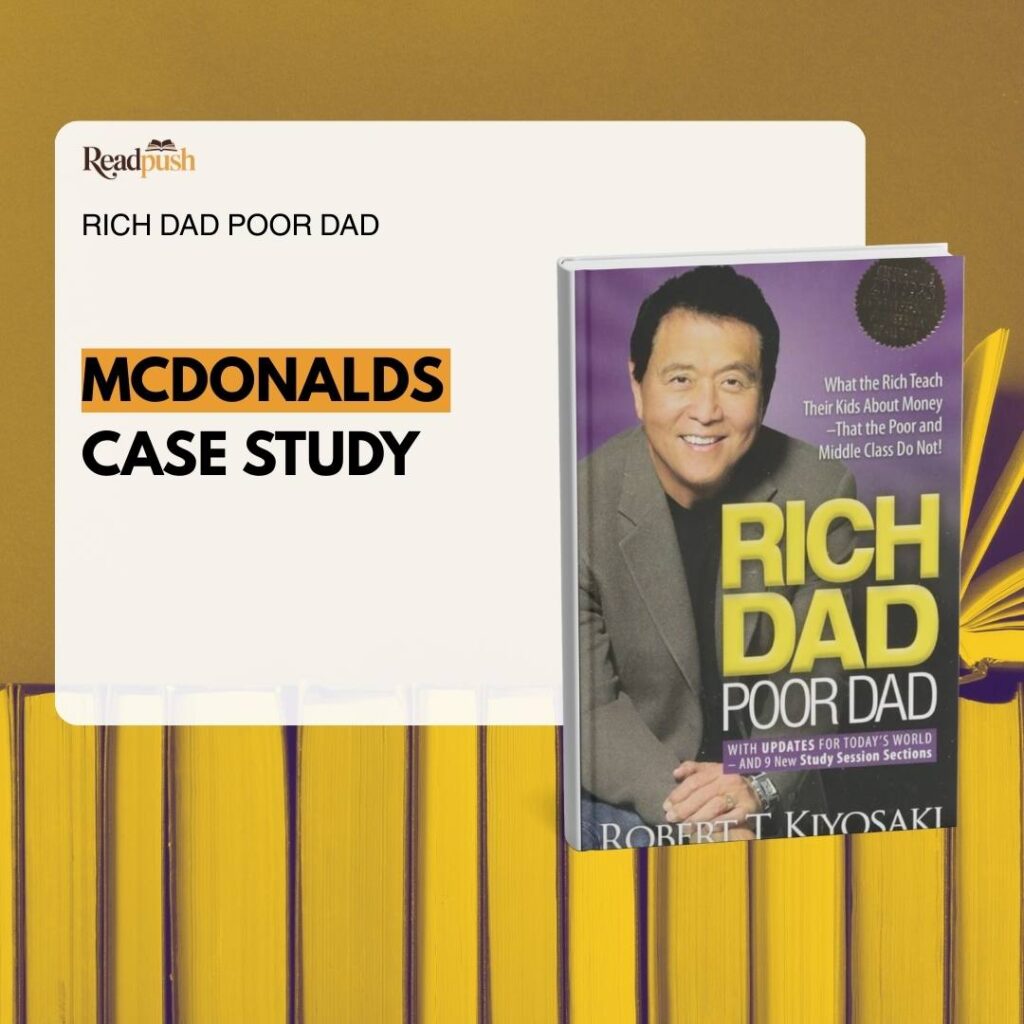
- McDonald’s is not primarily a burger company. It is a real estate company that happens to operate burger restaurants. The distinction is not semantic. It changed how the entire franchise industry thinks about its business model.
- Harry Sonneborn’s insight was simple: control the land and you control the franchise. That one structural decision separated McDonald’s from every other franchise operation of the era.
- The “Mind Your Own Business” chapter in Rich Dad Poor Dad is pointing at exactly this: the restaurant was Ray Kroc’s job. The real estate was his business.
- You cannot do what McDonald’s did at the same scale. But the underlying principle (what do you own that earns when you are not working) applies at any scale, including yours.
I read a lot of business books that use McDonald’s as an example. Most of them get it wrong, or at least get it shallow. “Ray Kroc built a franchise empire” is technically true and also misses the interesting part.
The interesting part is that McDonald’s is not really a restaurant company. It is a real estate company. That distinction, once you understand it, explains almost everything about how the company scaled, why it has lasted, and why this case study actually matters as an illustration of the “Mind Your Own Business” principle from Rich Dad Poor Dad.
Here is what actually happened.
The problem McDonald’s was trying to solve
In the late 1950s, McDonald’s had a functioning franchise system but a fragile business model. Ray Kroc had expanded the brand aggressively, but the economics were painful. Franchise fees were thin. The company depended almost entirely on a percentage of food sales, which meant its income was tied to how many burgers got sold each day across hundreds of locations. Good sales days, good revenue. Bad sales days, the company felt it too.
This is the restaurant industry’s fundamental problem: thin margins, high operational complexity, and income that is directly tied to daily performance. Kroc was trying to build something that could scale without those constraints. The company needed a different business underneath the burger business.
Harry Sonneborn, McDonald’s first president and CFO, figured out what that business was.
The real estate insight
Sonneborn’s observation was that the most valuable thing about a McDonald’s location was not the food it sold. It was the land it sat on. High-traffic intersections, dense suburban areas, locations near highways: these spots appreciated in value over time and attracted consistent customer volume regardless of short-term sales performance.
His proposal: McDonald’s should not just franchise the restaurant concept. It should lease or buy the land and buildings, then sublease them to franchisees at a markup. The franchisee still operates the restaurant. But McDonald’s controls the property. And control of the property is where the real leverage is.
This is the move that built the company into what it is today. McDonald’s became the landlord. Franchisees became the tenants. The operational risk of running restaurants was transferred to individual operators, while McDonald’s captured the upside of real estate ownership: rising property values, reliable rent income, and the ability to reclaim locations if a franchisee did not perform.
How this maps to Kiyosaki’s framework
The “Mind Your Own Business” chapter in Rich Dad Poor Dad makes a distinction that most people nod at and fewer actually apply. Kiyosaki says your job is what you do to pay the bills. Your business is the asset column you are building on the side of, or because of, that job.
McDonald’s ran this at the corporate level. The restaurant franchise was the job. It brought in revenue, created brand visibility, and gave the company something to operate. But the real estate portfolio was the business. It was the thing that generated income independently of how any individual restaurant performed on any given day.
The Rich Dad Poor Dad summary covers the asset versus liability distinction in depth. What McDonald’s demonstrated is that this distinction is not just personal finance philosophy. It is a structural business decision. The companies that tend to build durable wealth are the ones that figure out, early, what the asset underneath their operations actually is.
|
The McDonald’s model Job vs business: how the distinction plays out at scale
|
||||||||||||||||||||||||
What this looks like by the numbers
McDonald’s currently owns roughly 40 to 45 percent of the land and about 70 percent of the buildings at its franchised locations globally. The company collects rent from franchisees that is typically based on a percentage of sales with a floor. When a restaurant performs well, McDonald’s captures the upside through both its royalty percentage and increased rent. When a restaurant underperforms, the rental income provides a floor that protects the company’s revenue regardless.
Real estate and rental income represents a significant portion of McDonald’s total revenue, consistently above $10 billion annually in recent years. That income is more stable than food service revenue because it is contractual rather than dependent on customer count. It also appreciates over time as property values rise.
This is not a side business for McDonald’s. It is the business. The restaurants are the mechanism that makes the real estate valuable. The real estate is what makes McDonald’s resilient.
What you can actually take from this
You are probably not going to build a global real estate portfolio anchored to a franchise system. That is not the point. The point is the question the McDonald’s case makes unavoidable: underneath whatever your current job or business is, what is the asset?
For a consultant, it might be proprietary frameworks or client relationships that generate referrals. For a small business owner, it might be the customer list or the brand equity. For an individual professional, it might be a rental property or an investment portfolio funded by the income your job produces. The job pays for things. The asset earns without you.
This is what Kiyosaki is actually describing in the “Mind Your Own Business” chapter, and what the McDonald’s story illustrates at scale. The restaurant was never the business. The land was. What is yours? The applied guide to building your first passive income stream works through what this looks like in practice for someone starting from a normal income.
|
Applying the lesson The question McDonald’s makes unavoidable, at any scale
|
||||||||||||||||
McDonald’s did not get lucky. It made a structural decision that separated it from every other franchise operation in an era when franchise was still a new concept. That decision was: we are in the real estate business. Everything else is how we make the real estate valuable.
One question, honestly answered, can be worth more than most strategy documents. What is your asset?
What this idea changes in practice
The useful way to read this piece is not as a shortcut around the book, but as a way to decide what the book is really asking you to notice. How McDonald's Became a Real Estate Company (and Why It Proves Kiyosaki Right) is easy to reduce to a phrase. The phrase is helpful, but it is also where many readers stop too early.
The practical question is: what changes after you understand the idea? If the answer is only that you can repeat the concept in a meeting, the idea has not done much work yet. A good business or self-improvement book should change a decision, a habit, a conversation, or a way of measuring progress.
For this article, the change is usually smaller and more concrete than the headline suggests. You stop treating the concept as an inspirational lesson and start using it as a filter. It helps you decide what to ignore, what to inspect more closely, and where your current approach may be wasting effort.
That is where ReadPush readers get the most value. Not from another summary, and not from pretending the book is perfect. The value is in separating the durable idea from the noise around it.
Where readers often get it wrong
The common mistake is to treat the book’s central idea as universal. Most book ideas are not universal. They are conditional. They work better for some people, teams, markets, and seasons than others.
That does not make the idea weak. It makes it usable. Advice becomes more useful when you know its boundary. A habit system helps when your life has enough stability to support repetition. A strategy framework helps when the market conditions match the assumptions behind the framework. A finance lesson helps when it is applied to the right kind of risk, not every risk.
So the better reading is not, is this book right? The better reading is, where is this book right, and what would make it wrong for me? That question protects you from two bad habits: dismissing useful books because they are imperfect, and overusing famous books because they sound confident.
If you take only one thing from this article, take that discipline. Apply the idea where the conditions fit. Leave it alone where they do not.
How to apply the lesson without overcomplicating it
Start with one decision. Do not turn the book into a whole operating system on day one. That is how good ideas become heavy.
- Name the problem. What are you actually trying to improve: focus, growth, cash flow, consistency, leadership, decision quality, or something else?
- Pick the relevant principle. Choose one idea from the book that speaks directly to that problem.
- Define the test. What would look different after two weeks if the idea is working?
- Review the result. Keep what helped. Drop what added friction.
This keeps the lesson grounded. You are not trying to become the kind of person who has mastered the whole book. You are trying to make one part of your work or life less vague.
The same issue appears from another angle in Rich Dad Poor Dad Lessons for Entrepreneurs, where the money decision underneath the book becomes easier to see without turning the book into a slogan.
The same issue appears from another angle in How to Run the Nine Step Life, where the money decision underneath the book becomes easier to see without turning the book into a slogan.
The same issue appears from another angle in Mind Your Own Business, where the business trade-off the book is trying to clarify becomes easier to see without turning the book into a slogan.
A better final takeaway
The strongest books on ReadPush are rarely the ones that give the neatest answers. They are the ones that improve the quality of your next question. How McDonald's Became a Real Estate Company (and Why It Proves Kiyosaki Right) is worth returning to for that reason.
Ask what the idea reveals. Ask what it hides. Ask what it would look like in a normal week, with normal constraints, limited time, and imperfect follow-through. If the idea still helps there, it is probably worth keeping.
That is the standard. Not whether the book sounds impressive. Whether it survives contact with real life.