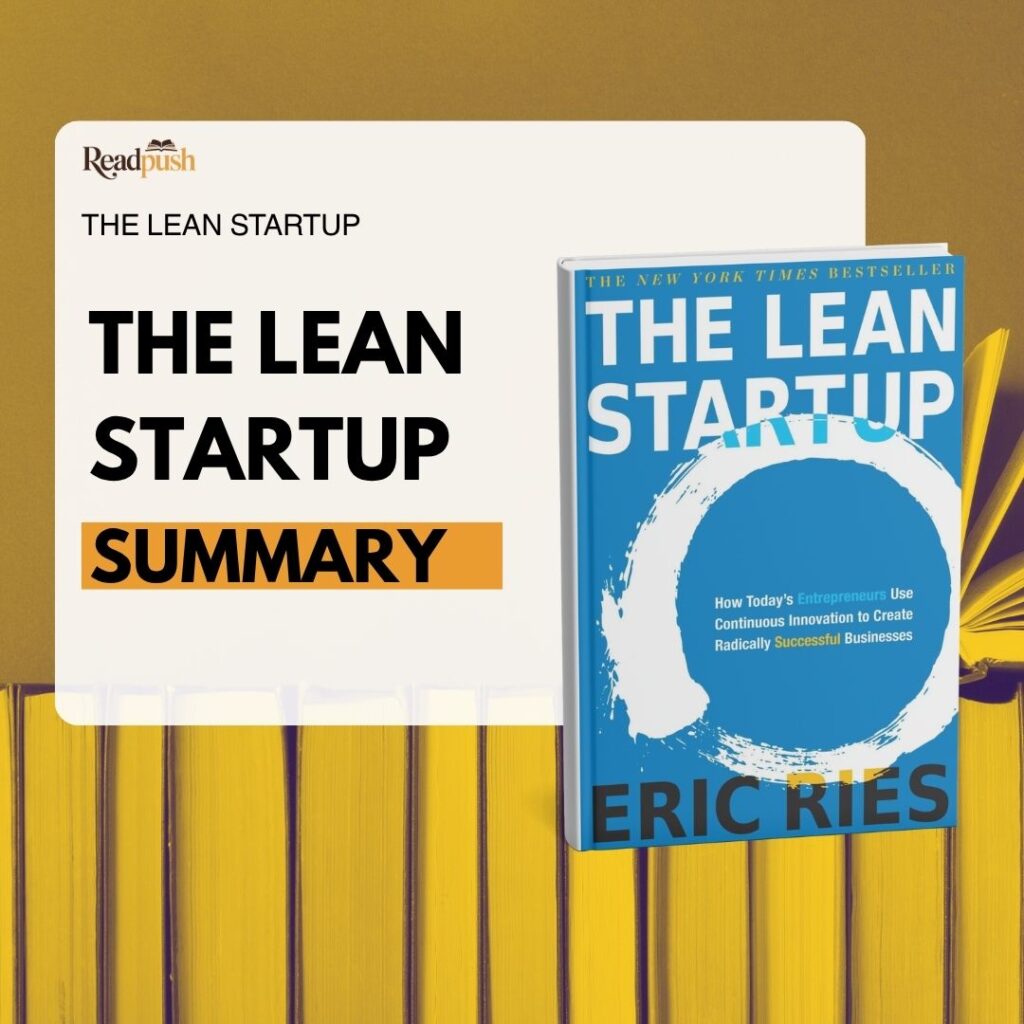
The Lean Startup changed how entrepreneurs think about launching and scaling businesses. It shows that success isn’t about luck or big funding but about learning quickly and adapting fast. This summary distills the core ideas so you can grasp the method in minutes. It’s ideal for entrepreneurs, managers, and creators who want to innovate with less waste and more clarity.
For a complete breakdown, see our [full review of The Lean Startup].
About the book
Written by Eric Ries, a Silicon Valley entrepreneur and co founder of IMVU, The Lean Startup was published in 2011 and remains one of the most influential business books of the modern startup era. It teaches how to manage uncertainty through continuous innovation. The book is targeted at founders, product leaders, and innovators who want a systematic way to grow their ideas into scalable businesses.
Main concepts
Concept 1: build measure learn loop
At the heart of The Lean Startup is the Build measure learn feedback loop. Instead of spending months developing a “perfect” product, entrepreneurs should build a minimum viable product (MVP), measure how users respond, and learn from real data to guide their next move.
For example, Ries tested IMVU’s early versions with real users instead of polishing the product in isolation. The feedback shaped each iteration.
The takeaway: treat every product launch as an experiment. Your goal is to learn what customers truly value, not just what you assume they do.
Concept 2: validated learning
Validated learning means proving your assumptions with data, not opinions. Instead of asking “Can this product be built?” ask “Should it be built?”
Startups often waste years building features no one needs. Ries argues that every experiment should test a specific hypothesis ,such as “customers will pay for this feature.”
When IMVU’s users ignored its complex social features but paid for simple virtual goods, that insight led to a profitable pivot.
Concept 3: the pivot
When evidence shows your direction isn’t working, it’s time to pivot ,a strategic shift to a new hypothesis while keeping your vision. Pivots are not failures; they’re course corrections based on learning.
Dropbox, for instance, pivoted early when it realized its demo video validated user demand before the product even existed. That learning helped shape a billion dollar business.
Concept 4: innovation accounting
Traditional metrics like revenue or user growth don’t mean much at the early stage. Innovation accounting focuses on learning milestones ,how much progress you’ve made toward a sustainable business model.
Measure actionable metrics, not vanity numbers. For instance, track the percentage of users who return or pay, not total downloads.
Concept 5: continuous deployment and agile development
The Lean Startup encourages continuous deployment ,releasing updates frequently to test and learn faster. It aligns with agile principles, reducing long planning cycles and promoting constant feedback.
By releasing small updates regularly, companies like Amazon or Spotify adapt faster than competitors stuck in long release schedules.
Key frameworks
The central framework of The Lean Startup is the build measure learn cycle, which powers all the other concepts. It helps entrepreneurs test ideas quickly, learn from real customer behavior, and adjust strategy before wasting time or capital.
This method helps you validate your product, find product market fit, and grow sustainably.
Key takeaways
- Start with a minimum viable product to test ideas fast.
- Focus on validated learning, not gut feeling.
- Use data driven decisions to decide when to pivot or persevere.
- Avoid vanity metrics; measure what truly shows progress.
- Build processes for continuous experimentation.
- Empower teams to release updates frequently.
- Treat your startup as a learning organization, not just a product factory.
- The faster you learn, the more resilient your business becomes
The Lean Startup redefines entrepreneurship as a process of continuous innovation and learning. It’s the must read playbook for anyone building something new in uncertain conditions. The single most important insight: success comes from learning faster than everyone else.
What this idea changes in practice
The useful way to read this piece is not as a shortcut around the book, but as a way to decide what the book is really asking you to notice. The Lean Startup is easy to reduce to a phrase. The phrase is helpful, but it is also where many readers stop too early.
The practical question is: what changes after you understand the idea? If the answer is only that you can repeat the concept in a meeting, the idea has not done much work yet. A good business or self-improvement book should change a decision, a habit, a conversation, or a way of measuring progress.
For this article, the change is usually smaller and more concrete than the headline suggests. You stop treating the concept as an inspirational lesson and start using it as a filter. It helps you decide what to ignore, what to inspect more closely, and where your current approach may be wasting effort.
That is where ReadPush readers get the most value. Not from another summary, and not from pretending the book is perfect. The value is in separating the durable idea from the noise around it.
Where readers often get it wrong
The common mistake is to treat the book’s central idea as universal. Most book ideas are not universal. They are conditional. They work better for some people, teams, markets, and seasons than others.
That does not make the idea weak. It makes it usable. Advice becomes more useful when you know its boundary. A habit system helps when your life has enough stability to support repetition. A strategy framework helps when the market conditions match the assumptions behind the framework. A finance lesson helps when it is applied to the right kind of risk, not every risk.
So the better reading is not, is this book right? The better reading is, where is this book right, and what would make it wrong for me? That question protects you from two bad habits: dismissing useful books because they are imperfect, and overusing famous books because they sound confident.
If you take only one thing from this article, take that discipline. Apply the idea where the conditions fit. Leave it alone where they do not.
How to apply the lesson without overcomplicating it
Start with one decision. Do not turn the book into a whole operating system on day one. That is how good ideas become heavy.
- Name the problem. What are you actually trying to improve: focus, growth, cash flow, consistency, leadership, decision quality, or something else?
- Pick the relevant principle. Choose one idea from the book that speaks directly to that problem.
- Define the test. What would look different after two weeks if the idea is working?
- Review the result. Keep what helped. Drop what added friction.
This keeps the lesson grounded. You are not trying to become the kind of person who has mastered the whole book. You are trying to make one part of your work or life less vague.
The same issue appears from another angle in Finance Corporate, where the money decision underneath the book becomes easier to see without turning the book into a slogan.
The same issue appears from another angle in Good to great, where the business trade-off the book is trying to clarify becomes easier to see without turning the book into a slogan.
The same issue appears from another angle in The Startup Community Way, where the business trade-off the book is trying to clarify becomes easier to see without turning the book into a slogan.
A better final takeaway
The strongest books on ReadPush are rarely the ones that give the neatest answers. They are the ones that improve the quality of your next question. The Lean Startup is worth returning to for that reason.
Ask what the idea reveals. Ask what it hides. Ask what it would look like in a normal week, with normal constraints, limited time, and imperfect follow-through. If the idea still helps there, it is probably worth keeping.
That is the standard. Not whether the book sounds impressive. Whether it survives contact with real life.
What to reread in the original book
If you go back to the source, reread the chapters around the core framework rather than the promotional parts around it. Most business and personal development books repeat themselves. The useful material is usually clustered where the author explains the mechanism: why the idea works, when it fails, and what kind of behaviour it is meant to change.
When you reread, mark examples differently from principles. Examples are there to clarify. Principles are there to travel. Trouble starts when readers copy the example and miss the principle underneath it.
That distinction is especially important with The Lean Startup. The surface lesson is easy to remember. The deeper value comes from noticing the assumptions behind the lesson. Once you see those assumptions, you can apply the idea with more judgement and less imitation.
Who should spend more time with this idea
This idea is most useful for readers who are already dealing with the problem the book describes. If the problem is theoretical for you, the lesson may sound clever and then disappear. If the problem is active, the lesson has somewhere to land.
That is why timing matters with books. The same chapter can feel obvious at one stage of life and quietly important at another. You are not only reading the book. You are reading it from a particular set of pressures.
Use that to your advantage. If the article made something feel uncomfortably familiar, that is probably the part to inspect first.