|
Summary at a glance
|
Slow Productivity by Cal Newport is a 2024 book about accomplishing meaningful work without turning every week into a state of permanent urgency. It is not a book about doing less in a lazy sense. It is a book about doing fewer things at once so that the important things can be done better.
This Slow Productivity summary explains Newport’s central argument, the three principles of the book, and the practical meaning of the framework. It also covers where the book is strongest, where it is harder to apply, and who is most likely to benefit from reading it.
Slow Productivity in one paragraph
Newport argues that modern knowledge work is trapped in pseudo-productivity: the habit of using visible activity as a substitute for measuring real output. Because knowledge work is hard to measure, many workplaces reward quick replies, busy calendars, constant availability, and long task lists. Slow Productivity offers a different model built around three principles: do fewer things, work at a natural pace, and obsess over quality. The goal is not to withdraw from ambition, but to create conditions where valuable work can be completed without chronic overload.
What is pseudo-productivity?
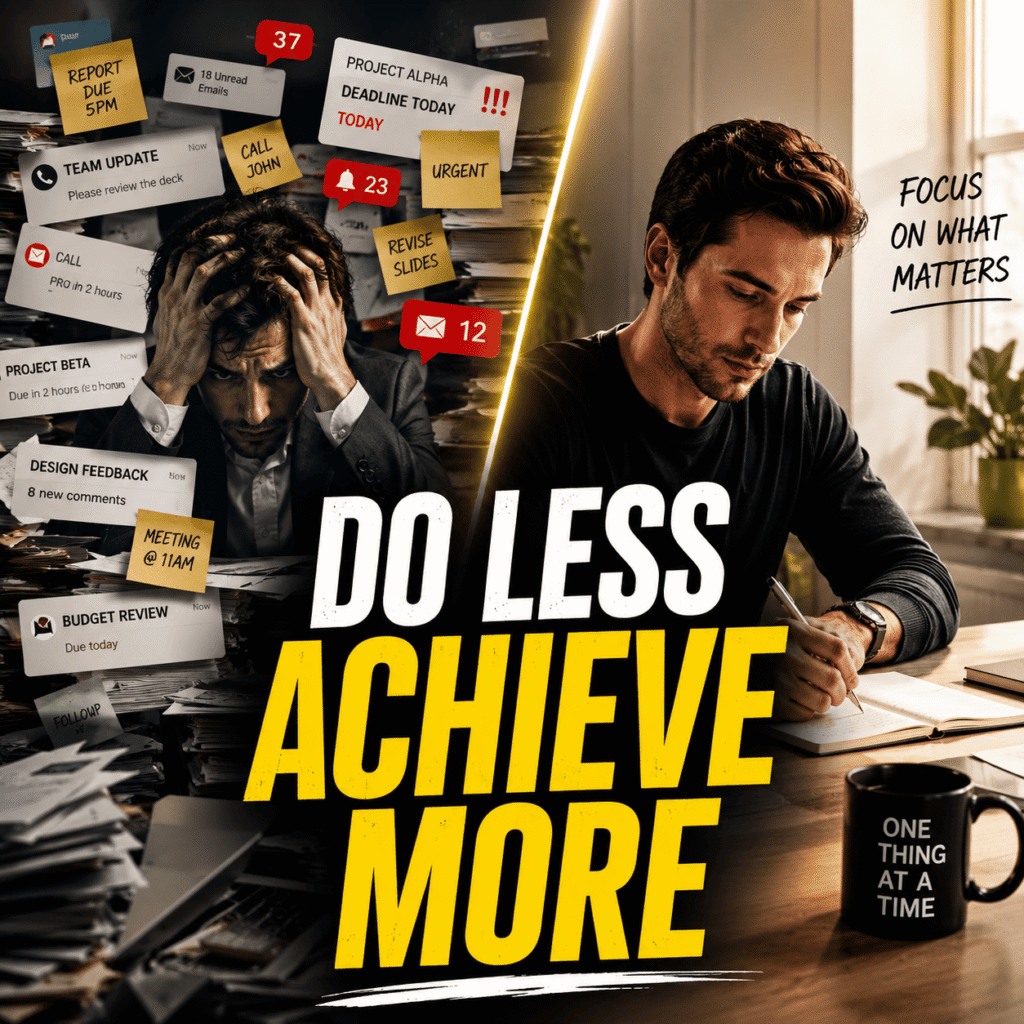
Pseudo-productivity is Newport’s term for the use of visible activity as a proxy for useful effort. To put it plainly, it is the belief that looking busy means you are being productive.
This is especially common in knowledge work. In a factory, output can often be counted directly. In knowledge work, the output is less visible: a strategy, a design decision, a line of research, a chapter, a product plan, a diagnosis, or a difficult judgment. Because this work is harder to measure, organizations often fall back on easier signals.
Those signals include fast email replies, frequent meetings, full calendars, rapid chat responses, and a general sense of being available. The problem is that these behaviors can fill the day without producing the work that matters most.
Newport’s argument is that pseudo-productivity creates exhaustion without necessarily creating accomplishment.
The book’s three principles
The official page for Slow Productivity presents the framework as a philosophy for sustainable accomplishment. The book’s subtitle, The Lost Art of Accomplishment Without Burnout, is a useful guide to Newport’s purpose.
The framework is built around three principles. Each one is simple to state, but more difficult to apply in a normal work environment.
|
The three principles of Slow Productivity
|
Principle 1: Do fewer things
The first principle is the foundation of the book. Newport argues that many knowledge workers are not failing because they lack discipline. They are failing because they are trying to keep too many active commitments alive at the same time.
An active commitment is not simply an item on a list. It is anything that can generate meetings, messages, decisions, updates, follow-ups, and mental background noise. A person may believe they have five projects, but if each project produces daily coordination demands, the real load is much higher.
Doing fewer things means limiting the number of commitments that are allowed to be active at once. This does not necessarily mean abandoning ambition. It means sequencing work more carefully so that important projects are finished instead of constantly restarted.
In practice, this principle may involve using a waiting list for new projects, setting stricter intake rules, clarifying what is truly active, and resisting the urge to say yes simply because something sounds valuable.
Principle 2: Work at a natural pace
The second principle challenges the assumption that important work should always move at maximum speed. Newport argues that sustainable accomplishment often requires variation: periods of intensity, periods of steadier progress, and periods of recovery or reflection.
This does not mean working slowly in every moment. It means avoiding the permanent emergency mode that has become normal in many offices. Creative and intellectual work often improves when it has enough time to mature.
For context, Newport uses historical examples throughout the book. He discusses writers, scientists, artists, and thinkers whose best work developed across longer rhythms than the modern workplace usually allows. The point is not that today’s worker can copy those lives exactly. The point is that high-quality cognitive work has rarely been produced well under constant fragmentation.
In practice, working at a natural pace may mean planning projects with more realistic timelines, reducing artificial urgency, building seasonal rhythms into the year, and allowing some parts of the work to develop more slowly than a task manager would prefer.
Principle 3: Obsess over quality
The third principle is about making quality the organizing standard. Newport argues that if you commit to producing unusually good work, many decisions become clearer. You become more selective about commitments because lower-value work threatens the quality of higher-value work.
This principle is important because it prevents slow productivity from becoming a vague call to relax. Newport is not arguing for lower standards. He is arguing for fewer commitments in service of higher standards.
Obsessing over quality may mean investing in better tools, practicing a craft more deliberately, studying strong examples, seeking useful feedback, or declining opportunities that would dilute your best work.
The central idea is that meaningful accomplishment depends less on constant activity and more on the steady improvement of what you produce.
Slow Productivity vs Deep Work
Slow Productivity is closely related to Newport’s earlier book Deep Work, but the two books solve different problems.
Deep Work is about the practice of sustained concentration. It asks how a person can protect attention and produce valuable work in a distracted environment.
Slow Productivity is about the larger workload that surrounds that practice. It asks why so many workers have schedules and commitments that make deep work difficult in the first place.
A simple distinction is this: Deep Work helps you use a focused work block well. Slow Productivity helps you build a working life where focused work blocks are not constantly destroyed by overload.
Key takeaways from Slow Productivity
The first takeaway is that busyness is not the same as accomplishment. This sounds obvious, but many work systems reward busyness because it is easier to see.
The second takeaway is that active commitments have hidden costs. A project does not only take the time required to do the main task. It also creates coordination, context switching, follow-up, and mental residue.
The third takeaway is that pace matters. Work done under constant urgency may feel efficient, but it often reduces quality and increases burnout.
The fourth takeaway is that quality can be a filter. If a commitment prevents you from doing your most important work well, it may be more expensive than it first appears.
What Slow Productivity gets right
The book’s strongest idea is its critique of pseudo-productivity. Many readers will recognize the pattern immediately: the day is full, the messages are answered, the meetings are attended, but the work that would actually matter remains unfinished.
Newport also gives useful language to a problem that is often treated as personal weakness. The reader may not be disorganized or unmotivated. The system may simply be asking for too many simultaneous commitments.
The book is also valuable because it connects productivity with quality. It does not merely ask how to get more done. It asks what kind of work is worth protecting.
Where the book is limited
The main limitation is autonomy. Some readers have enough control to reduce active commitments, reshape timelines, or protect slower rhythms. Others do not. A junior employee, support worker, nurse, teacher, or manager in a highly reactive role may find some advice difficult to apply directly.
This does not make the book useless for those readers. It means the ideas may need to be applied at a smaller scale. For example, a person may not be able to redesign a company’s workflow, but they may be able to limit personal side projects, reduce unnecessary availability, clarify priorities with a manager, or protect one small block of higher-quality work.
Another limitation is that the book’s historical examples can feel distant from ordinary office life. The examples are useful for illustrating a philosophy, but they do not always translate neatly into a modern workplace with Slack, clients, deadlines, and performance reviews.
Who should read Slow Productivity?
Read Slow Productivity if you are a knowledge worker who feels constantly busy but not meaningfully productive. It is especially useful for writers, researchers, software developers, founders, consultants, managers, academics, creators, and professionals whose best work requires judgment and sustained attention.
It is also useful if you liked Deep Work but found that focus blocks alone did not solve your problem. In that case, your issue may not be attention. It may be workload design.
You may find the book less directly applicable if your work is mostly reactive and tightly scheduled by others. Even then, the critique of pseudo-productivity can help you notice which parts of your workload create the most unnecessary noise.
The same issue appears from another angle in Deep Work, where the question of attention, habits, and what actually changes behaviour becomes easier to see without turning the book into a slogan.
The same issue appears from another angle in Essentialism, where the larger question the book raises becomes easier to see without turning the book into a slogan.
The same issue appears from another angle in Thinking Fast and Slow, where the business trade-off the book is trying to clarify becomes easier to see without turning the book into a slogan.
Final summary
If you remember three things from Slow Productivity, let it be these.
First, modern knowledge work often mistakes visible activity for real productivity. Second, meaningful accomplishment usually requires fewer active commitments and a more natural pace. Third, the purpose of doing fewer things is not comfort alone; it is better work.
Newport’s book is best read as a philosophy of workload design. It will not solve every workplace constraint, and some readers will have more freedom to apply it than others. Still, its central question is useful for almost anyone doing cognitive work: are you measuring your day by how busy it looked, or by what it actually produced?
That question is the book’s lasting contribution.