|
Quick takeaways
|
I have had days where I answered sixty emails, cleared a task board, sent three follow-ups, updated a spreadsheet, and still ended the day with the sour little feeling that nothing important happened.
That is the whole Deep Work vs shallow work problem. Shallow work feels productive because it is visible. Deep work feels suspicious because it is quiet. Nobody cheers when you spend two uninterrupted hours thinking through the offer, rewriting the sales page, or solving the problem that keeps creating all the tiny tasks.
Cal Newport gave the distinction a name in Deep Work. It is one of those ideas that sounds obvious until you use it on your own calendar and realize, with some discomfort, that your day is mostly maintenance wearing a blazer.
The short answer: deep work creates, shallow work maintains
Deep work is focused, cognitively demanding work that creates new value and is hard to replicate. Newport’s official book page describes Deep Work as focused success in a distracted world, which is neat marketing, but the useful part is simpler: deep work is the work that needs your full brain.
Shallow work is logistical, routine, and usually easier to do while distracted. Email. Scheduling. Status updates. Basic admin. Coordination. It is not fake work. It just usually does not create much new value by itself.
The founder version: deep work builds the thing. Shallow work keeps people from yelling while you build the thing.
Deep Work vs shallow work at a glance
|
The task classifier
|
What Deep Work gets right
Newport is right that serious work needs protected attention. The work that changes your career or business usually requires holding a messy problem in your head long enough for the obvious answer to get bored and leave.
For founders, deep work is often the thing nobody is demanding today but everyone will feel later. Positioning. Pricing. A better offer. A hard strategic decision. Writing something that actually persuades. Fixing the root cause instead of answering the tenth symptom email.
The brutal part is that deep work rarely gives instant social proof. You can spend two hours thinking and have nothing visible until the third hour. Shallow work gives little dopamine receipts all day.
What shallow work is actually for
Shallow work is not the villain. Please answer the customer. Please send the invoice. Please schedule the call before everyone starts communicating through passive-aggressive calendar invites.
Shallow work keeps the machine running. It becomes a problem when the machine runs beautifully in circles. A business can have polished admin and no strategy. A writer can have perfect notes and no draft. A student can make gorgeous flashcards and still not understand the material.
|
Common mistake Do not call shallow work useless. That just makes you feel superior while your inbox catches fire. Call it what it is: necessary maintenance that needs boundaries. |
Why shallow work takes over
Shallow work takes over because it is visible, urgent, and easy to justify. It lets you feel responsive. It gives you proof that you did something. It also protects you from the mild terror of work where the answer is not obvious.
Deep work has no such manners. It asks you to sit with difficulty. It asks you to produce judgment, not motion. In a workplace built around notifications and meetings, that can feel almost antisocial.
Research on attention residue helps explain why this matters. Sophie Leroy’s work on attention residue found that switching tasks can leave part of your attention stuck on the previous task, which is exactly why a morning chopped into messages can ruin a thinking block before it starts.
How to audit your workday
Take yesterday’s calendar or task list. Put each task through two tests.
First, the output test: did this create something valuable that did not exist before? Second, the replacement test: could someone competent do it after a short explanation? If the answer is yes, it may be necessary, but it is probably shallow.
|
The 4-box work audit
|
How to reduce shallow work without becoming impossible to work with
Start by batching one category. Email twice a day instead of every seven minutes. Put admin into a container. Make meetings earn their place. Create templates for repeat answers.
Then protect one deep work block. Not a mythical four-hour retreat with a candle and a perfect desk. Sixty minutes. One task. Phone away. Tabs closed. A clear finish line.
|
In plain English Do not try to eliminate shallow work. Put it in a box so it stops wandering around the whole day. |
Common misconceptions about Deep Work vs shallow work
Myth: shallow work is useless. Shallow work is often necessary. The problem is volume, timing, and status.
Myth: deep work means disappearing for half the day. One serious hour can matter if the task is chosen well.
Myth: email is always shallow. Most email is shallow. A carefully written strategic message can be deep if it requires judgment and changes an outcome.
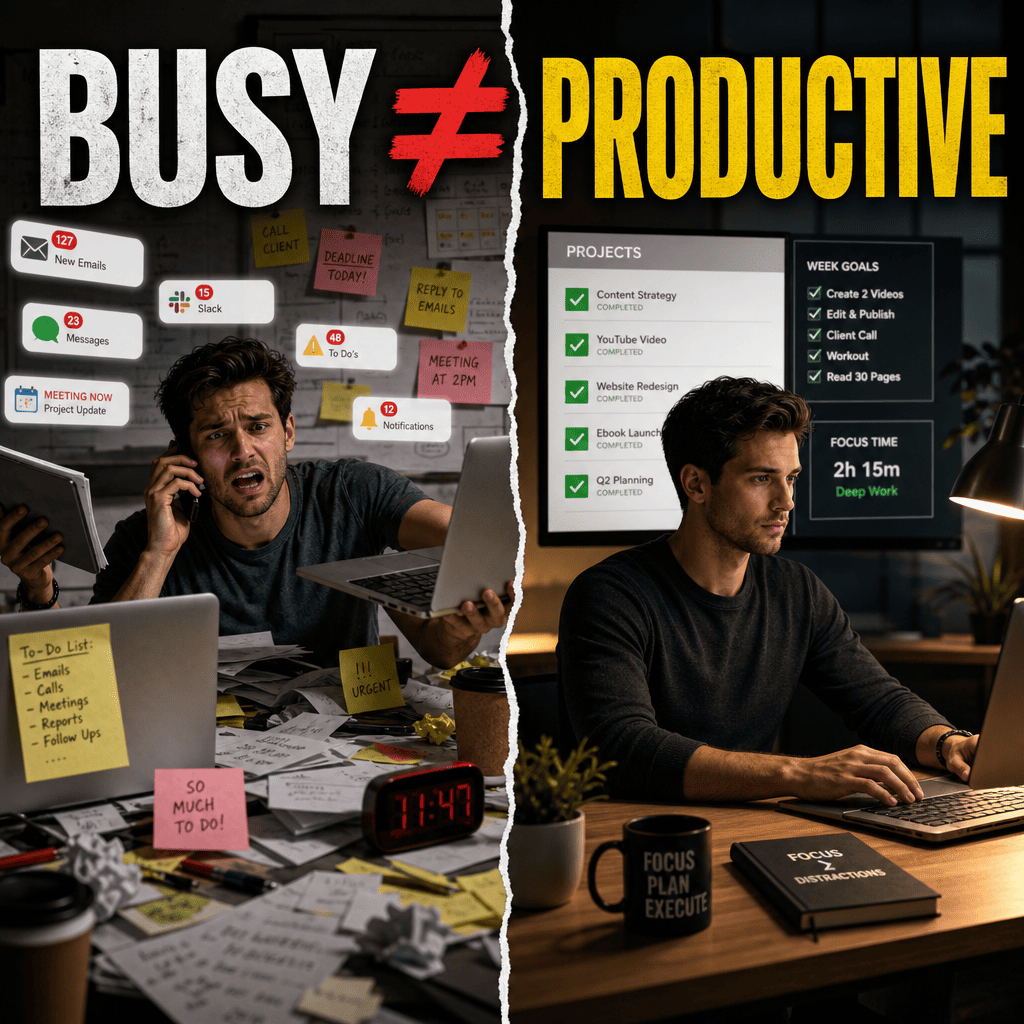
Myth: busy people are productive people. Busy can mean productive. It can also mean unprotected.
FAQ
What is the difference between deep work and shallow work?
Deep work requires focused attention and creates hard-to-replicate value. Shallow work is routine, logistical, and usually easier to do while distracted.
Is shallow work bad?
No. Shallow work is often necessary. It becomes harmful when it consumes the time and energy needed for meaningful work.
How many hours of deep work should you do?
Start with one 45 to 60 minute block. Newport writes about larger blocks, but most people need proof they can protect one block before designing an ideal schedule.
What are examples of shallow work?
Common examples include routine email, scheduling, status updates, basic admin, simple formatting, and meetings with no decision or creative demand.
How do I reduce shallow work?
Batch it, template it, delegate what you can, and stop treating every notification as a command. Then protect one deep work block before the shallow work expands.
Protect the work that changes the day
The practical move is small: pick one shallow task to batch and one deep task to protect this week.
If you want the original framework, read Cal Newport’s Deep Work. If you want the research phrase for why task switching feels so expensive, look up the APA’s summary of multitasking costs.
But do not let research become another shallow task. Close the tabs. Choose the work. Give it one honest hour.
What this idea changes in practice
The useful way to read this piece is not as a shortcut around the book, but as a way to decide what the book is really asking you to notice. Deep Work is easy to reduce to a phrase. The phrase is helpful, but it is also where many readers stop too early.
The practical question is: what changes after you understand the idea? If the answer is only that you can repeat the concept in a meeting, the idea has not done much work yet. A good business or self-improvement book should change a decision, a habit, a conversation, or a way of measuring progress.
For this article, the change is usually smaller and more concrete than the headline suggests. You stop treating the concept as an inspirational lesson and start using it as a filter. It helps you decide what to ignore, what to inspect more closely, and where your current approach may be wasting effort.
That is where ReadPush readers get the most value. Not from another summary, and not from pretending the book is perfect. The value is in separating the durable idea from the noise around it.
Where readers often get it wrong
The common mistake is to treat the book’s central idea as universal. Most book ideas are not universal. They are conditional. They work better for some people, teams, markets, and seasons than others.
That does not make the idea weak. It makes it usable. Advice becomes more useful when you know its boundary. A habit system helps when your life has enough stability to support repetition. A strategy framework helps when the market conditions match the assumptions behind the framework. A finance lesson helps when it is applied to the right kind of risk, not every risk.
So the better reading is not, is this book right? The better reading is, where is this book right, and what would make it wrong for me? That question protects you from two bad habits: dismissing useful books because they are imperfect, and overusing famous books because they sound confident.
If you take only one thing from this article, take that discipline. Apply the idea where the conditions fit. Leave it alone where they do not.
How to apply the lesson without overcomplicating it
Start with one decision. Do not turn the book into a whole operating system on day one. That is how good ideas become heavy.
- Name the problem. What are you actually trying to improve: focus, growth, cash flow, consistency, leadership, decision quality, or something else?
- Pick the relevant principle. Choose one idea from the book that speaks directly to that problem.
- Define the test. What would look different after two weeks if the idea is working?
- Review the result. Keep what helped. Drop what added friction.
This keeps the lesson grounded. You are not trying to become the kind of person who has mastered the whole book. You are trying to make one part of your work or life less vague.
The same issue appears from another angle in Atomic Habits vs Four Thousand Weeks, where the question of attention, habits, and what actually changes behaviour becomes easier to see without turning the book into a slogan.
The same issue appears from another angle in Best books to stop procrastinating, where the question of attention, habits, and what actually changes behaviour becomes easier to see without turning the book into a slogan.
The same issue appears from another angle in What to read after Deep Work, where the question of attention, habits, and what actually changes behaviour becomes easier to see without turning the book into a slogan.
A better final takeaway
The strongest books on ReadPush are rarely the ones that give the neatest answers. They are the ones that improve the quality of your next question. Deep Work is worth returning to for that reason.
Ask what the idea reveals. Ask what it hides. Ask what it would look like in a normal week, with normal constraints, limited time, and imperfect follow-through. If the idea still helps there, it is probably worth keeping.
That is the standard. Not whether the book sounds impressive. Whether it survives contact with real life.