|
Quick takeaways
|
I have read enough productivity books to know that reading productivity books can become its own form of procrastination.
You buy the book. You underline the sentence. You feel organized for 36 hours. Then the week punches you in the mouth and you are back to answering messages at midnight with six tabs open and a cold cup of coffee nearby.
So when someone asks, which productivity book made a real difference, I do not think the answer should be another elegant list of classics. The useful answer is narrower: which book actually changes a behavior after the reading mood wears off?
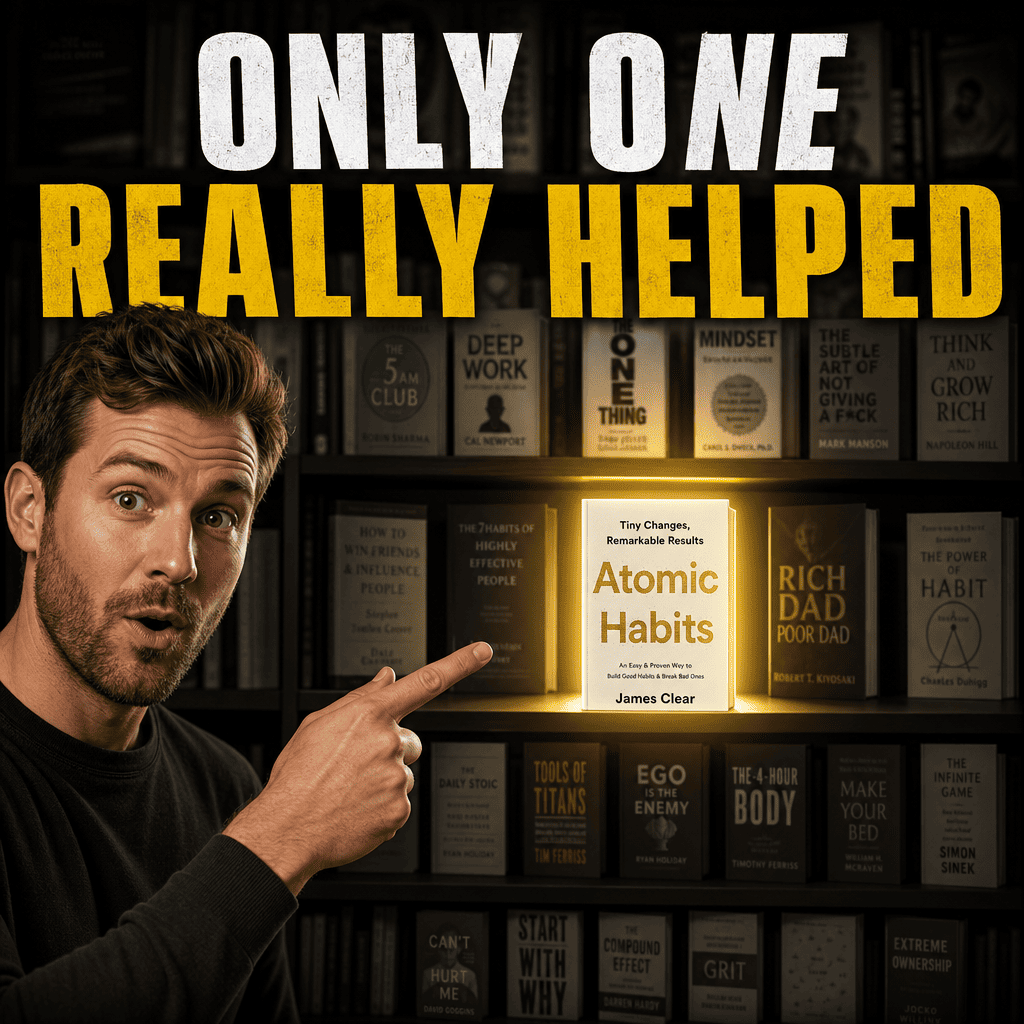
For most people, my answer is Atomic Habits by James Clear.
Not because it is the deepest productivity book. It is not. Not because every idea is brand new. It is not that either. It makes a real difference because it lowers the emotional cost of starting. That is where a lot of work actually breaks.
The honest answer: Atomic Habits, for most people
Atomic Habits works because it does not ask you to wake up with a heroic personality. It asks you to redesign the next tiny action.
That sounds small because it is small. That is the point.
When I first read it, the part that stuck was not the inspirational language about becoming 1 percent better. It was the boring, practical idea that behavior is easier when the environment helps. If the thing you want to do is visible, simple, and attached to something you already do, you are less dependent on motivation.
ReadPush has a full Atomic Habits summary, but the shortest version is this: small systems beat big intentions. Clear’s Four Laws of Behavior Change give you a practical way to design those systems: make the habit obvious, attractive, easy, and satisfying.
That is why it makes a difference. It turns “I need to be more disciplined” into “I need to make the first step easier.” Those are not the same problem.
|
Clara’s test A productivity book made a real difference if you can name one behavior you still do differently thirty days later. |
Why Atomic Habits changes behavior when other books do not
Most productivity books accidentally make the reader feel behind. Better mornings. Better focus. Better systems. Better self-control. It can become a very tidy way to feel inadequate.
Atomic Habits is useful because it makes the unit of change smaller. Instead of trying to become a person who writes every morning, you make the document easy to open. Instead of trying to become someone who handles money calmly, you set a Friday cash review with one number to check. Instead of promising to stop scrolling, you move the phone away from the desk before the hard task starts.
This is not glamorous. Glamour is often where execution goes to die.
The first experiment: pick one work behavior and make the first step almost stupidly easy. If you want to do sales outreach, open the lead list. If you want to write, title the document. If you want to plan the day, write only the first important task. You are training the start, not performing a personality transplant.
But Deep Work may be the real answer if your problem is attention
If your work problem is scattered attention, Deep Work by Cal Newport may make a bigger difference than Atomic Habits.
Newport’s argument is that valuable work often requires long, distraction-free concentration. His official page for Deep Work frames the book around focused success in a distracted world.
This book changed my work in a different way. It made me stop pretending that I could do serious thinking between inbox refreshes. I could not. Most people cannot. We just get very good at calling fragmented attention “being busy.”
Read Deep Work first if your day is full of shallow motion and your real work happens after everyone else leaves you alone.
The first experiment: schedule one protected 60-minute block before communication work. One output. No messages. No “quick checks.” If the task matters, give it the cleanest attention you have.
Getting Things Done may be better if your brain is full
If your mind feels like a messy storage unit, Getting Things Done by David Allen may be the book that makes the real difference.
The system is built around capturing commitments outside your head. The overview of Getting Things Done describes the method as moving tasks into an external record so your attention can focus on action instead of remembering.
That sounds plain, and it is. But a lot of work stress is just unprocessed promises. Send the proposal. Reply to the accountant. Check the refund. Decide on the hire. Order the samples. Your brain keeps trying to be a calendar, project manager, and emotional support desk at the same time.
No wonder it gets loud in there.
Read GTD first if you are not lazy, not unfocused, and not unmotivated. You may simply be carrying too many open loops.
The first experiment: write every loose task in one place for 20 minutes. Then choose the next physical action for the five that matter. Do not perfect the system. Empty the room first.
Essentialism may be better if you keep saying yes
Essentialism by Greg McKeown makes a real difference for people whose productivity problem is actually consent.
That was a hard sentence for me to learn. In my company years, I said yes to things because they looked like momentum. Custom requests. Partnership calls. Random marketing experiments. Advice from people who did not understand my margins. The calendar filled up, and I called it growth because that sounded better than fear.
Essentialism helps because it treats focus as a choice with a cost. You cannot keep everything. You choose, or the week chooses for you.
Read it first if you are productive but overcommitted. Those are different problems. A better task system will not save you from a life you keep overfilling.
The first experiment: pick one commitment you would decline if it arrived today. Reduce it, renegotiate it, or remove it. The relief will tell you something.
Four Thousand Weeks may be better if productivity has become a trap
Four Thousand Weeks by Oliver Burkeman is the book I recommend when someone has already optimized everything and still feels behind.
The book is not trying to help you do more. It is trying to help you face the fact that you cannot do everything. Macmillan’s page for Four Thousand Weeks describes it as time management for mortals, which is the cleanest summary of the argument.
This book makes a difference when the problem is not laziness, distraction, or disorganization. The problem is that you are trying to build a life with no limits. Good luck with that. I tried. The burn rate was terrible.
Read this first if every productivity win just creates a new expectation. Sometimes the real improvement is not a better system. It is a cleaner surrender.
The first experiment: choose one thing you are not doing this week. Write it down. Let the trade-off be visible instead of pretending you will somehow fit it in.
|
Which book should you actually start with?
|
How to make any productivity book actually work
Do not read a productivity book like a student trying to pass a test. Read it like an operator looking for one useful lever.
Here is the rule I wish I had used earlier: one book, one behavior, seven days.
Pick one behavior from the book. Make it smaller than your ego wants. Test it for a week. Ignore the rest of the book until the first behavior is real.
This protects you from the most common productivity-book trap: collecting frameworks instead of changing defaults. You do not need ten systems. You need one Monday that looks different from last Monday.
The same issue appears from another angle in Books that changed how you work, where the larger question the book raises becomes easier to see without turning the book into a slogan.
The same issue appears from another angle in Man Search for Meaning when life is, where the emotional pattern the book is trying to name becomes easier to see without turning the book into a slogan.
The same issue appears from another angle in Maybe You Should Talk to Someone is, where the larger question the book raises becomes easier to see without turning the book into a slogan.
So, which productivity book made a real difference?
If I have to answer cleanly, I would say Atomic Habits.
It made the biggest difference because it changed how I thought about starting. I stopped waiting for discipline to arrive like a weather pattern. I started making useful behaviors easier to begin.
But the honest answer depends on where your work is leaking.
If you leak attention, read Deep Work. If you leak commitments, read Getting Things Done. If you leak your calendar to other people’s priorities, read Essentialism. If you leak your life into endless optimization, read Four Thousand Weeks.
Then stop reading for a minute.
Change one thing you do on Monday. That is the only review that matters.