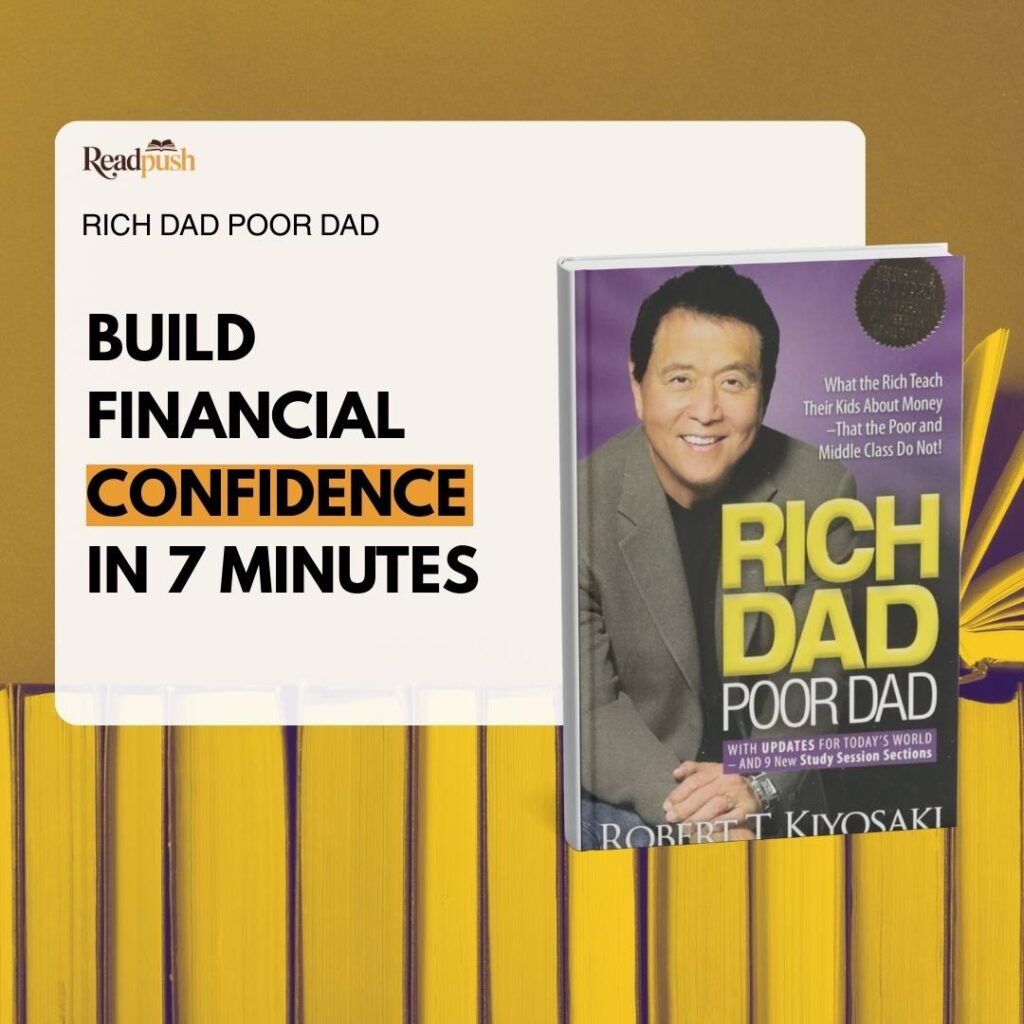

Rich Dad Poor Dad changed how millions think about money by challenging everything schools teach about work and wealth. The book contrasts two mindsets about income and shows why financial education matters more than a high salary. This summary is for anyone who wants the core ideas fast without reading for hours. For a complete breakdown, see our full review of Rich Dad Poor Dad.
About the book
Robert Kiyosaki is an entrepreneur and educator known for teaching financial literacy. Rich Dad Poor Dad was published in 1997 and remains relevant because the need for practical money skills has only grown. It is written for people who want to move beyond wage dependence and build long term wealth with intention.
Main concepts
Concept 1: the two mindsets
Rich Dad Poor Dad centers on the idea that wealthy people think differently about money. The poor and middle class focus on stability while the rich focus on opportunity. Your mindset shapes every financial decision you make.
Kiyosaki uses the example of his two fathers. One worked for security and relied on a paycheck. The other invested and built assets that produced income. This contrast shows that wealth starts in the mind.
The takeaway is simple. Your beliefs about money often matter more than your income. A small shift in thinking can open new paths to financial growth.
Concept 2: the importance of financial education
The book argues that traditional schools teach people to work for money instead of learning how money works. Financial education is not optional. It is the foundation of freedom.
Kiyosaki explains how people get trapped in the cycle of working to pay bills without understanding assets, liabilities or cash flow. He gives the example of someone buying a new car with debt because it feels like progress. In reality it reduces financial freedom.
The takeaway is clear. Learning about assets and money flow is the first step toward independence.
We explore this idea in depth in our analysis of the first big idea from Rich Dad Poor Dad.
Concept 3: the power of assets
Rich Dad Poor Dad defines an asset as something that puts money in your pocket. Everything else is a liability. The simplicity of this rule helps people make better choices.
Kiyosaki gives a practical example. Rental property that generates monthly income is an asset. A house you live in is a liability because it takes money from you. When you understand this difference you start building wealth with purpose.
The takeaway is direct. Focus on buying assets that produce income. This is the engine of long term freedom.
We also explore the second big idea in our detailed breakdown of the value of building assets early.
Concept 4: the need to escape the rat race
The rat race is the cycle of paycheck to bills to more bills. Many people stay stuck because they believe hard work alone creates success. Rich Dad Poor Dad teaches that you need a different approach.
Kiyosaki shows how people increase expenses when income increases. He shares a story of coworkers who celebrated raises with new debt. They worked harder but got nowhere.
The takeaway is powerful. Escape the rat race by increasing passive income instead of increasing lifestyle costs.
Concept 5: the role of courage and action
Knowledge alone does not create wealth. Action does. The book highlights the courage needed to take risks, learn from mistakes and move forward.
Kiyosaki tells how he and his friend learned business by trying things early and failing often. These simple experiments built confidence.
The takeaway is encouraging. You learn by doing. Consistent action creates momentum.
Key frameworks
Rich Dad Poor Dad introduces a simple money framework built on assets, liabilities and cash flow. The goal is to grow assets that generate passive income until this income covers your living costs. This is how you reach financial freedom. It helps you understand where your money goes and how to redirect it toward growth.
For step by step implementation, follow our guide on how to apply the cash flow quadrant framework.
Key takeaways
• Build a mindset that looks for opportunity instead of security.
• Learn how money works so you can make smarter choices.
• Buy assets that produce income and avoid unnecessary liabilities.
• Track cash flow to understand where your money goes each month.
• Grow passive income until it covers your basic needs.
• Take action even when you feel uncertain.
• Start small and build experience through real decisions.
• Challenge old beliefs about work, income and success.
Bottom line
Rich Dad Poor Dad is a practical guide to changing how you think about money and your future. It is ideal for professionals who want financial clarity without complicated theories. The most important insight is that wealth starts with mindset then grows with assets. To dive deeper, explore our complete breakdown of the lessons from Rich Dad Poor Dad and our analysis of the first big idea and second big idea that shape the book.