Quick takeaways
- The ten lessons here are a distillation of the nine-step system, useful whether or not you plan to run the full process. The life-energy reframe and the three evaluation questions are the ones with the most carry.
- Lesson 3, the three questions, is the most operationally dense. Apply it to your top five spending categories before you do anything else from this book.
- “Enough” is not minimum. The book is clear on this. It is the level at which more stops producing more satisfaction. Finding that level is harder than it sounds and worth the effort.
- The crossover point is concrete, not abstract. Calculate it for your actual situation. The distance to the finish line changes how you think about everything else.
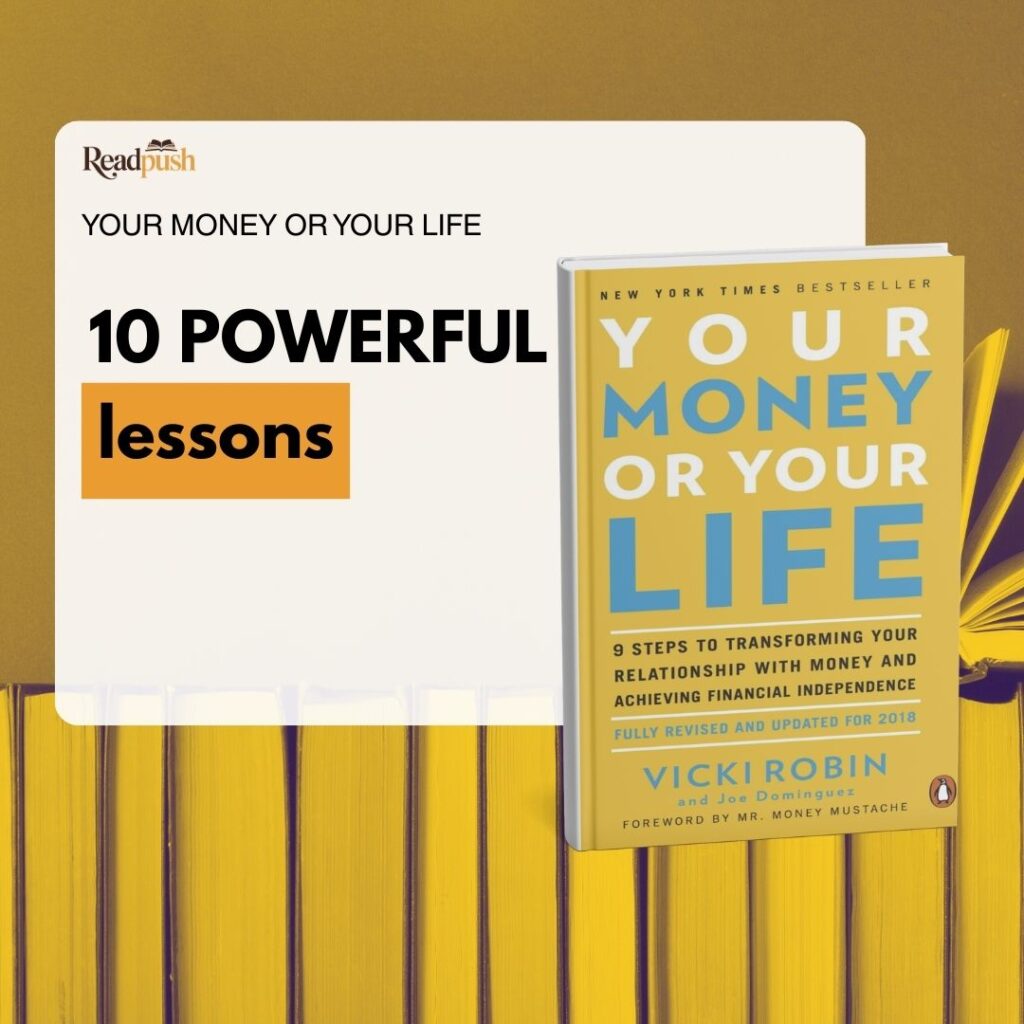
Your Money or Your Life by Vicki Robin and Joe Dominguez has one central idea: your money represents time from your life, and you should treat it that way. Ten lessons from that framework, with direct notes on what each means in practice.
If you want the full nine-step system before these lessons, the Your Money or Your Life summary covers it. This piece is the applied distillation: what the book is actually asking you to do, and which parts are most worth your time.
Lessons on awareness and what your money actually costs
1. Every dollar spent is hours of your life
The foundational reframe. Money is not an abstraction. It is time you traded for it. When you calculate your real hourly rate (take-home income minus job-maintenance costs, divided by actual hours including commute and decompression) and start converting purchases into hours of life, the spending math changes. Not for everything. But for enough things to matter.
This is not a reason to stop spending. It is a reason to spend consciously. The gym membership you use twice a month costs different hours than you think. So does the car you drive to a job you could take transit to.
2. Track everything, without judgment
The system requires logging every transaction for at least a month. Not to budget. Not to restrict. To see what is actually happening. Most people underestimate their spending in at least one category by 20 to 30 percent. You cannot make good decisions about money you cannot see.
The “without judgment” part matters. The tracking phase is data collection, not self-criticism. The evaluation comes later. If you mix them, you stop tracking.
3. Apply the three questions to every spending category
This is the most operationally dense lesson in the book. For each spending category, ask three questions: Did I receive fulfillment proportional to the life energy this cost? Does this align with my values and life purpose? How would this spending change if I did not need to earn money?
The third question is the one that produces results. It separates spending you would choose freely from spending that exists only to support or recover from work. For many people, this category is larger than expected. Convenience food, streaming services watched primarily for decompression, clothing bought to meet workplace norms: these reveal themselves under question three.
4. Define what “enough” means, specifically
“Enough” is not a minimum. Robin is careful about this. It is the level at which additional spending stops producing additional satisfaction. Most personal finance frameworks push toward more. This one asks you to find where more stops helping. That requires honest attention to which spending categories are producing diminishing returns on actual life quality.
Write the number down. Not as a ceiling but as a reference. The exercise changes how you evaluate the things that want your money.
|
10 lessons at a glance Your Money or Your Life: the practical structure
|
||||||||||||||||||||||||||||||||||||||||||||||||||||||||||||
Why this point matters
This idea matters because it changes how the reader judges the book. The useful question is not whether the author sounds convincing, but whether the principle helps explain a real decision, habit, or trade-off.
When the idea is used well, it gives the reader a clearer filter. It shows what to pay attention to, what to question, and what not to copy blindly from the book’s examples.
The same issue appears from another angle in The Crossover Point Explained, where the money decision underneath the book becomes easier to see without turning the book into a slogan.
The same issue appears from another angle in Rich Dad Poor Dad Quotes, where the money decision underneath the book becomes easier to see without turning the book into a slogan.
The same issue appears from another angle in Your Money or Your Life Quotes, where the money decision underneath the book becomes easier to see without turning the book into a slogan.
Lessons on purpose, independence, and building toward the finish line
5. Financial independence is a specific number, not a feeling
Financial independence in the YMYL framework is defined precisely: the month your investment income exceeds your monthly expenses. Not a vague sense of security. Not a percentage of some retirement target. A specific month on the wall chart where two lines cross. Everything in the system is aimed at accelerating that month.
Calculate your crossover point from your actual numbers. How far away is it? What would it take to close the gap by six months? That question is more productive than most financial planning conversations.
6. Make the crossover point visible
The wall chart is the system’s accountability mechanism. Two lines plotted monthly: income in life energy, expenses in life energy. Post it somewhere you see it. Robin’s claim, backed by the experience of people who completed the system, is that visual tracking produces behavioral change that spreadsheet tracking does not. Seeing the gap close in a physical space changes what decisions feel relevant.
7. Align spending with values, not with defaults
Most spending is habitual rather than chosen. Subscriptions accumulate. Convenience spending grows as income grows. Social expectations drive purchases in categories that do not actually matter to you. The evaluation process is designed to surface this: not to tell you what to value, but to check whether your spending reflects what you already value. The categories where it does not are the candidates for reduction. Not every category. Just the ones failing the three questions.
8. Debt is a claim on future life energy
Every debt payment is a portion of future hours already committed. The YMYL framework does not have a debt payoff system as specific as Ramsey’s debt snowball, but the logic is compatible: reducing debt reduces the future life energy committed elsewhere, which increases the gap you can redirect toward the crossover. Prioritize high-interest consumer debt first. The life-energy framing makes the cost of carrying it more visceral than the interest rate alone.
9. Invest the gap, but update the investment advice
The gap between income and aligned spending is capital. The book’s original recommendation was long-term government bonds, which made sense in the 1990s market environment. It does not make sense now. The principle is correct: invest the gap in something that compounds and generates passive income. The vehicle should be chosen based on current options, not the book’s original instructions.
For current portfolio construction, Bogle, JL Collins, or a fee-only advisor are better guides than Robin on this specific question. The nine-step implementation guide addresses this directly and covers how to adapt the framework for the current environment.
10. Review the system quarterly, not annually
A system that is reviewed once a year drifts. Life changes faster than that. New income levels, new expenses, new goals: these need to be incorporated on a shorter cycle or the alignment work done in the evaluation phase gradually disconnects from your actual situation. Quarterly is often enough. More frequent becomes administrative overhead that reduces the chance you sustain it.
|
Where to start The three lessons with the most immediate carry
|
||||||||||||||||||
The lessons that have the most carry are the ones that change a number or a question, not just an attitude. Calculate the real hourly rate. Apply the three questions. Calculate the crossover point. Those three actions will produce more useful information than reading the rest of the book without doing them.