Every entrepreneur faces the same timeless question: how do you build a company that not only grows fast but stays strong for decades? That dilemma lies at the heart of two modern business classics, Good to great by Jim Collins and the lean startup by Eric Ries. Both promise to guide you from ambition to lasting success, yet they take strikingly different paths.
Collins focuses on disciplined leadership, purpose driven strategy, and long term momentum. Ries, on the other hand, argues for experimentation, data driven learning, and adaptability in fast moving markets. Each book has transformed how founders think about growth, but deciding between them depends on what kind of organization you want to build.
We’ve written comprehensive reviews of both Good to great and the lean startup, and this comparison will help you decide which framework better fits your goals in 2025.
They’re comparable because both aim to answer the same question, what makes a company truly sustainable , but they speak to different business realities. In this post, you’ll learn their core philosophies, strengths, writing styles, and which book best aligns with your stage of growth.
Quick overview of each book
Good to great overview
Jim Collins, a stanford researcher and management scholar, is best known for studying what separates enduring companies from their competitors. Published in 2001, Good to great summarizes five years of rigorous research comparing successful businesses with similar firms that failed to sustain excellence.
Collins concludes that greatness stems from disciplined people, disciplined thought, and disciplined action. His framework revolves around concepts like level 5 leadership, the hedgehog concept, and the flywheel effect , all designed to help organizations transform long term performance.
The book’s context is the early 2000s corporate world, when stability, process, and leadership consistency were the gold standard.
The lean startup overview
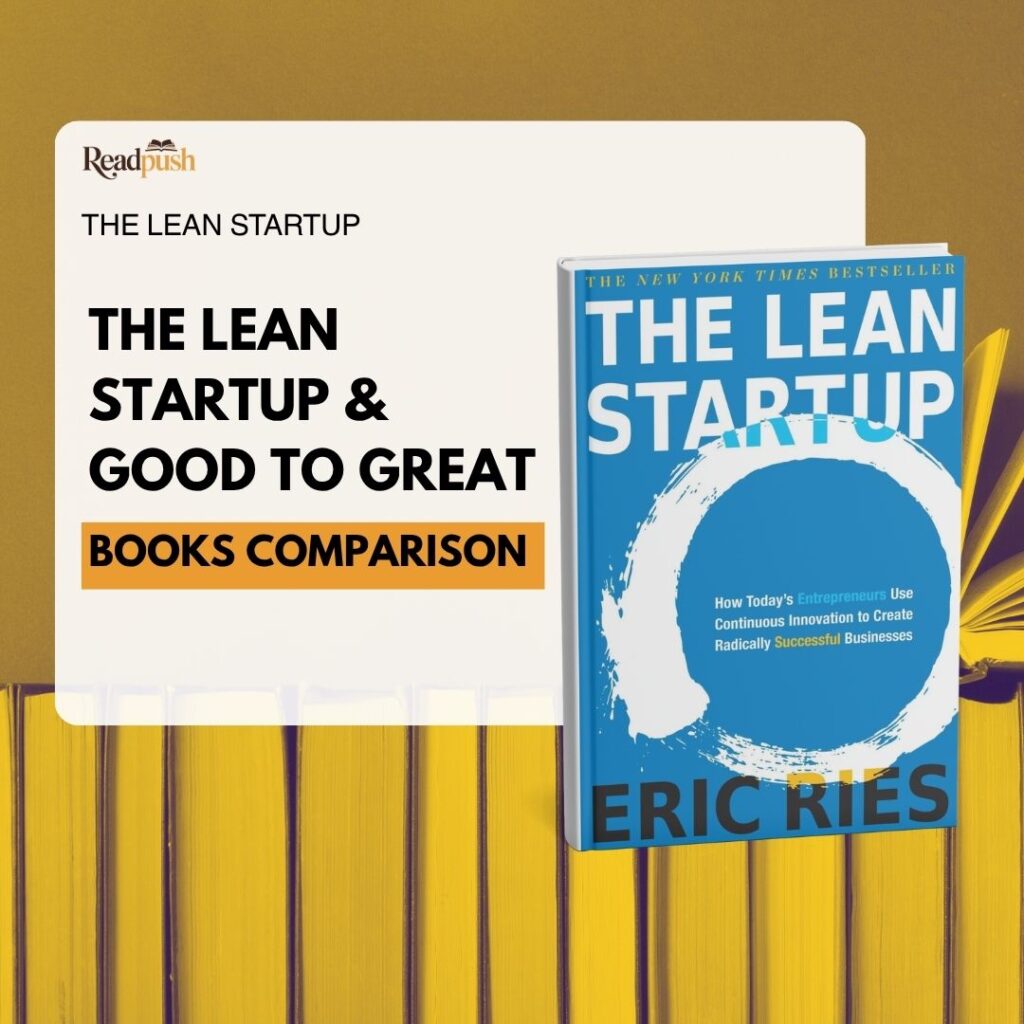
Eric Ries, a silicon valley entrepreneur and student of steve blank, wrote the lean startup in 2011 after experimenting with new ways to reduce startup failure. the book’s main idea is that success comes from validated learning , a process of rapid experimentation, measuring real user feedback, and pivoting when needed.
Ries proposes a flexible management system built for uncertainty, using concepts like minimum viable product (mvp), the build measure learn loop, and innovation accounting. his goal is to teach founders how to build businesses that adapt as fast as the world changes.
The lean startup emerged during the digital revolution, when technology was lowering entry barriers and speed mattered more than size.
Side by side comparison
Core philosophy and approach
Good to great’s perspective
Collins sees sustainable growth as the outcome of clarity and discipline. companies become great when they get the right people on board, confront the brutal facts of their situation, and commit to a focused mission , the hedgehog concept. once momentum builds, the flywheel effect ensures that growth compounds steadily over time.
His philosophy is grounded in consistency. you don’t chase trends; you stay true to your purpose and refine your execution until excellence becomes habit.
The lean startup’s perspective
Ries views growth through a different lens. he believes uncertainty is the natural state of business, so the only way to survive is through continuous learning. the build measure learn loop lets entrepreneurs test assumptions and adjust quickly before wasting resources.
Instead of long term planning, ries favors adaptive management where every experiment, success, or failure feeds the next iteration. growth is sustainable not because it’s stable, but because it’s resilient and responsive.
Key difference
While Good to great values discipline and stability, The lean startup prioritizes flexibility and discovery. Collins’s world assumes you already have a viable business that needs refinement. ries’s world assumes you’re still searching for a model that works. one defines sustainability as enduring excellence; the other defines it as continuous adaptation.
Strength of each
What Good to great does best
Collins excels at turning abstract leadership values into actionable principles. His research shows how ordinary companies like Walgreens and Kimberly Clark achieved decades of superior performance by embracing humility, long term thinking, and data driven discipline.
For leaders managing established teams, Good to great provides a blueprint for sustainable systems. The flywheel effect, for instance, explains how small, consistent wins compound into unstoppable momentum , a concept we explore deeper in our Good to great case study of Walgreens.
What the lean startup does best
Ries’s biggest strength lies in practicality for fast changing industries. The MVP approach allows founders to validate ideas with real customers before investing heavily. It replaces opinion with evidence and guesswork with learning.
A perfect example is his own startup, IMVU, which tested virtual goods through continuous iteration until finding product market fit , a process we detail in our lean startup case study.
Key takeaway
Collins teaches how to sustain excellence once you’ve found it. Ries teaches how to discover it in the first place. One is about mastering momentum; the other is about mastering experimentation.
Writing style and accessibility
Good to great’s style
Collins writes like a researcher and teacher. His tone is analytical, backed by data, and filled with memorable metaphors like the “flywheel” and “doom loop.” it’s methodical and inspiring but best suited to readers who enjoy structured argumentation.
The lean startup’s style
Ries writes like a founder speaking from the trenches. His tone is conversational, filled with examples from tech startups, and focused on action. Readers in fast paced industries often find it easier to relate to.
Which is easier to digest
For structured learners, Good to great offers more clarity. For practitioners who prefer iteration and experimentation, The lean startup feels more accessible.
Who should read which
Read good to great if
- You manage an established company and want to sustain long term growth.
- You’re focused on leadership, culture, and building processes that last.
- You prefer data backed case studies over rapid experiments.
- You want a timeless framework for operational excellence.
Read the lean startup if
- You’re launching or scaling a startup in an uncertain market.
- You value agility, fast feedback, and iterative development.
- You prefer practical steps over management theory.
- You want to learn how to turn ideas into viable products quickly.
Read both if
- You’re scaling a startup into a mature business and need both agility and discipline.
- You want to blend Ries’s experimental mindset with Collins’s structured leadership.
- You see innovation and stability as complementary, not opposing.
- A good order is to start with the lean startup to master validation, then move to Good to great to sustain growth once you’ve found your model.
Together, they form a complete growth philosophy: build fast, learn constantly, and scale with discipline.
Both good to great and the lean startup redefine what sustainable growth means, but they apply to different stages of business maturity. Collins gives you the blueprint for enduring greatness; Ries gives you the tools to survive and adapt in chaos.
If 2025 proves anything, it’s that sustainability now requires both stability and speed. The wisest entrepreneurs borrow from both playbooks.
Explore our complete guides to Good to Great and The Lean Startup, including lessons, frameworks, and key quotes from each.
What this idea changes in practice
The useful way to read this piece is not as a shortcut around the book, but as a way to decide what the book is really asking you to notice. The Lean Startup is easy to reduce to a phrase. The phrase is helpful, but it is also where many readers stop too early.
The practical question is: what changes after you understand the idea? If the answer is only that you can repeat the concept in a meeting, the idea has not done much work yet. A good business or self-improvement book should change a decision, a habit, a conversation, or a way of measuring progress.
For this article, the change is usually smaller and more concrete than the headline suggests. You stop treating the concept as an inspirational lesson and start using it as a filter. It helps you decide what to ignore, what to inspect more closely, and where your current approach may be wasting effort.
That is where ReadPush readers get the most value. Not from another summary, and not from pretending the book is perfect. The value is in separating the durable idea from the noise around it.
Where readers often get it wrong
The common mistake is to treat the book’s central idea as universal. Most book ideas are not universal. They are conditional. They work better for some people, teams, markets, and seasons than others.
That does not make the idea weak. It makes it usable. Advice becomes more useful when you know its boundary. A habit system helps when your life has enough stability to support repetition. A strategy framework helps when the market conditions match the assumptions behind the framework. A finance lesson helps when it is applied to the right kind of risk, not every risk.
So the better reading is not, is this book right? The better reading is, where is this book right, and what would make it wrong for me? That question protects you from two bad habits: dismissing useful books because they are imperfect, and overusing famous books because they sound confident.
If you take only one thing from this article, take that discipline. Apply the idea where the conditions fit. Leave it alone where they do not.
How to apply the lesson without overcomplicating it
Start with one decision. Do not turn the book into a whole operating system on day one. That is how good ideas become heavy.
- Name the problem. What are you actually trying to improve: focus, growth, cash flow, consistency, leadership, decision quality, or something else?
- Pick the relevant principle. Choose one idea from the book that speaks directly to that problem.
- Define the test. What would look different after two weeks if the idea is working?
- Review the result. Keep what helped. Drop what added friction.
This keeps the lesson grounded. You are not trying to become the kind of person who has mastered the whole book. You are trying to make one part of your work or life less vague.
The same issue appears from another angle in Finance corporate vs Principles of corporate finance, where the money decision underneath the book becomes easier to see without turning the book into a slogan.
The same issue appears from another angle in Good to Great vs built to last, where the business trade-off the book is trying to clarify becomes easier to see without turning the book into a slogan.
The same issue appears from another angle in The Lean Startup vs The Startup Community, where the business trade-off the book is trying to clarify becomes easier to see without turning the book into a slogan.
A better final takeaway
The strongest books on ReadPush are rarely the ones that give the neatest answers. They are the ones that improve the quality of your next question. The Lean Startup is worth returning to for that reason.
Ask what the idea reveals. Ask what it hides. Ask what it would look like in a normal week, with normal constraints, limited time, and imperfect follow-through. If the idea still helps there, it is probably worth keeping.
That is the standard. Not whether the book sounds impressive. Whether it survives contact with real life.