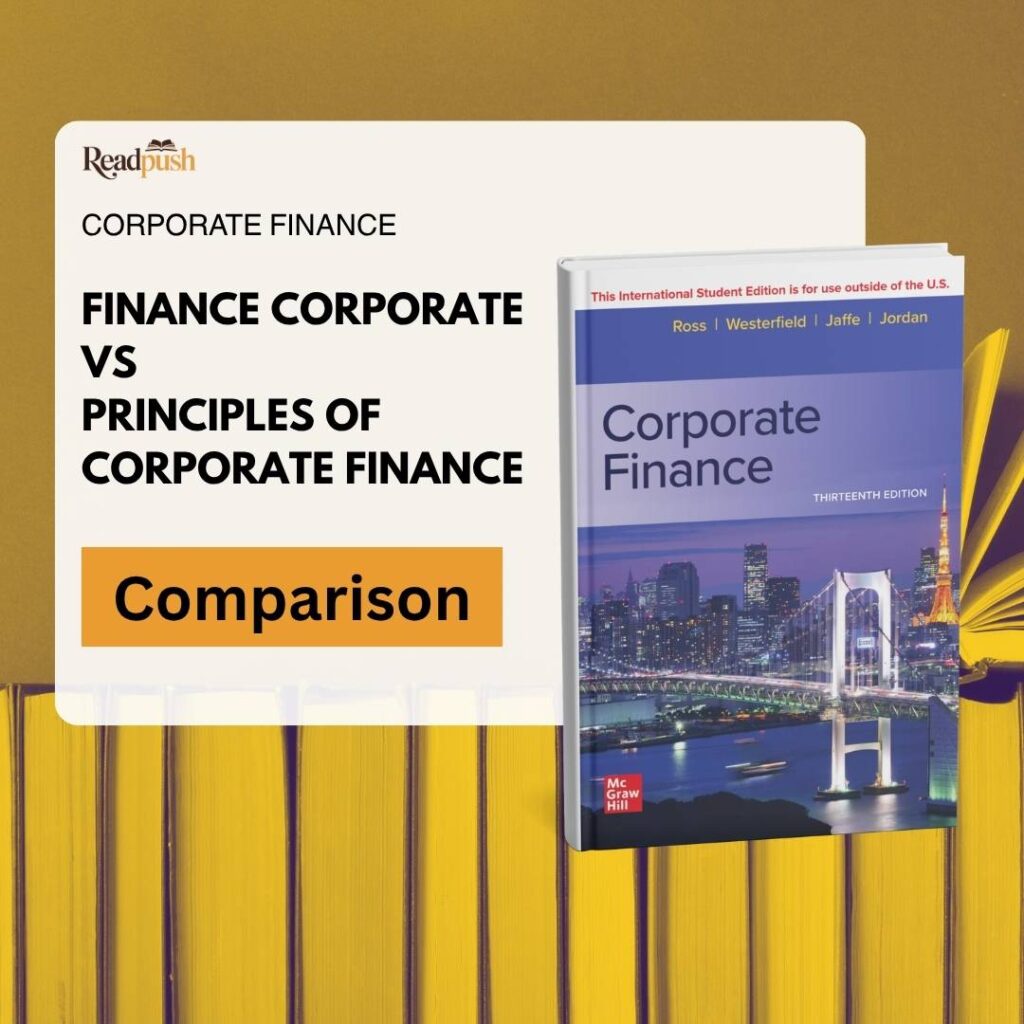
People who want to master corporate finance often face the same question. Should they read Finance Corporate or Principles of Corporate Finance. Both books are respected. Both are widely used in top business schools. Both promise to transform the way you understand cost of capital firm valuation the leverage effect and the balance between debt and equity. Yet they serve slightly different needs, and choosing the right one will save you time and give you better results.
Finance Corporate is known for its structured learning path and hands on exercises. Principles of Corporate Finance is known for deep conceptual clarity and broad theoretical insight. If you want to understand how capital structure choices affect real firms and how to calculate the weighted average cost of capital with confidence, you will see value in both. But the difference between Finance Corporate and Principles of Corporate Finance will determine which one you should read first.
We have written comprehensive reviews of both Finance Corporate and Principles of Corporate Finance in our learning hub so you can explore them in depth. This comparison will show where they overlap where they disagree, and how each one helps you master modern finance frameworks.
By the end you will know which book supports your goals today. Whether you want to build valuation models, understand Modigliani Miller theory in real world context, or design strategy around the trade off theory, this guide will help you choose the right path.
Quick overview of each book
Finance corporate overview
Finance Corporate is written by Ross, Westerfield, and Jaffe and translated and adapted in French by experts including Georges Hübner and Hugues Pirotte. It is a foundational corporate finance textbook that focuses on the mechanics of value creation, optimal capital structure decisions, and financial strategy. The main thesis responds to a simple question. How do firms create and preserve value through financial policy. The book blends rigorous formulas with applied logic and real business reasoning. First published many years ago, it continues to evolve with modern finance theory and remains one of the most used academic references globally.
Principles of corporate finance overview
Principles of Corporate Finance is written by Brealey, Myers and Allen and is considered one of the most authoritative guides in the field. It approaches finance as a logic system that explains how markets, investors and firms behave. The main thesis is that corporate finance decisions must align with value maximization and rational economic behavior. It leans more into conceptual explanations and offers historical context on financial theory development. It has been used by MBA programs, analysts, and executives worldwide for decades and continues to shape finance education.
Side by side comparison
core philosophy and approach
Finance Corporate takes a balanced academic and practical approach. It teaches how to compute weighted average cost of capital, how to apply cash flow valuation, and how to evaluate capital budgeting decisions using a toolkit approach. It guides you to master models before exploring nuance which makes it strong for structured learning.
Principles of Corporate Finance leans toward conceptual clarity and research backed logic. It focuses on understanding why capital markets function as they do and how investor behavior interacts with firm decisions. It spends more time on theory foundations like Modigliani Miller and market efficiency.
The key difference rests in emphasis. Finance Corporate wants you to know how to do finance. Principles of Corporate Finance wants you to know why finance works the way it does.
strength of each
Finance Corporate excels in hands on application. It gives you a step ladder. Learn discounting, then free cash flows, then capital budgeting, then optimal capital structure application. If you are building valuation models or preparing for professional exams like CFA fundamentals this book fits perfectly.
A strong example is its guidance on finding the optimal capital structure and using scenario analysis to control financial risk. That connects directly to our case study on Southwest Airlines where leverage resilience plays a critical role in survival and value.
Principles of Corporate Finance excels in explaining the meaning behind decisions. It offers clarity on Modigliani Miller and trade off theory, and explains risk return relations in detail. If you prefer to understand economic logic before formulas, this book fits your mindset.
Finance Corporate includes case discussion and simplified practice examples. Principles of Corporate Finance draws from historical finance developments and research based reasoning. Both are valuable. One gives you tools. The other gives you depth.
writing style and accessibility
Finance Corporate uses clear structure and step by step models. It is direct, visual, and very organized. It reads like a training manual.
Principles of Corporate Finance reads like a thoughtful conversation with an economist. It requires more time per chapter but rewards you with deep insight.
Finance Corporate tends to be easier to digest for beginners and practitioners who want speed and clarity.
Who should read which
Read Finance corporate if :
- You want a practical path to master corporate finance skills
- You plan to work in consulting; banking; FP and A; or valuation
- You prefer structured learning, examples, and formulas
- You like using spreadsheets and case solutions
- You want confidence applying the optimal capital structure framework on real firms
Finance Corporate gives you what you need to act and build models.
Read Principles of corporate finance if :
- You enjoy theory and want to understand the logic beneath decisions
- You aim to work in economics ; academic finance : or research heavy roles
- You find value in exploring the psychology and rationale behind markets
- You prefer narrative explanations before formulas
This book teaches you to think deeply about finance theory.
Read both if :
- You are preparing for a finance leadership role ;
- You want to combine conceptual depth with practical mastery
- You plan to pursue an MBA or already hold one
- You want to master advanced topics like capital structure, market efficiency, and financial risk under uncertainty
Recommended order:
- Start with Finance Corporate for practical grounding
- Read Principles of Corporate Finance to deepen understanding
Doing so gives you both power and wisdom. You build models and understand the philosophy behind them.
Finance Corporate vs Principles of Corporate Finance is not a battle. It is a choice based on learning style and professional goals. One gives you a toolbox for action. The other gives you a foundation for thinking. Both books stand the test of time. Both shape how finance is practiced globally.
For most business builders; analysts; and executives; Finance Corporate is the better starting point because it gives you fast, structured command of the skills that matter in real work. As your expertise grows, Principles of Corporate Finance elevates your thinking with deep theoretical understanding. Together they deliver a complete finance education.
Explore our complete guides to Finance Corporate and Principles of Corporate Finance to dive into lessons, models, quotes, and cases that will strengthen your decision making and your value as a leader.
What this idea changes in practice
The useful way to read this piece is not as a shortcut around the book, but as a way to decide what the book is really asking you to notice. Finance Corporate is easy to reduce to a phrase. The phrase is helpful, but it is also where many readers stop too early.
The practical question is: what changes after you understand the idea? If the answer is only that you can repeat the concept in a meeting, the idea has not done much work yet. A good business or self-improvement book should change a decision, a habit, a conversation, or a way of measuring progress.
For this article, the change is usually smaller and more concrete than the headline suggests. You stop treating the concept as an inspirational lesson and start using it as a filter. It helps you decide what to ignore, what to inspect more closely, and where your current approach may be wasting effort.
That is where ReadPush readers get the most value. Not from another summary, and not from pretending the book is perfect. The value is in separating the durable idea from the noise around it.
Where readers often get it wrong
The common mistake is to treat the book’s central idea as universal. Most book ideas are not universal. They are conditional. They work better for some people, teams, markets, and seasons than others.
That does not make the idea weak. It makes it usable. Advice becomes more useful when you know its boundary. A habit system helps when your life has enough stability to support repetition. A strategy framework helps when the market conditions match the assumptions behind the framework. A finance lesson helps when it is applied to the right kind of risk, not every risk.
So the better reading is not, is this book right? The better reading is, where is this book right, and what would make it wrong for me? That question protects you from two bad habits: dismissing useful books because they are imperfect, and overusing famous books because they sound confident.
If you take only one thing from this article, take that discipline. Apply the idea where the conditions fit. Leave it alone where they do not.
How to apply the lesson without overcomplicating it
Start with one decision. Do not turn the book into a whole operating system on day one. That is how good ideas become heavy.
- Name the problem. What are you actually trying to improve: focus, growth, cash flow, consistency, leadership, decision quality, or something else?
- Pick the relevant principle. Choose one idea from the book that speaks directly to that problem.
- Define the test. What would look different after two weeks if the idea is working?
- Review the result. Keep what helped. Drop what added friction.
This keeps the lesson grounded. You are not trying to become the kind of person who has mastered the whole book. You are trying to make one part of your work or life less vague.
The same issue appears from another angle in The lean startup vs good to great, where the business trade-off the book is trying to clarify becomes easier to see without turning the book into a slogan.
The same issue appears from another angle in The Lean Startup vs The Startup Community, where the business trade-off the book is trying to clarify becomes easier to see without turning the book into a slogan.
The same issue appears from another angle in Deep Work vs Slow Productivity, where the question of attention, habits, and what actually changes behaviour becomes easier to see without turning the book into a slogan.
A better final takeaway
The strongest books on ReadPush are rarely the ones that give the neatest answers. They are the ones that improve the quality of your next question. Finance Corporate is worth returning to for that reason.
Ask what the idea reveals. Ask what it hides. Ask what it would look like in a normal week, with normal constraints, limited time, and imperfect follow-through. If the idea still helps there, it is probably worth keeping.
That is the standard. Not whether the book sounds impressive. Whether it survives contact with real life.