Most small business owners know they should market consistently but few actually do. They jump between random ads, post on social media when inspiration strikes, and hope for word of mouth to save them. The result is inconsistent leads and unpredictable cash flow.
If this sounds familiar, the problem isn’t your ambition; It’s your system. You don’t have a simple, repeatable process for turning strangers into loyal customers. That’s what The 1-Page Marketing Plan framework by Allan Dib fixes. It gives you a structured way to plan and execute marketing without chaos or guesswork.
Imagine running your business knowing exactly what to do next week, next month, and next quarter to attract leads and convert them into paying customers. That clarity is what this guide will help you create.
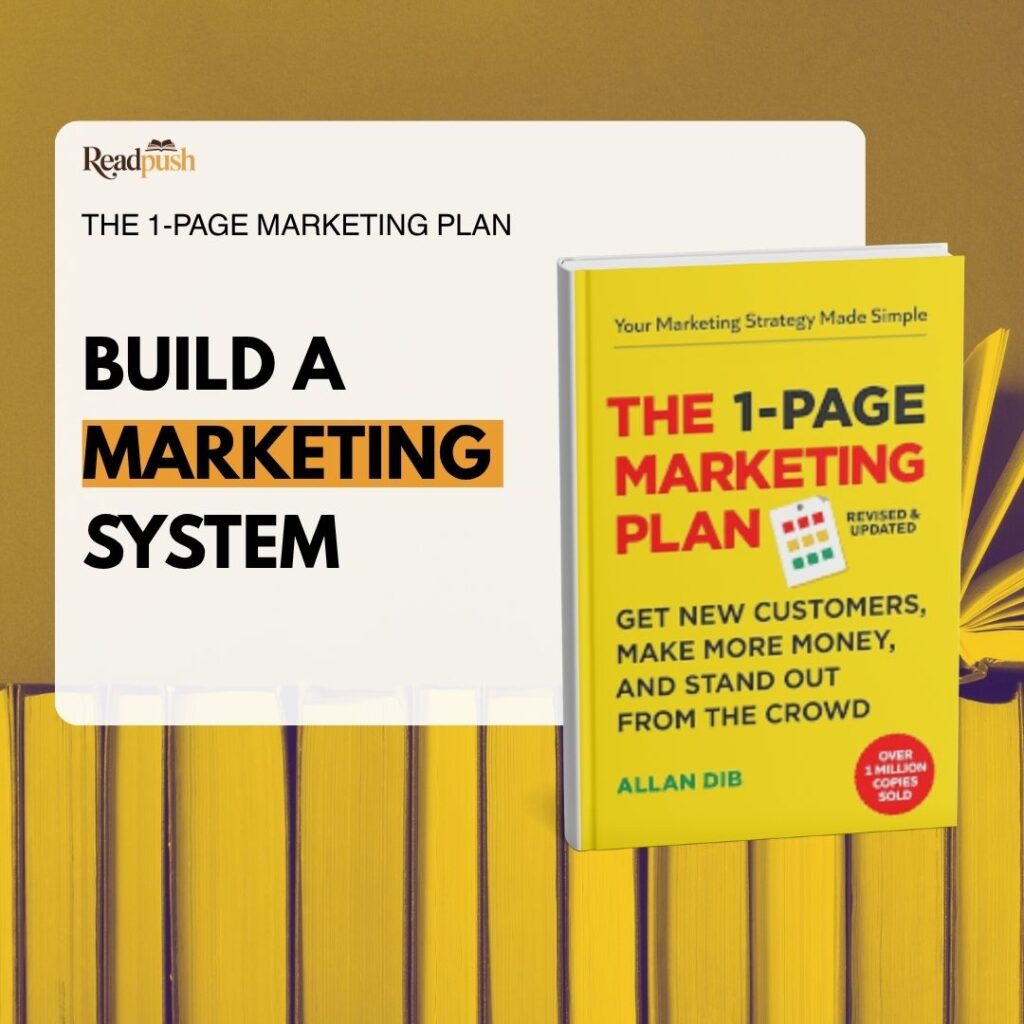
This framework comes from Allan Dib’s The 1-Page Marketing Plan, which argues that a simple, structured plan beats complicated strategies every time you can read our complete 1-Page Marketing Plan breakdown for the full concept.
By the end of this guide, you’ll know how to:
- Map out your marketing in nine precise steps
- Build a lead generation and conversion system
- Keep customers coming back with loyalty and referrals
You’ll learn a process you can use forever: one page, one system and massive impact.
Understanding The 1-Page Marketing Plan framework
At its core, The 1-Page Marketing Plan turns what most companies overcomplicate into a clear, nine-step map. Instead of endless strategy documents, you fill in one page that outlines how to attract, nurture and keep customers for life.
Why it works is simple. Marketing isn’t about creativity for its own sake. It’s about clarity and consistency. When you have one defined process, every action you take builds on the last. You know where your money goes and what results to expect.
The framework divides marketing into three main stages:
- Before: attracting attention and capturing leads
- During: converting those leads into paying customers
- After: delivering value, increasing loyalty, and generating referrals
Each stage contains three steps, giving you a total of nine actions to plan and execute.
For the full context of this framework within Allan Dib’s bigger philosophy, see our guide on building a complete business growth framework.
Prerequisites
Before you start mapping your marketing plan, you need a few things in place:
- A clear target audience: Know exactly who you serve and what problems they face.
- A basic offer: You should already sell something with proven demand.
- Tools: A simple CRM, email platform and tracking sheet.
- Time commitment: Expect to spend one full day outlining your plan, then one hour weekly reviewing progress.
You also need the right mindset. This isn’t about perfection. It’s about structure and progress. You’ll adjust as you go but first, you must commit to finishing your one-page blueprint.
Step-by-step implementation
STEP 1: Define your target market
What to do: Write down the specific group of people you serve best. Focus on one niche rather than everyone.
Why this matters: When your message speaks directly to one audience, your marketing becomes magnetic.
Example: Instead of “helping businesses with marketing,” aim for “helping real estate agents get more listings.”
Use your customer data or surveys to refine this group.
STEP 2: Craft a clear marketing message
What to do: Write a short statement that explains your unique value. Focus on the result customers want.
Why this matters: People buy outcomes, not features.
Example: A gym might say, “Lose fat and feel confident again,” instead of “We have modern equipment.”
STEP 3: Choose your advertising media
What to do: Select the channels where your audience already spends time. Start with two: one paid, one organic.
Why this matters: Spreading yourself across ten platforms guarantees burnout and wasted money.
Example: A local restaurant might combine Google Ads with Instagram reels.
Track every channel’s results. The goal is not exposure but measurable responses.
STEP 4: Capture leads
What to do: Create a simple lead magnet, something valuable you give in exchange for contact details.
Why this matters: You can’t follow up or build relationships without collecting leads.
Example: Offer a free checklist, trial, or video training that solves one small pain point.
Keep your landing page simple: headline, benefit, and form. See our full lead capture guide for proven templates.
STEP 5: Nurture leads
What to do: Set up a sequence of emails that deliver value and build trust before selling.
Why this matters: Most leads won’t buy immediately. You must educate and warm them up.
Example: A consultant might send three educational emails before inviting the prospect to book a call.
Include stories, client examples, and tips. Consistency builds credibility.
STEP 6: Convert leads into sales
What to do: Present your offer with urgency and clarity. Use testimonials, guarantees and deadlines.
Why this matters: People act when they see clear benefits and limited risk.
Example: “Enroll by Friday and get your first session free.”
Monitor your conversion rate and improve your call-to-action based on feedback. For extra help, see our step-by-step marketing plan execution guide.
STEP 7: Deliver a world-class experience
What to do: Overdeliver after the sale. Communicate updates, surprise customers with small bonuses, and ask for feedback.
Why this matters: A happy customer buys again and refers others.
Example: CD Baby’s fun shipping email turned customers into lifelong fans.
Document your customer journey and find ways to delight them at every stage.
STEP 8: Increase customer lifetime value
What to do: Create upsells, cross-sells, or subscription models.
Why this matters: It’s cheaper to sell to an existing customer than to find a new one.
Example: A web designer offers monthly site maintenance after project completion.
Use your CRM to identify your most loyal buyers and design new offers for them.
STEP 9: Orchestrate referrals
What to do: Build a structured referral system. Ask happy clients to introduce you to others and reward them for it.
Why this matters: Referrals are the highest-converting leads you’ll ever get.
Example: Dropbox grew explosively with a two-sided referral bonus both parties benefited.
Create an easy process your customers can follow. Mention it in your follow-up emails and thank them personally for referrals.
Common mistakes to avoid
- Trying to target everyone. Broad messaging dilutes your power.
- Ignoring follow-up. Most leads need multiple contacts before buying.
- Overcomplicating your funnel. A one-page plan works because it’s simple.
- Neglecting customer experience. If people regret buying, your marketing fails long-term.
- Focusing only on acquisition. Retention and referrals drive profit.
- Not tracking results. Without data, you can’t know what’s working.
Stay disciplined. Review your one-page plan monthly. Adjust one variable at a time.
If you want extra help avoiding these pitfalls, see our detailed post on marketing strategy lessons from Allan Dib.
Building your marketing system using The 1-Page Marketing Plan framework changes everything. You move from random acts of marketing to a structured engine that brings in consistent leads and loyal customers.
When you apply this nine-step framework, you’ll finally feel in control of your business growth. You’ll know who to target, how to reach them, and what to do after they buy.
The transformation is real: clarity, focus, and measurable results. The single principle to remember is that simplicity scales. Complexity kills execution.
Ready to take the next step? Explore our full 1-Page Marketing Plan lessons guide or dive deeper into building customer lifetime value and designing your marketing system for growth.
Start today. Your future customers are already waiting for your next move.
What this idea changes in practice
The useful way to read this piece is not as a shortcut around the book, but as a way to decide what the book is really asking you to notice. The 1-Page Marketing Plan is easy to reduce to a phrase. The phrase is helpful, but it is also where many readers stop too early.
The practical question is: what changes after you understand the idea? If the answer is only that you can repeat the concept in a meeting, the idea has not done much work yet. A good business or self-improvement book should change a decision, a habit, a conversation, or a way of measuring progress.
For this article, the change is usually smaller and more concrete than the headline suggests. You stop treating the concept as an inspirational lesson and start using it as a filter. It helps you decide what to ignore, what to inspect more closely, and where your current approach may be wasting effort.
That is where ReadPush readers get the most value. Not from another summary, and not from pretending the book is perfect. The value is in separating the durable idea from the noise around it.
Where readers often get it wrong
The common mistake is to treat the book’s central idea as universal. Most book ideas are not universal. They are conditional. They work better for some people, teams, markets, and seasons than others.
That does not make the idea weak. It makes it usable. Advice becomes more useful when you know its boundary. A habit system helps when your life has enough stability to support repetition. A strategy framework helps when the market conditions match the assumptions behind the framework. A finance lesson helps when it is applied to the right kind of risk, not every risk.
So the better reading is not, is this book right? The better reading is, where is this book right, and what would make it wrong for me? That question protects you from two bad habits: dismissing useful books because they are imperfect, and overusing famous books because they sound confident.
If you take only one thing from this article, take that discipline. Apply the idea where the conditions fit. Leave it alone where they do not.
How to apply the lesson without overcomplicating it
Start with one decision. Do not turn the book into a whole operating system on day one. That is how good ideas become heavy.
- Name the problem. What are you actually trying to improve: focus, growth, cash flow, consistency, leadership, decision quality, or something else?
- Pick the relevant principle. Choose one idea from the book that speaks directly to that problem.
- Define the test. What would look different after two weeks if the idea is working?
- Review the result. Keep what helped. Drop what added friction.
This keeps the lesson grounded. You are not trying to become the kind of person who has mastered the whole book. You are trying to make one part of your work or life less vague.
The same issue appears from another angle in How Apple built tribe of raving fans, where the marketing problem behind the framework becomes easier to see without turning the book into a slogan.
The same issue appears from another angle in Powerful lessons from the page marketing plan, where the marketing problem behind the framework becomes easier to see without turning the book into a slogan.
The same issue appears from another angle in How to validate your startup idea using, where the business trade-off the book is trying to clarify becomes easier to see without turning the book into a slogan.
A better final takeaway
The strongest books on ReadPush are rarely the ones that give the neatest answers. They are the ones that improve the quality of your next question. The 1-Page Marketing Plan is worth returning to for that reason.
Ask what the idea reveals. Ask what it hides. Ask what it would look like in a normal week, with normal constraints, limited time, and imperfect follow-through. If the idea still helps there, it is probably worth keeping.
That is the standard. Not whether the book sounds impressive. Whether it survives contact with real life.