Quick takeaways
- Atomic Habits works on your behavior. Mindset works on how you interpret failure. They’re solving different problems, and which one you need depends on where you’re stuck.
- If you’re taking action but nothing feels like it’s compounding, Atomic Habits is probably your book. If you’re not taking action because some part of you has decided you can’t, Mindset comes first.
- The books aren’t rivals. Read together, they cover most of the gap between knowing what to do and actually becoming someone who does it.
- The recommended reading order matters: Mindset first, then Atomic Habits. Belief first, then behavior.
When someone asks me which book to read, Atomic Habits or Mindset, I usually ask them a question back: where are you getting stuck?
It’s not a deflection. It’s the only way to give a useful answer. These two books are not interchangeable. They’re not even competing for the same shelf space, really. James Clear and Carol Dweck are working on different parts of the same problem, and if you pick the wrong one for where you are, you’ll finish it, nod along, and find yourself back at square one within a month.
What follows is a comparison that’s less about features and more about fit. Both books are genuinely worth your time. One of them is worth your time right now.
What each book is actually doing
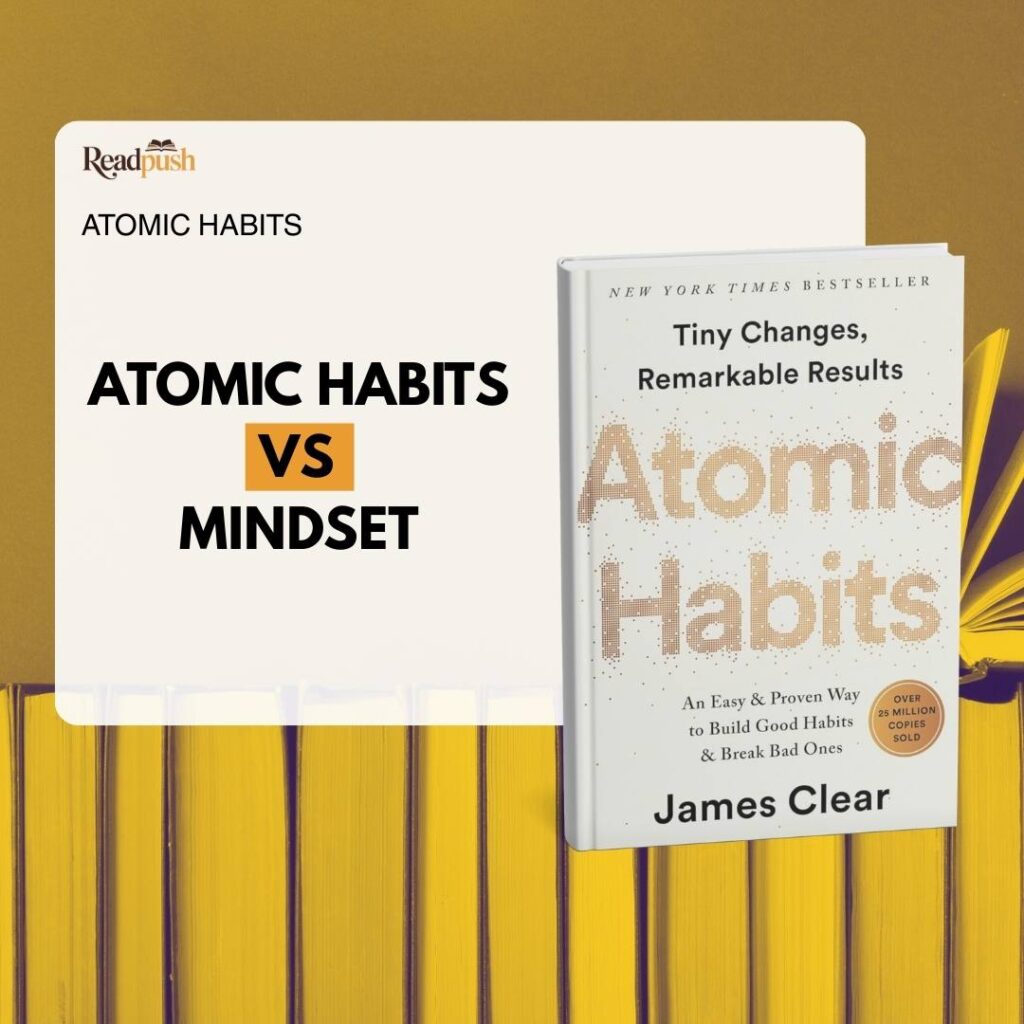
Atomic Habits, published in 2018, is a behavioral design manual. James Clear’s argument is that the system you operate inside shapes your behavior more than your intention does. He builds on existing research in habit formation, specifically the habit loop model, and translates it into four practical laws: make it obvious, make it attractive, make it easy, make it satisfying. The book’s deepest idea is that identity follows repeated action. You don’t decide to become a runner and then go running. You go running, and eventually, you become a runner.
Carol Dweck’s Mindset, published in 2006 and still taught in schools and leadership programs worldwide, lives at a different layer. Dweck spent decades studying how people explain their own abilities to themselves, and what she found is that this explanation, whether abilities are fixed or growable, predicts behavior more reliably than almost anything else. A fixed mindset reads failure as evidence of limits. A growth mindset reads failure as information. That distinction, quiet as it sounds, has enormous consequences for what people will attempt, persist through, and eventually achieve.
So one book is asking: how do you design better behavior? The other is asking: what do you believe about your own capacity to change? Both questions matter. They’re just not the same question.
|
Atomic Habits vs Mindset: what each one is doing
|
The person who needs Atomic Habits right now
If you know what you want to change and you’re willing to try, but you keep losing momentum after a few weeks, Atomic Habits is probably what’s missing. The problem isn’t conviction. It’s architecture.
Clear’s insight about environment is the one I find most practically powerful: you behave based on what’s visible, convenient, and easy, far more than you behave based on what you intend. Most people trying to change a habit are fighting their environment rather than redesigning it. They’re relying on willpower to do what a well-arranged kitchen or a well-structured morning could do automatically.
The identity piece is equally important, though it’s slower to feel. Clear’s argument is that every action you take is a vote for the kind of person you’re becoming. You don’t have to believe you’re a disciplined person before you act like one. You act like one, imperfectly and inconsistently at first, and the identity follows the evidence you create. This is not the same as faking it. It’s building a case, one small action at a time.
If this sounds familiar, if you’ve been in motion but not gaining traction, Atomic Habits gives you the scaffolding you’re missing. It won’t make you want to change. It helps you change even when the wanting is thin.
Something to notice
Atomic Habits works best when you already have some buy-in. If there’s a part of you that doesn’t believe change is possible for you specifically, the systems will feel hollow. That’s not a failure of the book. It’s a signal that you might need Mindset first.
The person who needs Mindset right now
Dweck’s research is, at its core, about how people explain themselves to themselves. And what she found is that the explanation matters enormously. People with a fixed mindset, those who believe their intelligence or talent is essentially set, interpret challenges as threats, effort as evidence of inadequacy, and failure as confirmation that they were never really capable. People with a growth mindset interpret the same events as information, as invitations to adjust and try again.
These aren’t personality types in the pop-psychology sense. They’re patterns of thought, and Dweck’s work shows they can shift. A 2007 study she conducted with students showed that teaching growth mindset concepts directly improved academic motivation and performance, particularly among students who had internalized fixed beliefs about their intelligence.
The reader who needs Mindset is often the one who avoids starting things. Not because they’re lazy, that framing isn’t helpful, but because starting means risking failure, and failure means something threatening about who they are. You might recognize this as perfectionism. You might recognize it as procrastination. What Dweck would say is that both are often fixed mindset in disguise.
In my experience, this is also the reader who will pick up Atomic Habits, absorb the framework, and then not apply it, because somewhere underneath the practical enthusiasm is a quiet belief that the framework probably won’t work for them. Mindset is what addresses that layer. It doesn’t give you a system. It gives you a reason to trust that a system could work.
Where the books genuinely differ in approach
Atomic Habits is built for application. The chapters are short. Each section ends with something you can try today. Clear anticipates resistance and designs around it. The book trusts you to adapt the framework to your context. It’s confident in the way a good coach is confident: here’s the method, now use it.
Mindset moves more slowly. Dweck is a researcher, and the book reads like one, in a good way. She builds her argument through studies, case studies of athletes and executives, and a lot of careful unpacking of what fixed and growth mindset actually look like in practice. It’s not a quick read in the way Atomic Habits is, and the payoff is less immediately tangible. The shift she’s describing is internal, and internal shifts don’t always announce themselves cleanly.
Neither approach is better in the abstract. They’re suited to different readers at different moments. If you need to do something by next week, Clear will help you more. If you need to understand why you haven’t done anything for the past three years, Dweck probably gets closer to it.
|
Which one do you need right now?
If you’re not sure: read Mindset first. Then Atomic Habits. |
Common misconceptions about this comparison
Myth: they’re basically saying the same thing. Both books care about growth and both are rooted in research, but the mechanism is different. Clear is working on behavior design. Dweck is working on the story you tell yourself about effort and failure. One book without the other leaves a real gap.
Myth: Mindset is only useful for people with low confidence. Fixed mindset thinking shows up in high achievers just as often, sometimes more. The perfectionist who won’t submit work until it’s flawless. The executive who avoids feedback because being wrong is intolerable. Dweck’s research spans children, Olympic athletes, and Fortune 500 leaders. The pattern doesn’t sort by how capable someone already is.
Myth: Atomic Habits is enough on its own. For many readers it is, for a while. But Clear’s framework assumes you believe change is available to you. When someone reads the four laws and then finds reasons none of them apply to their specific situation, that’s usually not a problem with the laws. That’s the fixed mindset doing its quiet work underneath the practical framework.
Myth: reading order doesn’t matter. It does, at least for some readers. Mindset prepares the ground. If you’ve spent years telling yourself you’re not a disciplined person, or not a creative person, or not someone who finishes things, you need to loosen that belief before a habit system will take root. Reading Clear before Dweck can lead you to use the framework as confirmation that you’re bad at this. Reading Dweck first gives you a different lens for interpreting your own early struggles.
A note on self-blame
Neither book is a verdict on your character. If you’ve tried habit systems before and they’ve collapsed, that’s not evidence that you’re beyond help. It might be evidence that you needed the belief layer first. Take a second with that one.
The same issue appears from another angle in Rich Dad Poor Dad vs The Total, where the money decision underneath the book becomes easier to see without turning the book into a slogan.
The same issue appears from another angle in Atomic Habits vs Mindset, where the question of attention, habits, and what actually changes behaviour becomes easier to see without turning the book into a slogan.
The same issue appears from another angle in Deep Work vs Slow Productivity, where the question of attention, habits, and what actually changes behaviour becomes easier to see without turning the book into a slogan.
How to use both books together
If you’re going to read both, and I think most people would genuinely benefit from doing so, start with Mindset. Not because it’s better, but because it addresses the layer that comes first. You need to believe that your abilities aren’t fixed before the question of how to build better daily habits becomes meaningful rather than futile-seeming.
Then read Atomic Habits with Dweck’s framework in mind. When Clear talks about identity-based habits, becoming a runner by running, becoming a writer by writing, notice how it connects to what Dweck says about growth mindset. Both are making the same argument from different angles: you are not a fixed thing. You’re a person whose patterns can change, gradually and through practice.
The combination covers most of the distance between where most people are and where they want to be. Mindset gives you the psychological ground to stand on. Atomic Habits gives you the practical tools to build on it. Neither one alone is quite as complete as the two together.
Read Mindset slowly. Let it challenge whatever you quietly believe about your own limits. Then pick up Atomic Habits and let it give you something to do with the space that opens up.