Quick takeaways
- The most useful part of Robbins’s book is not the specific strategies. It is the structural insight that you can design a financial life that does not require you to constantly check the markets and react to them.
- Dalio’s All-Seasons Portfolio is the idea most readers find genuinely transferable. It is built for all economic conditions, not optimistic ones.
- The behavioral traps chapter is worth reading even if you skip everything else. Loss aversion and herd mentality are expensive, and most people experiencing them do not know it.
- The book is long and, in places, repetitive. Read the first half carefully. The second half rewards skimming for the sections that land for you specifically.
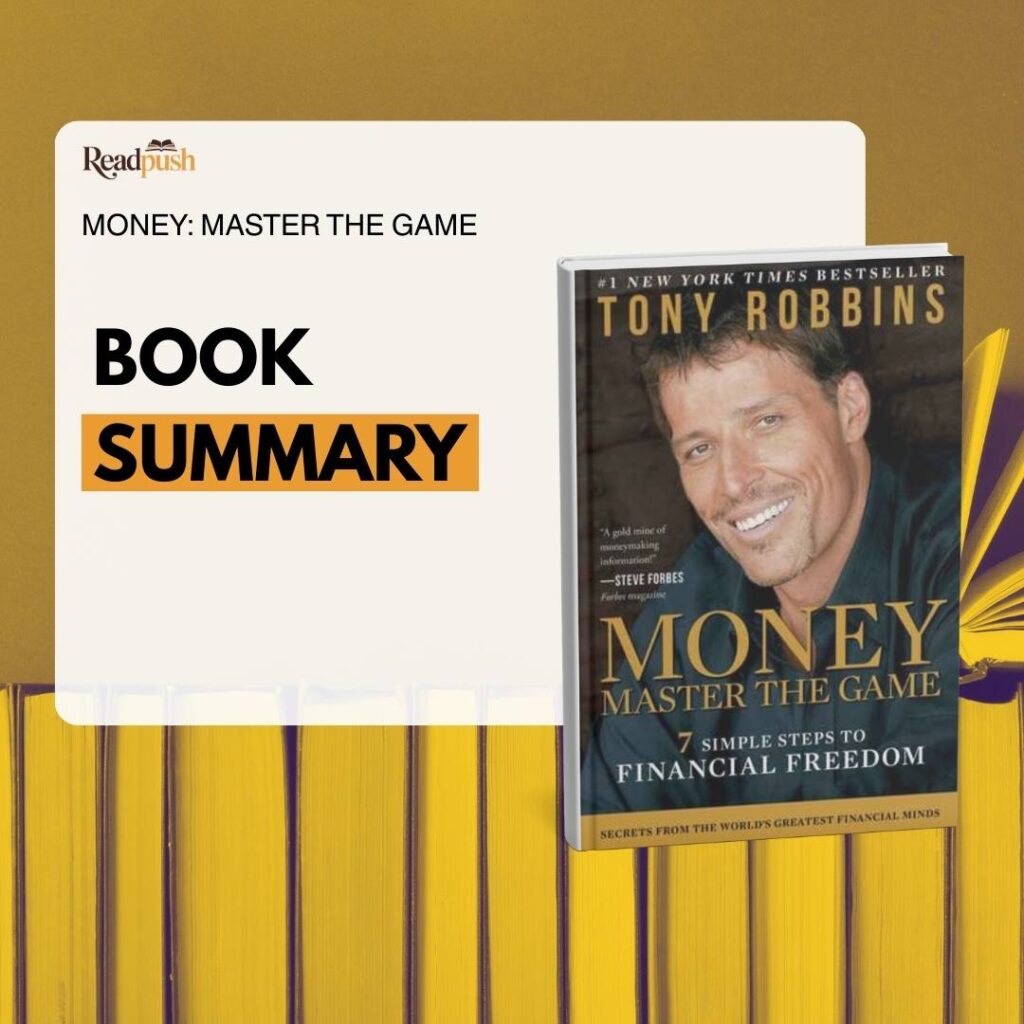
If you have ever felt like the world of investing is a language you were never taught, Money Master the Game is worth your time. Tony Robbins spent years interviewing fifty of the world’s most successful investors, people like Warren Buffett, Ray Dalio, and John Bogle, and the question he kept asking was: what do you know that ordinary people do not? What he got back, distilled across a very long book, is more accessible than the source material might suggest.
What’s worth noticing is that this is not a book about getting rich quickly or finding an edge. It is a book about designing a financial life that can hold, that does not require you to be watching markets and reacting to them, that gives you some peace alongside the growth. That is a different proposition from most financial advice, and it is the reason the book has stayed in circulation.
What the book is actually doing
Robbins organizes the book around seven steps to financial freedom, which sounds like every other personal finance framework until you see what he actually puts inside it. The steps move from the basic (automate your savings, define what “enough” looks like for you) to the more sophisticated (understand the fee structures that are quietly costing you compounding returns, learn the asset allocation strategies that have worked through both growth and recession).
The emotional case runs alongside the practical one throughout. Robbins is attentive to the anxiety that sits underneath most people’s relationship with money, the fear of making a mistake, the sense that everyone else understands something you do not, the avoidance that builds up over years of feeling underprepared. He does not pathologize this. He names it as common and then tries to give you something concrete enough to move through it.
The five ideas worth keeping
1. Take ownership before you optimize
Robbins is direct about the fact that most people have handed responsibility for their financial lives to advisors, employers, and vague good intentions, and have not examined the results. The first step is not a specific investment. It is the decision to actually look: at what you spend, at what you own, at what you are working toward and whether your current path leads there.
This sounds obvious. In my experience with clients who have avoided their finances for years, it is the hardest part. The specifics are easier once you have made the decision to engage. Automating 10 to 15 percent of your income toward investments, which Robbins recommends early and often, becomes possible once you have stopped looking away from the overall picture.
2. The All-Seasons Portfolio
This is the idea most readers find genuinely transferable. Ray Dalio’s All-Seasons Portfolio is built around a recognition that most portfolios are designed for growth conditions, which means they suffer badly when conditions are not favorable. Dalio’s approach allocates across asset classes in a way designed to hold up through different economic environments: growth, recession, inflation, deflation.
The specific allocation Robbins describes is roughly 30 percent stocks, 55 percent bonds (mixed duration), 7.5 percent gold, 7.5 percent commodities. This will not produce the highest returns in bull markets. It is designed to avoid catastrophic losses in bad ones, because catastrophic losses are what derail most people’s long-term financial progress. Stability makes compounding possible. Volatility interrupts it.
3. The fee problem
Robbins dedicates significant space to what many readers find the most practically useful section of the book: the cost of actively managed funds. The fees charged by most mutual funds, typically 1 to 3 percent annually, sound small. Over decades, they compound against you in the same way that investment returns compound for you. The difference between a 1 percent fee and a 0.1 percent fee over 40 years can exceed the value of the original investment.
Bogle’s low-cost index fund approach, which Robbins advocates strongly, eliminates most of this drag. The argument is not that active managers cannot beat the market. It is that most of them cannot beat it consistently enough to justify the fee difference, and that most investors would do better in well-allocated low-cost index funds than in most actively managed alternatives.
4. Behavioral traps and what they actually cost
cat <> /home/claude/post535_rewrite.htmlLoss aversion, herd mentality, panic selling: Robbins names the psychological patterns that make rational investing genuinely difficult. What’s worth noticing is that these are not character flaws. They are predictable responses to uncertainty, and they are expensive precisely because they feel justified in the moment. The person who sold everything in March 2009, at the bottom of the financial crisis, felt completely rational. The pattern is systematic and almost universal.
Dollar-cost averaging, which means investing a fixed amount at regular intervals regardless of market conditions, is his main tool here. It sidesteps the timing question, which is the question most people get wrong, by making timing irrelevant. You buy more shares when prices are low and fewer when they are high, automatically, without having to decide anything in a moment of market anxiety.
5. Design for income, not just accumulation
The later sections of the book shift from building wealth to structuring it for the long term, specifically for a retirement that does not require you to spend your final decades worrying about whether the portfolio will outlast you. Robbins advocates for what he calls a “lifetime income plan,” which combines guaranteed income sources, annuities, Social Security, potentially pensions, with investment growth.
The guaranteed income covers essentials. The investment portfolio grows for everything else. The goal is to remove the financial anxiety that accompanies the question “what if I outlive my money?” For anyone who has watched a parent or grandparent carry that anxiety, the emotional case for designing against it is not abstract. It helps to understand both sides, the accumulation and the distribution, before you need to act on the second one.
|
Money Master the Game Five ideas worth keeping, and what each one offers
|
||||||||||||||||||||||||||||||
The same issue appears from another angle in Good to great, where the business trade-off the book is trying to clarify becomes easier to see without turning the book into a slogan.
The same issue appears from another angle in Your Money or Your Life, where the money decision underneath the book becomes easier to see without turning the book into a slogan.
The same issue appears from another angle in The Total Money Makeover, where the money decision underneath the book becomes easier to see without turning the book into a slogan.
A word on the book’s limits
It is worth being honest that Money Master the Game is very long, and not uniformly so. Robbins writes with the energy and repetition of someone used to speaking on stage, and the book sometimes reads that way. The first half is denser and more practically useful. The second half rewards skimming for the sections that feel directly relevant to your situation.
Some of the strategies, particularly around annuities, are more suited to certain life stages and not universally applicable. The “secrecy” framing in the early chapters, the idea that wealthy people are deliberately keeping this from you, overstates the case. The information Robbins shares is not secret. It is just not the information most people encounter first. That is a simpler and more accurate observation than the one the book leads with.
For the behavioral and psychological picture of why financial decisions are so hard, The Psychology of Money is a sharper, shorter treatment that pairs well with this book. Housel’s work on why the best financial plan is the one you can actually hold covers the emotional terrain with more precision than Robbins, if that is the part you find hardest.
|
Reading guide How to approach this book and what to read alongside it
|
||||||||||||
If you have been putting off thinking seriously about your money because it feels too complicated or too far outside your expertise, this book is a reasonable place to start. It will not tell you everything. It will help you feel less alone in the confusion, which is often the thing that needs to shift first.
Read it slowly. Let the parts that land, land. The rest will be there when you are ready for it.
ARTICLE2 echo “Article written: $(wc -c < /home/claude/post535_rewrite.html) bytes" python3 -c " content = open('/home/claude/post535_rewrite.html').read() em = content.count('\u2014') en = content.count('\u2013') print(f'Em dashes: {em}, En dashes: {en}') "