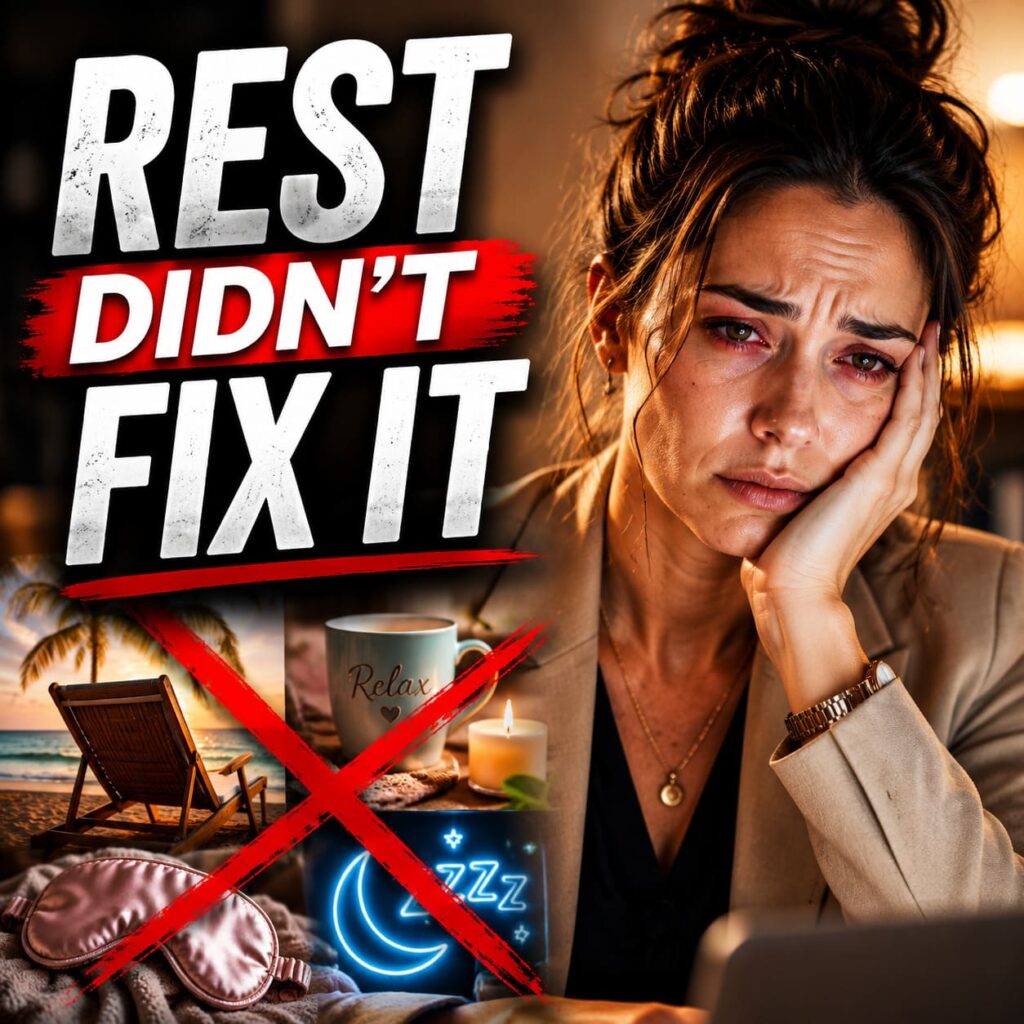
If you picked up Burnout because you keep resting and still wake up tired, this is going to land a little differently from a normal book review.
Not because the book is perfect. It is not. Most self-improvement books have a few sentences that help, a few that overreach, and a few that sound better in a quote graphic than they do in an actual life. But Emily Nagoski and Amelia Nagoski’s book touches something real, and that is worth taking seriously.
What is worth noticing is the emotional pattern underneath the topic. The surface might be therapy, shame, burnout, trauma, attachment, anxiety, or time. Underneath, the question is often quieter: why am I finding this so hard, and why do I keep pretending I am not?
The real reason this book works
The book works because it gives language to something many people already feel but have not been able to name cleanly. That matters. Naming a pattern does not solve it, but it changes your relationship to it. It becomes something you can look at instead of something you disappear into.
In my experience with clients, people often arrive with a practical problem and a much more tender question underneath it. They want help with procrastination, but the real fear is failure. They want help with boundaries, but the real fear is being disliked. They want help with overthinking, but the real fear is that if they stop scanning for danger, something will go wrong.
Burnout is useful because it slows that process down. It helps you notice the point where an old strategy is still trying to protect you, even though it may now be making your life smaller.
That distinction matters. You are not broken because you developed a strategy that once helped. You may, though, be tired because the strategy is still running long after the original danger has changed.
The thing you may be avoiding
The avoidance pattern here is this: you may be telling yourself that exhaustion is a personal failure of discipline.
If this sounds familiar, take a second with that one. Not to shame yourself. Shaming yourself is probably part of the problem already. Just notice the shape of it.
Most avoidance does not feel like avoidance from the inside. It feels sensible. It feels like being responsible, realistic, loyal, busy, low-maintenance, generous, practical, or careful. Sometimes it is those things. Sometimes it is fear wearing clothes that make it easier to defend.
A good book does not rip that defence away from you. It helps you see it. Gently. Enough that you can ask whether it is still needed.
That is the quiet value of Burnout. It makes a familiar coping strategy visible without turning you into the villain of your own story.
What the book gets right
What the book gets right is this: it explains the stress cycle without making your body the enemy. That is not a small thing. A lot of advice fails because it begins too far from the reader’s actual emotional weather.
You can tell someone to communicate better, rest more, let go, set a boundary, change a habit, forgive, accept, focus, or stop people-pleasing. All of that may be good advice. It may also be useless if it ignores the fear attached to the behaviour.
People do not usually repeat painful patterns because they enjoy them. They repeat them because the pattern is doing a job. It may be a costly job. It may be clumsy. It may be outdated. But it is still trying to help.
This is where the better self-improvement books have a little humility. They do not only ask, What should you do differently? They ask, What has made the old way feel necessary?
Burnout is strongest when it stays close to that question.
Where readers can misuse it
The danger with this book is not usually that readers will ignore it. The danger is that they will turn it into another standard to fail.
This happens quietly. You read a chapter about compassion and criticise yourself for not being compassionate enough. You read about boundaries and feel ashamed that you still find them hard. You read about presence and become tense about how rarely you feel present. Very human. Not very helpful.
Please do not turn the book into a new voice in the inner courtroom. That is not what it is for.
Use it as a mirror, not a measuring stick. A mirror lets you see what is there. A measuring stick tells you whether you are acceptable. Most of us have enough of those.
The emotional skill underneath the advice
The emotional skill underneath the book is the ability to pause before becoming the old pattern.
That pause may be very small. It may be the breath before the apology you do not mean. The moment before you send the long text. The second before you agree to something your body has already refused. The little space before you decide that one mistake means you are hopeless.
In that pause, there is a chance to ask a better question. Not, what is wrong with me? Try, what am I trying to protect? Or, what do I need that I am pretending not to need?
Those questions do not make life easy. But they make it more honest. Honest is a better starting place than impressive.
A gentle way to read it
Read this book slowly enough that you can feel your reactions. If a sentence annoys you, notice that. If a passage makes you want to close the book, notice that too. Resistance is not always a sign that the author is wrong. Sometimes it is a sign that the book has touched a locked drawer.
You do not have to open the drawer immediately.
One of the kinder ways to read self-improvement is to stop treating every insight as an instruction. Some insights are only invitations. You can let them sit beside you for a while before deciding what they ask of you.
It also helps to read with your real life in view. Not your ideal self. Not the version of you who sleeps eight hours, eats beautifully, communicates perfectly, and never gets defensive. The actual you. The one reading this between obligations, carrying old stories, doing their best with imperfect tools.
One practice to try
Here is a small practice from the heart of this book: do one physical thing that lets your body complete the stress response.
Keep it small enough that you can actually do it. That is not lowering the bar. That is respecting reality. Many people fail at emotional change because they design it for a day they are not actually living.
Try the practice once a day for a week. If a week feels too much, try three days. If three days feels too much, try once, honestly. There is no prize for making healing more dramatic than it needs to be.
After you try it, ask yourself one question: did this make me more available to my life, or more at war with myself?
That question will tell you a great deal.
What to be careful with
Be careful with any interpretation of this book that makes you less compassionate toward yourself or other people. Good insight should increase responsibility without increasing cruelty.
That balance is delicate. Too much softness can become avoidance. Too much harshness can become punishment dressed up as growth. The middle place is where change usually happens: honest, specific, and kind enough that you can stay present.
If the book stirs up more than you expected, put it down for a while. Talk to someone safe if you can. That might be a friend, a partner, a therapist, a support group, or one person who knows how to listen without immediately fixing.
You are allowed to need support. That is not a failure of reading comprehension. It is being human.
Who this book is for
This book is for the reader who suspects the surface problem is not the whole problem. It is for someone who is ready to be a little more honest, but not bullied into change.
It may be for you if you recognise the pattern and feel both relieved and exposed. That combination is common. Relief says, there is a name for this. Exposure says, now I may have to do something with what I know.
It may not be for you if you want a book to give you certainty without discomfort. The better books rarely do that. They give you contact. Contact with yourself, with other people, with the parts of life you have been managing at a distance.
That can be tender. It can also be useful.
The same issue appears from another angle in The Gifts of Imperfection and the quiet, where the emotional pattern the book is trying to name becomes easier to see without turning the book into a slogan.
The same issue appears from another angle in Self Compassion when your inner critic has, where the emotional pattern the book is trying to name becomes easier to see without turning the book into a slogan.
The same issue appears from another angle in The Body Keeps the Score is powerful, where the emotional pattern the book is trying to name becomes easier to see without turning the book into a slogan.
Final thought
Burnout is worth reading because it does not only ask you to improve. At its best, it asks you to understand the part of you that made improvement feel complicated in the first place.
That is where real change often begins. Not with a dramatic declaration. Not with a perfect plan. With a quieter moment of recognition: oh, this is what I have been doing.
Read it slowly. Let it meet you where you are. You are allowed to need the help this book offers. That is what it is for.
A small permission
One more thing, because it matters: you do not have to earn gentleness by becoming more impressive first. Many people treat kindness toward themselves as something they will be allowed to have after they are calmer, thinner, more productive, less reactive, more healed, easier to love.
But gentleness is not a graduation gift. It is often the condition that makes honest change possible. Start there, if you can. Start small, if you need to.
A small permission
One more thing, because it matters: you do not have to earn gentleness by becoming more impressive first. Many people treat kindness toward themselves as something they will be allowed to have after they are calmer, thinner, more productive, less reactive, more healed, easier to love.
But gentleness is not a graduation gift. It is often the condition that makes honest change possible. Start there, if you can. Start small, if you need to.
A small permission
One more thing, because it matters: you do not have to earn gentleness by becoming more impressive first. Many people treat kindness toward themselves as something they will be allowed to have after they are calmer, thinner, more productive, less reactive, more healed, easier to love.
But gentleness is not a graduation gift. It is often the condition that makes honest change possible. Start there, if you can. Start small, if you need to.
A small permission
One more thing, because it matters: you do not have to earn gentleness by becoming more impressive first. Many people treat kindness toward themselves as something they will be allowed to have after they are calmer, thinner, more productive, less reactive, more healed, easier to love.
But gentleness is not a graduation gift. It is often the condition that makes honest change possible. Start there, if you can. Start small, if you need to.
A small permission
One more thing, because it matters: you do not have to earn gentleness by becoming more impressive first. Many people treat kindness toward themselves as something they will be allowed to have after they are calmer, thinner, more productive, less reactive, more healed, easier to love.
But gentleness is not a graduation gift. It is often the condition that makes honest change possible. Start there, if you can. Start small, if you need to.
A small permission
One more thing, because it matters: you do not have to earn gentleness by becoming more impressive first. Many people treat kindness toward themselves as something they will be allowed to have after they are calmer, thinner, more productive, less reactive, more healed, easier to love.
But gentleness is not a graduation gift. It is often the condition that makes honest change possible. Start there, if you can. Start small, if you need to.